
ISG stands for “I Swear to God.” People use it in texts, DMs, and comments to add emotional weight to what they’re saying, whether that’s honesty, surprise, frustration, or excitement. It’s not a religious statement most of the time. It’s just a fast way to say “I mean this.”
If a friend texts “isg that test was brutal,” they’re not swearing an oath. They’re telling you, with extra intensity, that the test really was that bad. That’s the whole function of ISG. It takes a flat sentence and gives it a punch.
You’ll see it everywhere from group chats to TikTok captions, and once you know what it means, you’ll notice it’s actually pretty easy to read in context.
ISG Meaning & Definition
At its core, ISG is short for “I Swear to God.” It works as an intensifier, similar to saying “I promise” or “for real, for real.” When someone types ISG, they want you to know they’re being sincere, or that their reaction is genuine rather than exaggerated for effect (even though, ironically, people also use it while exaggerating).
A few common shades of meaning:
- Honesty: “isg I didn’t take your charger” (defending yourself)
- Surprise: “isg I didn’t see that coming” (reacting to news)
- Frustration: “isg if he does that again I’m leaving” (venting)
- Excitement: “isg that show was amazing” (hyping something up)
The literal words matter less than the tone they carry. Most people who type ISG aren’t thinking about the phrase “I swear to God” at all. It’s become its own standalone unit of expression, the same way “OMG” stopped being a literal exclamation a long time ago.
Where Does ISG Come From?
ISG follows the same path as most texting abbreviations. Long phrases get compressed because typing takes longer than speaking, and messaging apps reward speed. “I swear to God” is five words and takes real effort to type out every time, so it eventually got clipped down.
Its longer cousin, ISTG, actually shows up more often in some circles, but ISG is common enough that it’s fully understood on its own. Both mean the same thing. The shortening happened naturally through repeated use in texting and social apps, not because anyone officially coined it.
Slang like this tends to spread through group chats first, then jump to comment sections, then get picked up by captions, and eventually it’s just part of how a whole generation writes.
Examples of ISG in Conversation
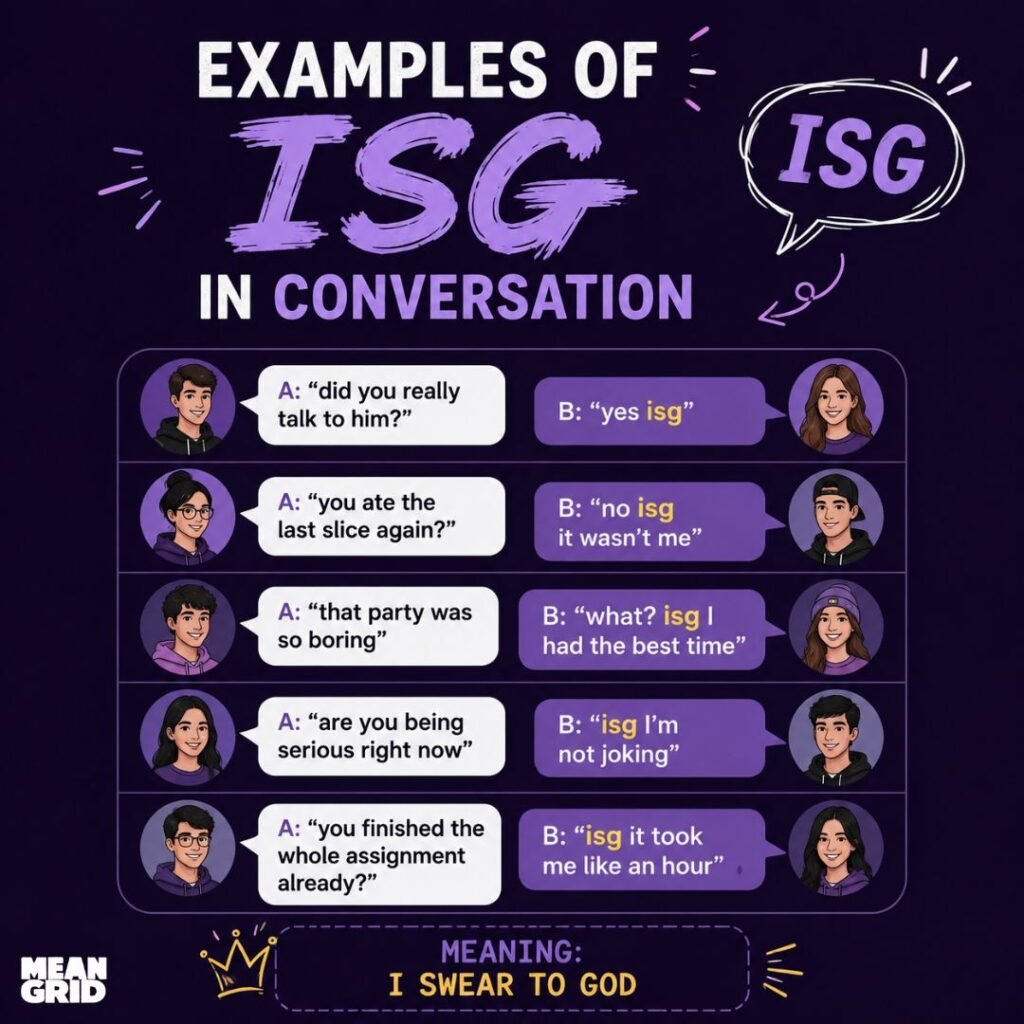
Seeing it in real exchanges makes the meaning click faster than any definition can.
- A: “did you really talk to him?” B: “yes isg”
- A: “you ate the last slice again?” B: “no isg it wasn’t me”
- A: “that party was so boring” B: “what? isg I had the best time”
- A: “are you being serious right now” B: “isg I’m not joking”
- A: “you finished the whole assignment already?” B: “isg it took me like an hour”
Notice how ISG almost always sits at the start or end of a sentence, rarely buried in the middle. That placement is part of what makes it read naturally instead of clunky.
When to Use and When Not to Use ISG
ISG fits casual, personal conversations. Group chats, DMs, comments, captions, texts between friends. It’s built for that register.
It doesn’t fit formal writing. Skip it in work emails, school assignments, professional Slack messages, or anything where you’re representing yourself in an official capacity. Not because it’s offensive, but because it instantly signals casual tone, and that clashes with formal contexts the same way slipping “yo” into a cover letter would.
A simple gut check: if you wouldn’t say “I swear to God” out loud in that setting, don’t type ISG either.
How Is ISG Used in Different Contexts?
The core meaning stays the same everywhere, but the emotional flavor shifts depending on who’s using it and why.
Guys tend to use ISG in a more playful or competitive way, like backing up a claim about a game or a joke. Girls often use it to add drama or stress sincerity in a story, especially when recapping something surprising or upsetting. Neither usage is “more correct.” The meaning doesn’t change, only the delivery does.
In gaming chats, ISG shows up to back up in-game claims or react to a clutch moment. In group chats about drama, it shows up constantly to signal “this is真实 real, I’m not making it up.”
ISG Meaning on Snapchat, TikTok, Instagram, WhatsApp
Each platform bends ISG slightly toward its own style, but the core meaning holds steady everywhere.
| Platform | How ISG Typically Shows Up |
| Snapchat | Quick reactive snaps and captions, often paired with a face reaction |
| TikTok | Comments reacting to something shocking, funny, or relatable |
| Captions and comments adding personal emotion to a photo or moment | |
| Group chat arguments or quick honesty checks between friends |
On Snapchat, since messages disappear fast, ISG adds urgency, almost like swearing to something before the moment vanishes. On TikTok, it’s a comment staple for reacting to relatable or wild content. On Instagram, it softens captions and makes them feel more personal instead of staged. On WhatsApp, it tends to show up more in longer group conversations where people are hashing something out.
ISG Meaning in Professional or Technical Fields
Outside of texting, ISG can stand for other things entirely, and this is where confusion creeps in. In business and IT settings, ISG often means “Information Systems Governance” or refers to actual companies and research firms that use ISG as an abbreviation in their name. In gaming or tech-forward circles, some people have also used ISG loosely to mean “I Speak Geek,” a badge for someone deeply into tech, coding, or niche fandoms.
These meanings almost never overlap with texting usage. If you see ISG in a business email or an IT meeting, it is not “I swear to God.” Context makes the difference obvious almost every time.
Which ISG Do They Actually Mean
This is the part most guides skip, and it’s exactly where people get tripped up. ISG isn’t one fixed phrase. It’s an abbreviation that different communities have claimed for different things, and picking the wrong one changes the entire message.
| Meaning | Where You’ll See It | How Common |
| I Swear to God | Texts, DMs, Snapchat, TikTok comments | Most common by far |
| I’m So Glad | Casual texts expressing relief or happiness | Occasional, context-dependent |
| I Speak Geek | Gaming or tech-culture circles | Rare, niche |
| Information Systems Governance | Business, IT, corporate documents | Only in professional writing |
The fastest way to tell them apart is location and tone. If it’s in a personal chat and the sentence has any kind of emotional charge, it’s “I swear to God” almost every time. If it shows up in a formal document or corporate context, it’s the governance term. The geek and glad meanings are rare enough that you’ll usually spot them from surrounding words, like a sentence about coding or a reply to good news.
There’s also a mechanical detail nobody covers: punctuation. ISG almost always gets a comma when it opens a sentence, like “isg, that was wild,” but it’s often dropped entirely when it caps one off, like “that was wild isg.” Both are fine. Lowercase is standard in casual texting even though it technically stands for a full sentence.
Common Misunderstandings About ISG
A few mix-ups happen constantly:
- Confusing it with IG. IG almost always means Instagram, not ISG. They look similar but aren’t related.
- Assuming it’s always religious. For the vast majority of texters, ISG carries zero religious weight. It’s an emotional intensifier, nothing more.
- Thinking it only shows up with negative news. ISG shows up just as often with good news, excitement, and compliments as it does with complaints.
- Reading it as sarcastic by default. Tone comes from surrounding words and emojis, not from ISG itself.
ISG vs Similar Terms and Alternatives
| Term | Meaning | Typical Tone |
| ISG | I Swear to God | Defensive or emphatic |
| ISTG | I Swear to God | Nearly identical to ISG, slightly more common |
| ONG | On God | Assertive, confident |
| FR | For Real | Neutral, simple emphasis |
All four essentially confirm sincerity, but the tone shifts slightly. “ISG I didn’t touch it” reads a little defensive. “ONG I didn’t touch it” reads more confident and matter-of-fact. “FR” is the mildest of the group, closer to just agreeing with something rather than swearing to it.
How to Respond to ISG
Replying is usually simple since ISG rarely needs a complicated answer.
- If you believe them: “okay okay I believe you”
- If you’re teasing: “sure you didn’t 👀”
- If you want more detail: “wait what happened, tell me everything”
The goal is matching their energy. If they used ISG to convince you of something, a short confirming reply works best. If they used it to hype something up, react with the same enthusiasm back.
Tips for Using ISG Naturally
Keep it short and don’t overuse it. ISG loses its punch fast if it shows up in every single message. Save it for moments that actually call for emphasis, whether that’s defending yourself, reacting to something wild, or expressing genuine excitement.
Pair it with an emoji when you want to soften or clarify tone, since text alone can read flatter than you intend. And read the room. If the conversation feels serious or formal, skip it entirely.
FAQ’s
Is ISG the same as ISTG?
Yes, both mean “I Swear to God,” and they’re used interchangeably in casual texting.
Is ISG rude or offensive?
No, ISG is generally seen as harmless slang, though some people avoid it in religious contexts out of personal preference.
Can ISG mean something other than “I Swear to God”?
Yes, in business settings it can mean “Information Systems Governance,” and in niche tech circles it occasionally means “I Speak Geek.”
Should I use a comma after ISG?
Usually yes when it opens a sentence, like “isg, I’m serious,” though it’s often dropped when ISG ends a sentence.
Is it okay to use ISG at work?
No, ISG reads as casual slang and doesn’t fit professional emails, meetings, or formal writing.
Conclusion
ISG almost always means “I Swear to God” in texting and social media, used to add sincerity, surprise, frustration, or excitement to a message.
The meaning shifts slightly outside casual chat, so context is everything. Once you know what to look for, spotting the right ISG takes seconds.

Albert is a dedicated meaning expert with over 6 years of experience researching word meanings, language usage, and definitions. At Mean Grid, he creates clear, accurate, and easy-to-understand content that helps readers explore the true meaning of words and phrases.