
You are halfway through an email, the sentence is perfect, and then your fingers freeze. Is it nosey or nosy? Spell check shrugs, and the coworker who reads everyone’s screen is still hovering behind you. Fair enough.
The nosey or nosy question trips up native speakers every single week. Both spellings show up in print, one is the safer pick, and the reason is simple once you see it. This guide covers how to spell nosy, what the word means, where it came from, and how to stop second guessing it for good.
Quick Answer – Nosey or Nosy
Nosy is the preferred spelling, especially in American English. Nosey is an accepted variant that appears in dictionaries and in everyday writing, but nosy is the standard form in most style guides.
If you only remember one thing, remember this: when you want the safe choice for school, work, or publishing, write nosy.
What Does Nosy (or Nosey) Mean?
Nosy means overly curious about other people’s private business. It describes someone who asks too many questions, snoops around, or pokes into matters that are not theirs.
The word is an adjective, and it usually carries a mild insult. Calling someone nosy is not a compliment, but it is rarely a declaration of war either.
Here are a few ways the word shows up in real life:
- A nosy neighbor who tracks every delivery truck on your street
- A nosy coworker who “accidentally” reads your screen
- A nosy relative who asks why you are still single at every holiday dinner
- A nosy question, such as “How much did you pay for that?”
A few related phrases are worth knowing. Nosy parker is a British expression for a busybody. To nose around means to explore or snoop. And “nosy” can also describe a literal nose in a joking way, though that use is rare today.
How Do You Spell Nosy?
You spell nosy N-O-S-Y. Take the word nose, drop the silent e, and add the letter y. That is the whole recipe.
This is the same pattern English uses everywhere. Rose becomes rosy. Smoke becomes smoky. Bone becomes bony. Nose becomes nosy.
So when someone asks how to spell nosy or nosey, the answer is that both exist, but nosy follows the standard rule and wins in most dictionaries. Nosey keeps the e, which feels natural because the root word nose has one. That is exactly why the variant refuses to die.
Where Does the Word Come From?
Nosy comes from the noun nose plus the adjective ending y. The ending turns a thing into a quality, so a nose becomes “nose-like” or “having to do with noses.”
The idea behind the meaning is easy to picture. Animals investigate the world with their noses, and a person who sticks their nose into other people’s affairs behaves the same way. The curious sense of nosy took hold in the 1800s, and it has been a handy insult ever since.
The British phrase Nosey Parker appeared in the early 1900s. Nobody has pinned down exactly who the original Parker was, and several stories compete for the credit. What matters here is that the phrase is often printed with an e, which helped keep nosey alive in British writing.
Grammar Breakdown: Forms and Word Class
Nosy is an adjective, and it follows the standard rules for adjectives ending in y. It can sit before a noun (“a nosy neighbor”) or after a linking verb (“my neighbor is nosy”).
Here are the common forms:
- Base form: nosy
- Comparative: nosier (“My aunt is nosier than my mom.”)
- Superlative: nosiest (“He is the nosiest person I know.”)
- Adverb: nosily (“She nosily peeked at the invitation list.”)
- Noun: nosiness (“His nosiness got old fast.”)
Notice that the y turns into an i before the endings. That is the same switch you see in happy, happier, happiest. If you use the nosey spelling, the forms become awkward on the page, since “noseyer” looks strange to most readers. That alone is a decent argument for choosing nosy.
Read More: Apart vs A Part: What’s the Difference and How to Use Each One Correctly
How to Use Nosy in Professional and Casual Writing
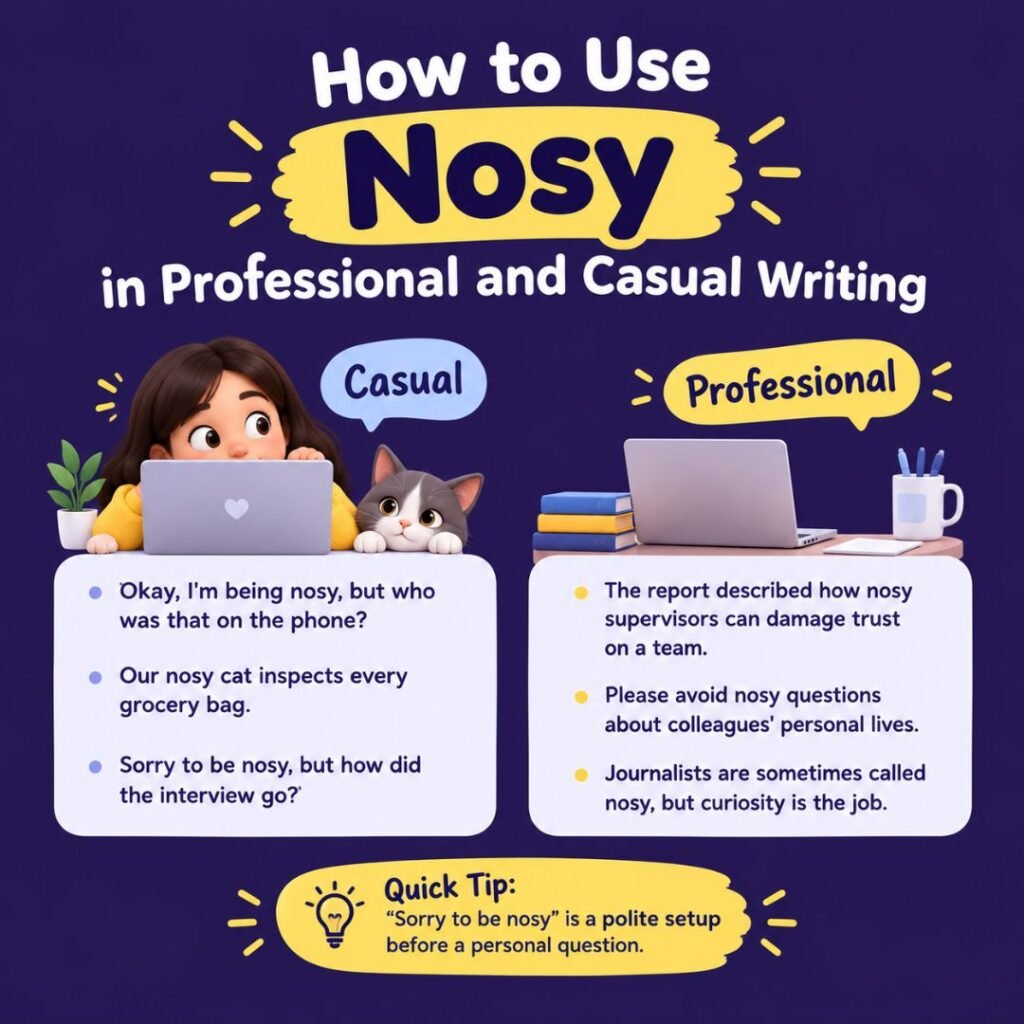
Use nosy in both formal and informal writing, but expect a softer tone in casual settings. The word works anywhere, though it can sound blunt in professional communication.
In casual writing, nosy is friendly and often teasing:
- “Okay, I’m being nosy, but who was that on the phone?”
- “Our nosy cat inspects every grocery bag.”
- “Sorry to be nosy, but how did the interview go?”
In professional writing, the word is usually descriptive and a little more careful:
- “The report described how nosy supervisors can damage trust on a team.”
- “Please avoid nosy questions about colleagues’ personal lives.”
- “Journalists are sometimes called nosy, but curiosity is the job.”
A small tip: “Sorry to be nosy” is a polite setup before a personal question. It acknowledges that you are about to cross a line, which usually earns you a little forgiveness.
Nosy vs Nosey: Comparison Table
Nosy is the standard spelling and nosey is an accepted variant. This table shows how the two compare, along with related words that often get mixed up.
| Word or Phrase | Correct? | Notes |
| nosy | Yes (preferred) | Standard in American English and most style guides |
| nosey | Yes (variant) | Common in casual and British writing |
| nosier / nosiest | Yes | Standard comparative and superlative |
| noseyer / noseyest | Rare | Looks odd and is almost never used |
| nosiness | Yes | The noun form |
| nosy parker | Yes | British idiom for a busybody |
| Nosey Parker | Yes | Common variant spelling of the same idiom |
| nosie | No | Misspelling |
| noisy | Different word | Means loud, not curious |
That last row deserves attention. Noisy and nosy look like cousins, but they have nothing in common. A noisy neighbor blasts music. A nosy neighbor watches you carry it inside.
Common Mistakes to Avoid
The most common mistake is treating nosey as flatly wrong, followed closely by mixing up nosy and noisy. Neither one is a disaster, but both are easy to fix.
Watch out for these:
- Calling nosey a typo. It is a recognized variant, so it is not an error. It is just less preferred.
- Mixing spellings in one document. Pick one and stick with it from the first paragraph to the last.
- Writing noisy when you mean nosy. The extra i changes the meaning completely.
- Using nosie. This spelling does not exist in any dictionary.
- Forgetting the i in nosier and nosiest. The y must change before those endings.
- Writing “know-sy” or “nozy.” Spelling it by sound alone leads to some creative results.
The mixing issue is the sneakiest. A reader may forgive either spelling, but spotting both in the same page makes the writing look careless.
Data and Trends: How Common Is the Mistake?
Nosy is far more common in American writing, while nosey holds a stronger presence in British and casual usage. Search behavior reflects that split, since many people look up both spellings side by side.
The pattern is easy to spot in how people search. Queries such as “nosey or nosy,” “is nosey a word,” and “how to spell nosy or nosey” show up constantly, which tells you the confusion is widespread. Most people are not searching because they are bad at spelling. They are searching because both versions look right.
A few takeaways about usage:
- Major American dictionaries list nosy first and treat nosey as a variant.
- British sources lean toward nosy as well, though nosey appears more often there, especially in the phrase Nosey Parker.
- Casual writing such as texts, captions, and social posts shows the most nosey, since people type by instinct.
- Spell checkers may underline nosey in some settings, which nudges writers toward nosy.
In short, the confusion is normal, and the fix is a quick habit rather than a grammar course.
Memory Trick: How to Remember Nosy
Remember that the word nose loses its e before the y, just like rose becomes rosy. That one comparison covers the whole spelling.
Here are three tricks you can use:
- The rosy trick: Rose becomes rosy, so nose becomes nosy. Same move, same result.
- The curious cousin trick: Nosy has an o and a s and a y, just like “snoop” has an s and an o. Snoops are nosy, and both words live in the same neighborhood.
- The i swap check: If you are wondering about noisy, ask yourself whether the thing is loud. Loud means noisy with the extra i. Curious means nosy.
Pick whichever trick makes you smile. The silliest one tends to stick best.
Step by Step Guide to Using Nosy Correctly
To use nosy correctly, confirm the meaning, pick the spelling, and match the word form to your sentence. It takes about ten seconds once you know the routine.
- Check the meaning. Are you describing someone overly curious about private matters? If yes, nosy is the right word.
- Rule out noisy. If the sentence is about sound, you need noisy instead.
- Choose the spelling nosy. It is the standard form and the safest option for school, work, and publishing.
- Pick the right form. Use nosier for comparisons, nosiest for the top spot, nosily for actions, and nosiness for the noun.
- Stay consistent. Whatever you choose, keep it the same throughout the document.
- Read the sentence out loud. If it sounds natural, you are done.
Mini Quiz: Test Your Nosy Skills
Try these eight questions to check how well the spelling has sunk in. Answers are listed at the end.
1. Which spelling is preferred in American English?
- a) nosey
- b) nosy
- c) nosie
2. Fill in the blank: “My neighbor is ______ about everything.”
- a) noisy
- b) nosy
- c) nozy
3. What is the comparative form of nosy?
- a) nosyer
- b) noseyer
- c) nosier
4. Which word means loud?
- a) nosy
- b) noisy
- c) nosey
5. True or false: nosey is a completely made up spelling.
- a) True
- b) False
6. Which phrase is a British idiom for a busybody?
- a) Nosy parker
- b) Noisy parker
- c) Nozy packer
7. What is the noun form of nosy?
- a) nosiness
- b) noisiness
- c) noseness
8. Which spelling follows the same rule as rose and rosy?
- a) nosey
- b) nosy
- c) both
Answers:
- 1) b,
- 2) b,
- 3) c,
- 4) b,
- 5) b,
- 6) a,
- 7) a,
- 8) b
FAQs
How do you spell nosy?
Nosy is spelled N, O, S, Y: take the word nose, drop the e, then add y.
How to spell nosy or nosey?
Use nosy as your default spelling; nosey is an accepted variant, but editors and dictionaries prefer nosy.
Is nosey a real word?
Yes, nosey is a real word, but it is just a less preferred variant spelling of nosy.
Is it nosy or nosey in British English?
British English accepts both spellings, though nosy is the main form; nosey appears often in Nosey Parker.
What is a nosy parker?
A nosy parker is a British expression for a busybody who pokes into other people’s private business.
Conclusion
Nosy is the preferred spelling, and nosey is an accepted variant. Both mean overly curious about other people’s private business, but nosy is the safe choice for school, work, and publishing.
Here is everything worth remembering:
- Spelling: Drop the e from nose and add y. Rose becomes rosy, so nose becomes nosy.
- Meaning: A nosy person asks too many questions or pokes into things that are not their business.
- Forms: Nosier, nosiest, nosily, and nosiness all follow the standard y to i rule.
- Nosey: It is a real word, but it shows up more in casual and British writing, especially in Nosey Parker.
- Biggest trap: Noisy means loud, while nosy means curious. One extra i changes the whole sentence.
- Consistency: Pick one spelling and keep it the same from start to finish.
Before you hit send, ask yourself one thing: curious or loud? Curious is nosy. Loud is noisy.
Now you can type it with confidence, and politely ignore the coworker still peeking at your screen.

Albert is a dedicated meaning expert with over 6 years of experience researching word meanings, language usage, and definitions. At Mean Grid, he creates clear, accurate, and easy-to-understand content that helps readers explore the true meaning of words and phrases.