
You are about to hit send on a message, and your spellchecker throws a red squiggle under the very first word. Annoying, right? It happens to a lot of people, because the greeting looks like it should be a single word, just like “goodbye.” So is it goodmorning or good morning? Spoken, the two sound identical, which is exactly why the mix up survives.
Written, only one of them is right. This guide shows you which one, how to spell it, when to capitalize it, and how to never second guess it again.
Quick Answer: Goodmorning or Good Morning?
Good morning is the correct spelling. It is always two separate words. “Goodmorning” is a misspelling that standard dictionaries do not list.
So if you have been wondering how do you spell good morning, the answer is simple: good, then a space, then morning. Capitalize the G when it opens a sentence or an email, and you are done.
What Does Good Morning Mean?
Good morning is a polite greeting used from sunrise until noon. It works as a hello when you meet someone, and it works as a wish for a pleasant start to their day.
Most people say it between about 5 a.m. and 12 p.m. After that, the greeting shifts to “good afternoon,” then “good evening.” Nobody checks a clock too strictly, though. If your coworker rolls in at 11:58 and you say “good morning,” you are fine. If they roll in at 12:03, you will probably survive.
It can also work as a stand alone reply, as a text message, or as a spoken line on a radio show. Same two words every time.
Where Did Good Morning Come From?
The phrase grew out of Middle English greetings that wished people a good start to the day. Older English had forms like “good morrow,” a version you may recognize from Shakespeare’s plays. “Morrow” meant morning or the next day.
Over time, “good morrow” faded and “good morning” took over. The word “morning” itself comes from “morn,” with an “ing” ending added, in the same way “evening” grew out of “even.” Greetings built on “good” plus a time of day, such as good day and good evening, followed the same pattern.
Notice something here. Every one of those greetings stayed as separate words. Not one of them ever fused into a compound, which is a hint about why “goodmorning” looks wrong to editors.
Grammar Breakdown: Why Good Morning Is Two Words
“Good” is an adjective and “morning” is a noun, so they stay as two separate words. Adjective plus noun, with a space between them. That is the same structure as “good idea,” “good luck,” or “good friend.”
Compare that with “goodbye.” That one started life as “God be with ye,” got squashed over centuries, and finally earned a place in the dictionary as one word. Greetings that become single words usually go through a long fusion process. “Good morning” never went through it. Dictionaries still list it as two words, and style guides treat it the same way.
You might spot “goodmorning” in usernames, hashtags, brand names, or text messages. Those are casual choices, not grammar rules. In anything formal, school work, email, or published writing, use two words.
Good Morning Capitalization and Punctuation
Capitalize only the first word, “Good,” when the greeting begins a sentence. Write “Good morning, everyone,” not “Good Morning, everyone,” unless it sits inside a title.
Here is the quick rulebook:
- At the start of a sentence or email: Good morning, Sarah.
- In the middle of a sentence: She smiled and said good morning.
- In a title or heading using title case: Good Morning America
- After the greeting, add a comma when you address someone by name: Good morning, Daniel.
An email salutation is the place people trip most. Capitalizing the “M” feels respectful, but it is not necessary. Sentence case is the standard choice for everyday emails.
How to Use Good Morning at Work and in Casual Chats
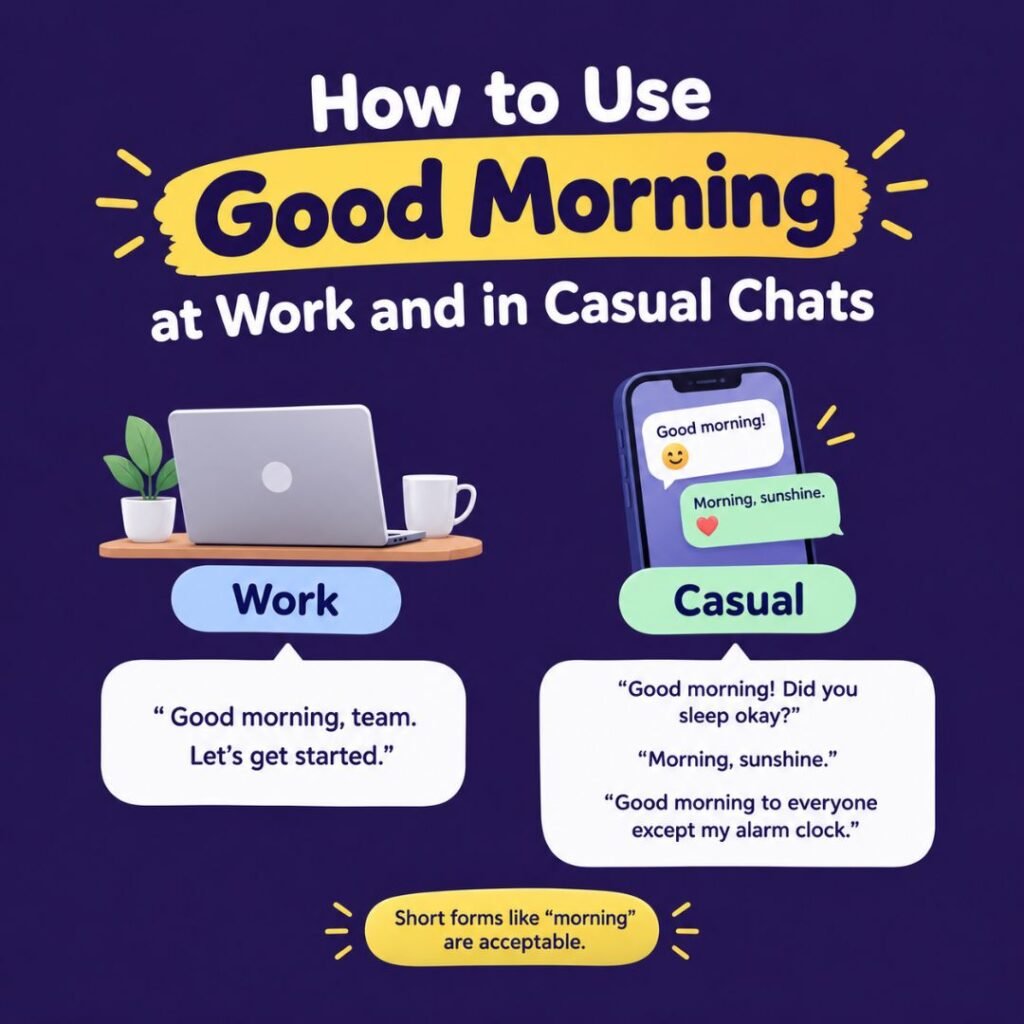
Use good morning in both formal and casual settings, and adjust only the words around it. The greeting itself never changes.
At work, it fits naturally at the top of an email or at the start of a meeting:
- “Good morning, team. Let’s get started.”
- “Good morning, Ms. Alvarez. Thank you for joining us.”
- “Good morning. I am following up on yesterday’s proposal.”
In casual chats, you have more freedom:
- “Good morning! Did you sleep okay?”
- “Morning, sunshine.” (shortened, and perfectly fine)
- “Good morning to everyone except my alarm clock.”
Short forms like “morning” are acceptable in speech and friendly texts. In professional writing, keep the full phrase. It reads warmer and cleaner.
Read More: Simpler vs More Simple: Which One Is Correct?
Good Morning vs Goodmorning: Comparison Table
The only correct written form is “good morning,” and every other version is either informal or a mistake. This table shows the common variations side by side.
| Written Form | Correct? | Where It Appears | Notes |
| Good morning | Yes | Emails, essays, books, speeches | Standard spelling |
| good morning | Yes | Mid sentence | Lowercase when not starting a sentence |
| Good Morning | Sometimes | Titles, signs, headings | Fine in title case only |
| Goodmorning | No | Texts, usernames, hashtags | Not in standard dictionaries |
| Good mourning | No | Typos and puns | Means grieving, not greeting |
| Morning | Informal | Chat, quick greetings | Short form, fine in casual speech |
| Gud morning | No | Text slang | Avoid in writing |
Also worth knowing: “good mourning” is a real phrase in some funny memes, but it has nothing to do with greeting anyone. Mourning with a “u” is about grief. Morning without the “u” is about sunrise.
Common Mistakes With Good Morning
The most common mistake is writing “goodmorning” as one word, followed by wrong capitalization and missing commas. Here are the slip ups worth watching:
- Writing it as one word: goodmorning
- Capitalizing both words in the middle of a sentence: She said Good Morning to him.
- Forgetting the comma before a name: Good morning Maria
- Mixing up “morning” and “mourning”
- Using “good morning” as the greeting for an evening message, which confuses time zones for global readers
- Typing “good mornin” in professional email
That last point about time zones is real. If your reader lives in another country, it may already be afternoon on their end. In global teams, many people just write “Hello” or “Hi” to dodge the issue.
How Common Is the Goodmorning Mistake?
It is one of the more frequently searched greeting spelling questions, and spellcheck tools flag it consistently. No official count exists for how many people write it wrong, but the signs are easy to see.
Here is what shows up in everyday search behavior:
- People type “goodmorning or good morning” directly into search bars to settle the question.
- Similar searches include “is it goodmorning or good morning” and “how do you spell good morning.”
- Word processors like Microsoft Word and Google Docs mark “goodmorning” as a spelling error.
- Autocorrect on most phones changes it to two words after you hit the space bar.
A quick comparison with other greetings helps explain the confusion:
| Greeting | Standard Spelling |
| Goodbye | One word |
| Good morning | Two words |
| Good afternoon | Two words |
| Good evening | Two words |
| Good night | Two words (some dictionaries also list “goodnight”) |
“Goodbye” is the odd one out. It is the lone fused greeting in the group, and that one exception explains why “goodmorning” feels plausible.
Memory Trick: How to Remember Good Morning
Think of the space as a tiny gap where your coffee goes. Good, coffee, morning. Two words, one cup in the middle.
Here are a few more tricks that stick:
- Say it out loud with a pause: “good… morning.” You can hear two beats, so you write two words.
- Match it with its siblings. You would never write “goodafternoon” or “goodevening,” so “goodmorning” fails the same test.
- Remember that “goodbye” is the exception, not the rule.
If none of those work, here is the lazy version: when in doubt, press the space bar.
Step by Step: How to Write Good Morning Correctly
Write “good,” add a space, write “morning,” then add punctuation that fits your sentence. Follow these steps and you will not slip.
- Type the word good.
- Press the space bar once.
- Type the word morning.
- Capitalize the G if it starts your sentence or email.
- Add a comma if you are greeting someone by name.
- Use an exclamation mark only in friendly, casual messages.
- Skip the capital M unless the phrase is part of a title.
A finished example looks like this: Good morning, Chris. Clean, polite, correct.
Mini Quiz: Test Your Good Morning Spelling
Answer these seven questions to check how well the rule stuck. Answers are listed right below the quiz.
- Which spelling is correct?
- A) Goodmorning
- B) Good morning
- C) Good mourning
- Should the “M” be capitalized in an email greeting like “Good morning, Alex”?
- A) Yes, always
- B) No, not in sentence case
- Which sentence is correct?
- A) She said Good Morning to everyone.
- B) She said good morning to everyone.
- Which word means feeling grief?
- A) Morning
- B) Mourning
- What follows “good morning” when you address someone by name?
- A) A comma
- B) A period
- Which greeting is traditionally written as a single word?
- A) Good afternoon
- B) Goodbye
- Which form is fine in a text to a friend?
- A) Morning!
- B) Mourning!
Answers:
- 1. B.
- 2. B.
- 3. B.
- 4. B.
- 5. A.
- 6. B.
- 7. A.
FAQs
Is it goodmorning or good morning?
It is good morning, written as two words. “Goodmorning” is a common misspelling and does not appear in standard dictionaries.
How do you spell good morning?
Spell it G O O D, then a space, then M O R N I N G. Capitalize the first letter only when the greeting begins a sentence.
Should good morning be capitalized?
Only the first word, “Good,” when it starts a sentence or a salutation. Capitalize both words only in titles, such as Good Morning America.
Is “good mourning” ever correct?
Only if you actually mean grieving or a period of loss. As a greeting, it is a typo or a joke. Morning without the “u” is the sunrise version.
Is it okay to just say “morning”?
Yes, in casual speech and friendly texts. In emails, interviews, and formal writing, use the full phrase “good morning” for a more polished feel.
Conclusion: Good Morning Is Always Two Words
Good morning is two words, every single time. Adjective, space, noun. That is the whole secret behind the question “is it goodmorning or good morning.”
Capitalize the first letter at the start of a sentence, add a comma before a name, and keep “mourning” for sadder situations. Do that, and your messages will start clean, whether you are writing to a boss, a client, a teacher, or your group chat.
Next time that red squiggle shows up, you will know exactly what to do. Press the space bar, grab your coffee, and carry on.

Albert is a dedicated meaning expert with over 6 years of experience researching word meanings, language usage, and definitions. At Mean Grid, he creates clear, accurate, and easy-to-understand content that helps readers explore the true meaning of words and phrases.