
AFK meaning in text is simple. It stands for “away from keyboard.” When someone sends it, they’re telling you they’ve stepped away and won’t answer right now.
You’ll spot it everywhere. A friend texts, “afk, dinner’s ready.” A teammate types, “AFK for five, grabbing water,” mid-match.
A coworker writes, “afk, quick doctor call.” The message is the same each time: I’m gone for a bit, but I’ll be back. People even send it from phones, where no real keyboard exists.
This guide covers where it came from, how to use it, and what most guides leave out.
AFK Meaning & Definition
AFK means “away from keyboard,” and it signals that you’re temporarily unavailable. Some people say “away from keys.” Same idea.
Here’s how it works in practice:
- Part of speech: It works as an adjective (“She’s AFK”). Gamers also use it as a noun (“He’s such an AFK”) and a verb (“I’m AFKing”).
- Spelling: AFK and afk both work. Lowercase feels more casual.
- Pronunciation: Say each letter: A, F, K.
- Time frame: Think minutes or hours, not days.
The core message is simple. You can’t reply right now.
Where Does AFK Come From?
AFK started in early text chat, long before smartphones. Dictionary records point to 1989, when it reportedly appeared in a Fidonet newsletter next to other shorthand like brb and lol. Fidonet was a dial-up network of bulletin boards.
In the 1990s, Internet Relay Chat (IRC) pushed it into the mainstream. Chat rooms moved fast, so a quick “afk” saved everyone from wondering where you went. Online games came next. Players on group quests needed a fast way to warn teammates. By the time texting took over, AFK was already a familiar piece of slang.
Examples of AFK in Conversation
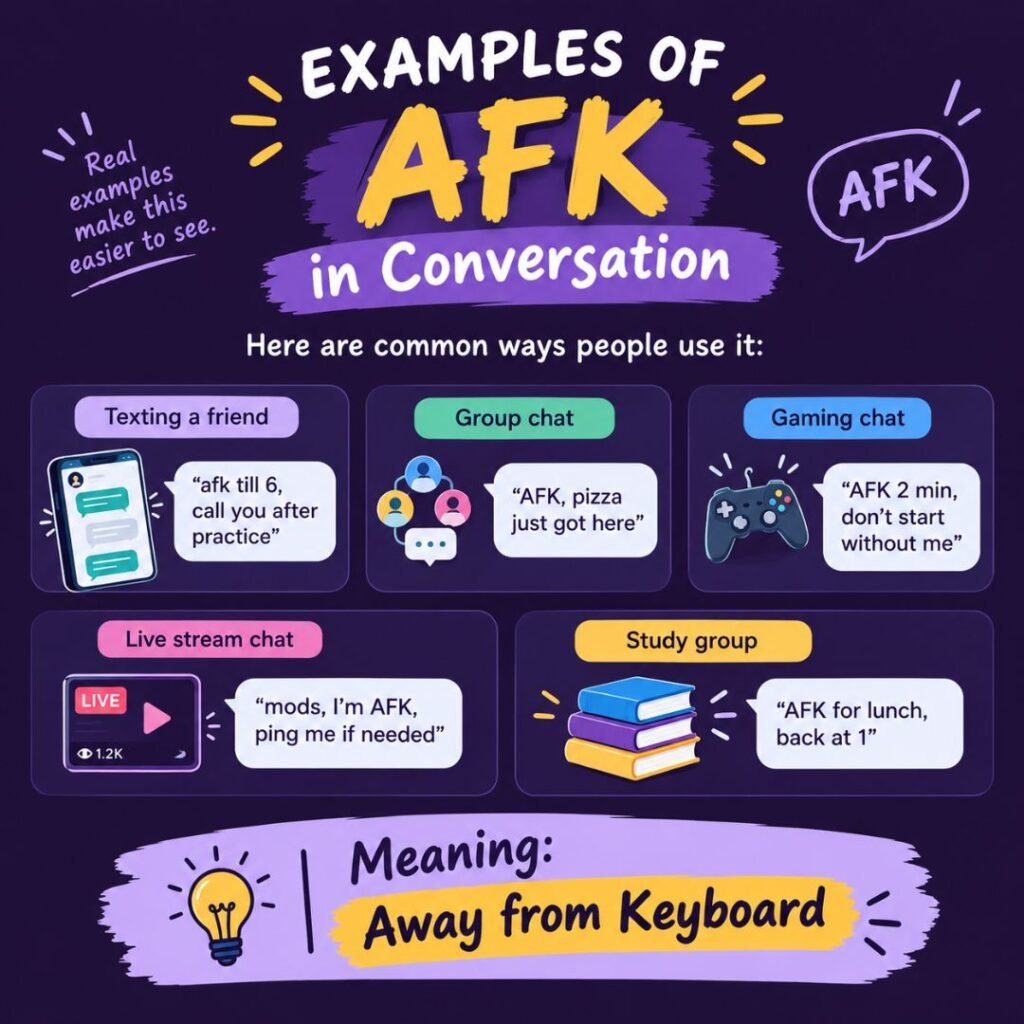
Real examples make this easier to see. Here are common ways people use it:
- Texting a friend: “afk till 6, call you after practice”
- Group chat: “AFK, pizza just got here”
- Gaming chat: “AFK 2 min, don’t start without me”
- Live stream chat: “mods, I’m AFK, ping me if needed”
- Study group: “AFK for lunch, back at 1”
Notice the pattern. Most messages add a reason, a return time, or both. That extra detail keeps people from guessing.
When to Use and When Not to Use AFK
Use AFK in casual chats and skip it in formal ones. It’s slang, so your audience matters.
Good times to use it:
- Texting friends or family
- Gaming sessions and Discord servers
- Casual team chats where slang is normal
- Live streams and fan communities
Times to skip it:
- Emails to clients or bosses
- Job applications and cover letters
- Messages to teachers, unless they use slang first
- Urgent situations where someone needs you
In formal settings, write “I’m stepping away and will reply by 3 p.m.” instead. It sounds polished and clear.
How Is AFK Used in Different Contexts?
AFK shifts slightly depending on where you use it. The core meaning stays fixed.
- Gaming: It warns teammates that you’ve left. Many games also punish idle players, so AFK can double as a complaint, as in “our healer went AFK mid-raid.”
- Group chats: It explains your silence. Friends know you haven’t ignored them.
- Remote work chat: In casual workplaces, it’s a quick status note. “afk, school pickup” says everything needed.
- Live streams: Streamers type it to tell chat they’ve stepped away. Viewers ask, “Is the host AFK?”
The tone changes more than the meaning does.
Read More Meaning: WTW Meaning: What It Stands For and How to Reply
AFK Meaning on Snapchat, TikTok, Instagram, and WhatsApp
AFK means the same thing on all four apps: you’ve stepped away and can’t reply yet. None of them gave it a special meaning.
- Snapchat: Friends use it in quick chats, like “afk, snap you back later.”
- TikTok: It shows up in comments and live chats when someone leaves a stream or game.
- Instagram: People drop it in DMs or story captions, like “afk, touching grass.”
- WhatsApp: It’s common in group chats when one person needs to disappear for a while.
No app has a built-in AFK button. You type it yourself.
What Other AFK Guides Skip: Safety and Smart Status Habits
Most guides stop at the definition. Three practical points matter more than people think.
1. Don’t announce an empty house.
Typing “afk, whole family is on vacation” in a public chat or live stream tells strangers your home is empty. Keep travel and location details private. Say “afk for a bit” and leave it there.
2. Use built-in status tools too.
Discord, Slack, and Microsoft Teams all have away or idle statuses. Set one, and people see you’re gone even if they miss your message. Typing AFK plus setting a status covers both bases.
3. Say when you’re back.
A quick “back” or “ok, here” closes the loop. Without it, people don’t know whether to wait or move on. It’s a small habit that makes you look considerate.
Common Misunderstandings About AFK
A few myths keep popping up.
- “AFK means they’re ignoring me.” It doesn’t. They’re away, not avoiding you.
- “You need a keyboard to say it.” You don’t. People send it from phones all the time.
- “AFK and A/F are the same.” They aren’t. A/F is a separate abbreviation, so check the context before you assume.
- “AFK is just a game title.” Not quite. AFK Arena and AFK Journey are mobile games named after the term, which can muddy search results. The slang meaning is still away from keyboard.
- “AFK means offline.” Not always. The person will likely see your message when they return.
AFK vs Similar Terms and Alternatives
AFK, BRB, GTG, and TTYL all signal a break. Each one promises something different.
| Term | Stands for | Return time | Best used when |
| AFK | Away from keyboard | Not stated, usually short | You’re unavailable and may be gone a while |
| BRB | Be right back | Very soon, minutes | You’re taking a quick pause |
| GTG | Got to go | Not returning now | You’re leaving the chat |
| TTYL | Talk to you later | Later, often hours | You’re ending a chat politely |
BRB promises a quick return. AFK promises nothing. Many people pair them as “brb afk” for emphasis.
How to Respond to AFK
You don’t have to reply, but a short response feels polite. Keep it light:
- Texting: “No worries, text me when you’re back.”
- Group chat: “Got it. We’ll save you a slice.”
- Gaming: “np, we’ll wait at the door.”
If it’s urgent, say so plainly: “Call me when you can, it’s important.” Then give them time.
Tips for Using AFK Naturally
- Match your crowd. Gamers and teens know it well. Some older relatives might not. Spell it out the first time.
- Keep it short. “afk 10” says enough.
- Watch your caps. Lowercase feels relaxed. All caps feels more urgent.
- Don’t stack slang. One abbreviation per message reads naturally. “brb afk gtg ttyl” reads like alphabet soup.
FAQs
What does AFK mean in text?
AFK means “away from keyboard.” It tells people you’ve stepped away and can’t reply right now.
What does AFK mean in gaming?
In games, AFK means a player has left their controls or screen. Teammates use it to warn others or to call out someone who stopped playing.
Is AFK the same as BRB?
No. BRB promises a quick return, while AFK only says you’re away with no set time.
Can you say AFK at work?
Yes, in casual workplaces and team chats. Skip it in formal emails and client messages.
Is AFK rude to say?
No. It’s a polite heads-up that prevents confusion.
Conclusion
AFK means away from keyboard. It’s a quick, friendly way to tell people you’ve stepped away and can’t reply yet. Use it freely with friends, gamers, and casual teams. Switch to plain words in formal emails and client messages.
Add a reason or return time when you can, and say “I’m back” when you return. Skip posting travel plans or an empty home in public chats. Pair it with a status tool, and you’ll stay polite, clear, and safe online.

Albert is a dedicated meaning expert with over 6 years of experience researching word meanings, language usage, and definitions. At Mean Grid, he creates clear, accurate, and easy-to-understand content that helps readers explore the true meaning of words and phrases.