
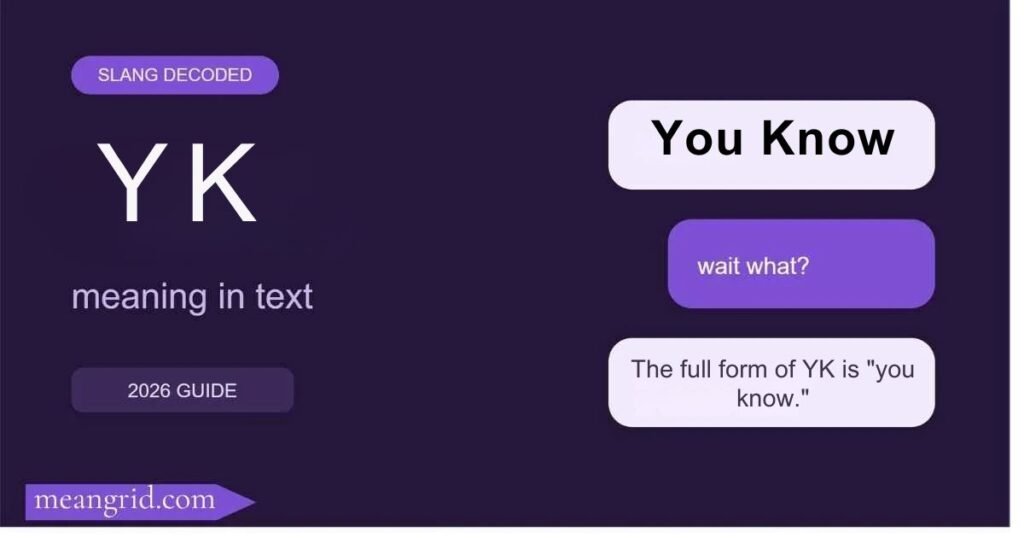
YK stands for “you know.” It’s a casual texting shortcut that adds emphasis, softens a point, or checks that the other person is following. A friend might text, “That meeting ran forever, yk?” Another might write, “yk how he gets.” Both mean, “You get what I’m saying.”
Think of it as a verbal habit in text form. This guide explains the YK meaning in text, where it came from, and how to use it. You’ll also learn how to reply when it lands in your inbox.
YK Meaning in Text: Definition
The full form of YK is “you know.” Most people type it in lowercase, but “Yk” and “YK” mean the same thing.
It works like a filler word, the little pause you add while talking. It does three jobs:
- Emphasis: “I was so tired, yk.”
- Connection: “Rough week, yk?” The sender wants you to relate.
- Softening: “I’m not a big fan, yk.” The opinion sounds gentler.
YK isn’t an official acronym. No rulebook governs it. People simply type what they’d say out loud.
Where Does YK Come From?
YK comes from the spoken phrase “you know,” which people have tossed into conversation for ages. Texting just gave it a shorter form.
Early phones had tiny keypads and message limits. Typing less meant sending faster, so shortcuts like “u,” “idk,” and “brb” spread quickly. YK joined that crowd.
Nobody can point to the very first YK text. Slang rarely has a birth certificate. Later, social apps carried it into comments, captions, and DMs, where fast, casual typing is the norm.
Examples of YK in Conversation
Real texts show it best. Here are a few everyday scenes.
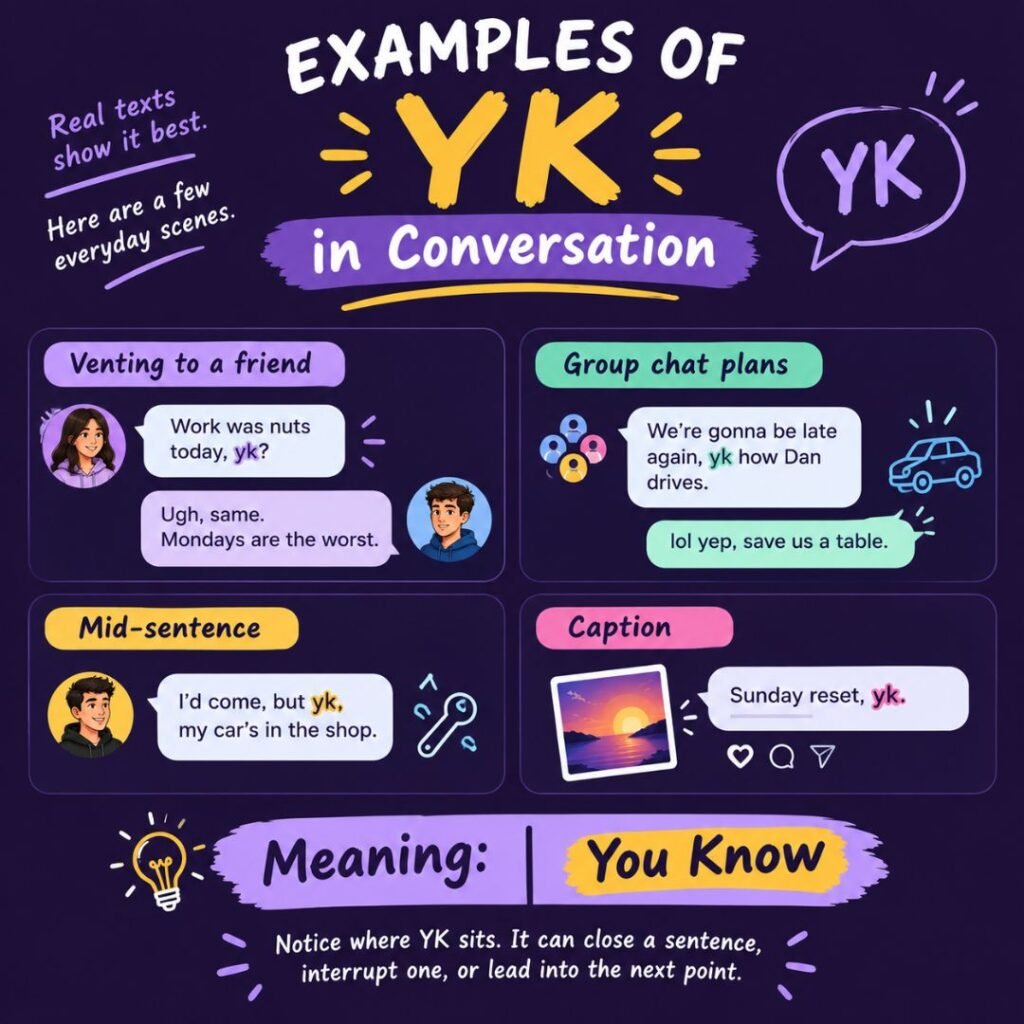
Venting to a friend
- “Work was nuts today, yk?”
- “Ugh, same. Mondays are the worst.”
Group chat plans
- “We’re gonna be late again, yk how Dan drives.”
- “lol yep, save us a table.”
Mid-sentence
- “I’d come, but yk, my car’s in the shop.”
Caption
- “Sunday reset, yk.”
Notice where YK sits. It can close a sentence, interrupt one, or lead into the next point.
When to Use and When Not to Use YK
Use YK in relaxed, low-stakes chats. Skip it when clarity or respect matters most.
Good places to use it:
- Texts with friends and family
- Group chats and DMs
- Casual captions and comments
- Light banter and storytelling
Better to avoid it in:
- Job applications and work emails
- Messages to teachers, managers, or clients
- Customer support chats
- Instructions, health details, or anything people might misread
Here’s a simple test. If you’d say “you know” out loud in that setting, YK works. If you’d speak more formally, type the full words.
How Is YK Used in Different Contexts?
YK shifts a little depending on what you’re doing with the message.
- Telling a story: It pulls the reader in. “So I walk in, and it’s empty, yk?”
- Giving an opinion: It cushions the point. “I think it’s overrated, yk.”
- Venting: It invites sympathy. “Everything’s piling up, yk.”
- Joking or teasing: It acts like a wink. “You and your ‘five minutes,’ yk.”
- Agreeing: It shows you’re on the same page. “Right, the traffic was insane, yk.”
In every case, the sender isn’t adding facts. They’re adding warmth and rhythm.
Read More Meaning: WYLL Meaning in Text: What It Stands For (2026 Guide)
YK Meaning on Snapchat, TikTok, Instagram, and WhatsApp
YK means “you know” on all four apps. The style around it is what changes.
- Snapchat: Quick, lowercase replies. Snaps vanish by default, so the tone stays loose.
- TikTok: Mostly comments and captions. Creators use it to make a post feel relatable.
- Instagram: DMs, Stories, and captions. It often travels with emojis.
- WhatsApp: Longer back-and-forth chats, group threads, and family groups. Here YK sounds like natural talk.
The meaning stays put. The platform only sets the mood.
YK Meaning in Professional or Technical Fields
YK has no widely recognized professional or technical meaning.
You may spot those two letters in initials, usernames, or product codes. Those uses have nothing to do with texting, and context makes the difference obvious. If a coworker types YK in a chat, they almost certainly mean “you know.”
How Punctuation and Tone Change What YK Means
The letters stay the same. The feeling around them can shift fast.
Here’s why. “You know” is a filler, and linguists call fillers like it discourse markers. They guide the flow of a conversation and build rapport more than they share information. In person, your voice and face carry that tone. In text, punctuation has to do the job.
| How it’s written | What it usually feels like | Example |
| yk? | Friendly, seeking agreement | “Long day, yk?” |
| yk lol | Light and jokey | “I’m broke again, yk lol” |
| yk… | Trailing off, something unsaid | “He’s just like that, yk…” |
| yk. | Flat or slightly impatient | “I told you already, yk.” |
| YK | Strong emphasis, can sound pushy | “I NEEDED that, YK” |
These are tendencies, not rules. The same message can sound warm from a close friend and sharp from someone annoyed.
So look at the bigger picture. Check earlier messages, emojis, and reply speed. A smiley or a “haha” usually signals warmth. A short, cold chain of replies suggests the opposite.
Common Misunderstandings About YK
- “It’s rude.” It isn’t. It’s a friendly filler.
- “It’s flirty or sexual.” It has no built-in sexual meaning. Flirting comes from the words around it, not the two letters.
- “It means you’re kidding.” Some sites list extras like this one, or “Yankee.” Those are rare guesses, not standard usage. If you’re unsure, just ask.
- “You have to answer it.” Often you don’t. YK usually trails a sentence and isn’t a question.
- “Only teens use it.” Anyone who says “you know” can type it.
YK vs Similar Terms
Several abbreviations look alike but do different jobs.
| Term | Stands for | Best used for |
| YK | You know | Casual filler, emphasis |
| YKW | You know what | Introducing a point or a change of mind |
| YKY | You know You.. | Checking understanding |
| IYKYK | If you know, you know | Inside jokes |
| IK | I know | Agreeing |
| IKR | I know, right? | Enthusiastic agreement |
The biggest mix-up is YK versus IYKYK. YK is a habit inside a sentence. IYKYK points to a shared experience that outsiders won’t get, like “Gas station sushi, IYKYK.”
How to Respond to YK
Answer the message, not the abbreviation. Here are three easy replies.
- Text: “Long week, yk?” Reply: “Totally. I need a nap.”
- Text: “I’m not mad, yk.” Reply: “Got it. I just wanted to check.”
- Text: “She’s just like that, yk.” Reply: “Ha, yep. I know exactly what you mean.”
Not sure what the sender means? Type, “Wait, which part?” That’s perfectly fine.
Tips for Using YK Naturally
- Use it once per message. More than that feels cluttered.
- Place it at the end for a friendly check, like “Rough day, yk?”
- Match the other person’s style. If they text in full sentences, ease off.
- Skip it when you share sad or serious news.
- Pair it with a real point. YK works best as a sprinkle, not the whole message.
Read: IKK Meaning in Text
Read: WSG Meaning in Text
Read: JSP Meaning in Text
FAQs
What does YK mean in text?
YK means “you know.” People type it to add emphasis, soften a statement, or check that you understand.
What does YK mean on Snapchat?
On Snapchat, YK also means “you know.” It shows up in quick chats and replies.
Is YK the same as IYKYK?
No. YK means “you know,” while IYKYK means “if you know, you know” and points to an inside joke or shared experience.
Can YK mean anything besides “you know”?
In texting, no standard alternative exists. Outside messaging, YK may appear as initials or a code, but that has no link to slang.
Is it okay to use YK in work messages?
Skip it in formal emails and messages to clients or managers. In casual team chats, it’s fine if your coworkers write that way.
Conclusion
YK is a tiny shortcut for “you know.” It adds warmth, rhythm, and a bit of emphasis to casual messages.
Use it with friends, skip it in formal settings, and let punctuation and context tell you how it’s meant.

Albert is a dedicated meaning expert with over 6 years of experience researching word meanings, language usage, and definitions. At Mean Grid, he creates clear, accurate, and easy-to-understand content that helps readers explore the true meaning of words and phrases.