
GMFU stands for “Got Me F***ed Up.” In texts, it’s a blunt reaction that means you’re shocked, annoyed, or offended. Depending on tone, it can mean “you’re kidding me,” “you’ve misjudged me,” or “I can’t believe that.”
That’s the GMFU meaning in text in a nutshell. Picture a friend texting “They raised rent again. GMFU.” That’s frustration. Now picture “You ate my last slice? GMFU” with a laughing emoji. That’s a joke. Same word, different mood, so tone does the heavy lifting.
GMFU Meaning and Definition
GMFU is an acronym for “Got Me F***ed Up.” The full phrase is “you got me f***ed up,” and the acronym just clips it for fast typing.
It does two main jobs:
- Shock or disbelief: “I can’t believe that just happened.”
- Pushback: “You’ve misjudged me, and I’m not taking that.”
Because it’s profane, it fits close friends and casual chats best. Lowercase usually feels relaxed, while all caps feels dramatic.
Where Does GMFU Come From?
The phrase “got me f***ed up” is older than the acronym. Slang references trace it to rap lyrics, but they disagree on the start date, with answers ranging from the 1990s to the mid 2000s. The longer phrase landed on Urban Dictionary in 2003, and the GMFU version followed in 2009.
The acronym follows the same pattern as GTFO and STFU. It went viral on social media around 2016 and 2017, and the first big tweet with it came in 2017. Songs titled GMFU from artists like Keke Palmer, Adrian Marcel, and DC the Don helped too. A song title let artists skip the full swear word while fans still got the message.
The roots sit in urban slang and hip-hop, and the phrase moved into everyday chat from there.
Why Do People Type GMFU Instead of the Full Phrase?
Three reasons keep the acronym alive. First, speed. Texting rewards short replies, and four letters beat five words.
Second, tone control. The letters look softer than the spelled-out swear, so the message lands lighter in group chats where parents, coworkers, or younger cousins might be reading.
Third, rhythm. GMFU works as a full reaction on its own, so it can sit at the end of a sentence or stand alone as a one-word reply. That mix of speed, softness, and punch is why you’ll see it under videos, in story replies, and in gaming lobbies.
Examples of GMFU in Conversation
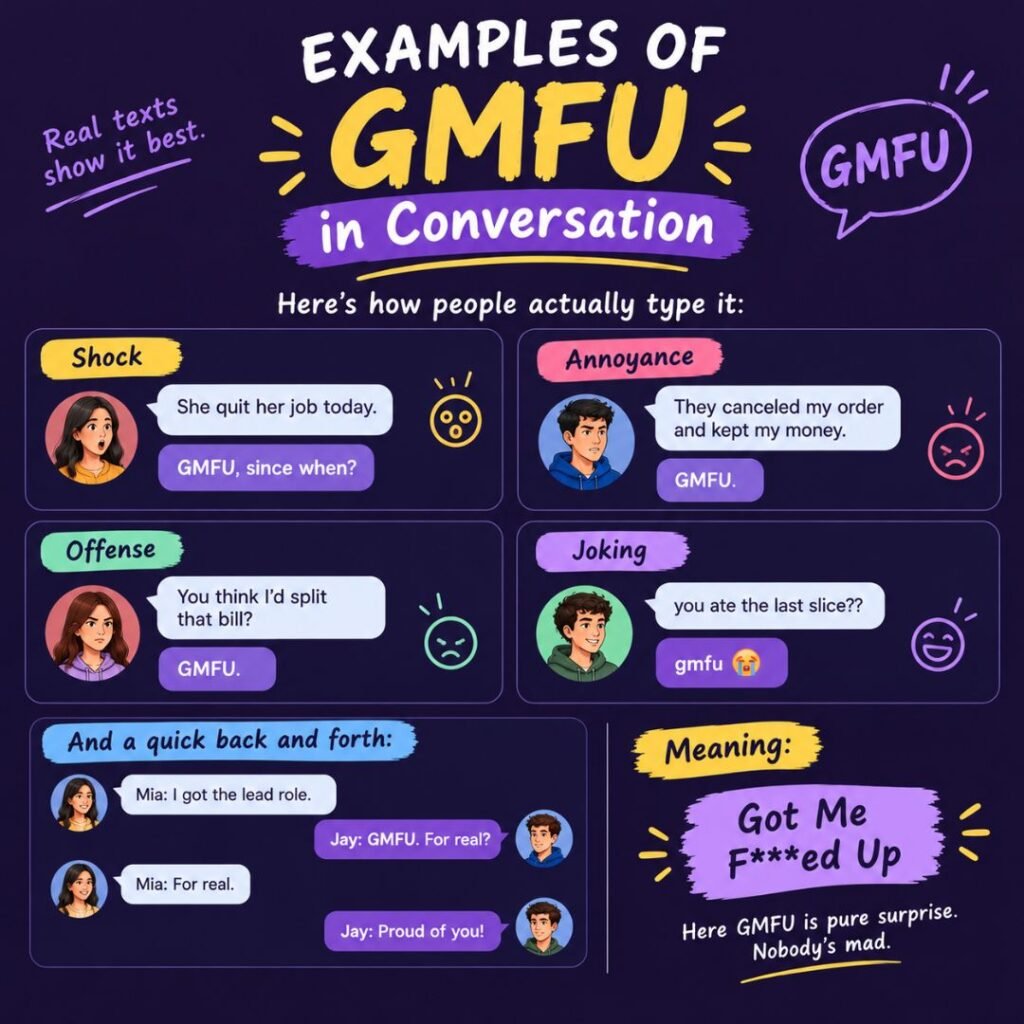
Here’s how people actually type it:
- Shock: “She quit her job today.” “GMFU, since when?”
- Annoyance: “They canceled my order and kept my money. GMFU.”
- Offense: “You think I’d split that bill? GMFU.”
- Joking: “you ate the last slice?? gmfu 😭”
And a quick back and forth:
- Mia: I got the lead role.
- Jay: GMFU. For real?
- Mia: For real.
- Jay: Proud of you!
Here GMFU is pure surprise. Nobody’s mad.
When to Use and When Not to Use GMFU
The word carries a swear, so it can offend even when you’re joking. That’s why audience matters.
Use it when:
- You’re texting close friends
- You’re joining group chat banter
- You’re reacting to wild news or memes
- You’re venting about small annoyances
Skip it when:
- You’re messaging a boss, teacher, or client
- You’re writing to relatives who don’t use slang
- Someone is dealing with something serious
- You don’t know the person well
A quick test: if you’d hesitate to say the swear out loud, don’t type the acronym.
Is GMFU Rude, Flirty, or Just Casual Slang?
It’s casual slang with a rough edge. The swear makes it rude in formal spaces, but friends use it all the time without meaning any harm.
Flirty? Rarely. In dating chats it can show playful shock, like “you remembered my order? gmfu 😭.” Most of the time, though, it signals annoyance or surprise, not romance.
If you can’t tell, ask one question: does the sender sound hurt, amused, or heated? Emoji, “lol,” and punctuation answer that fast. A message with 😭 or “lol” is usually a joke. A short “gmfu.” with a period often isn’t.
GMFU Meaning From a Girl
The meaning stays the same no matter who sends it. What changes is the relationship and the mood. A friend’s “gmfu” with a laughing emoji is playful teasing.
Someone you’re dating who types “you GMFU” after a rude joke is drawing a line. Short messages with no emoji usually signal real annoyance, so read the messages around it.
Read More: AFK Meaning in Text – What Does Afk Mean?
How To Respond When Someone Uses GMFU
Not sure what to say when someone texts you “GMFU”? Here are some simple replies anyone can use:
- “What do you mean?” when you’re confused.
- “I didn’t mean that.” when they misunderstand you.
- “Relax, I was joking.” when the conversation is playful.
- “Let’s talk about it.” when they’re upset.
- “My bad, I’m sorry.” when you made a mistake.
Tip: Understand their tone before replying. A calm response can prevent unnecessary arguments.
How Is GMFU Used in Different Contexts?
- Venting: Late buses, high prices, slow refunds.
- Reacting to news: Gossip, plot twists, big announcements.
- Gaming: A wild play or a surprise loss, like “that headshot was crazy, gmfu.”
- Banter: Friends teasing each other in group chats.
GMFU Meaning in Text on Snapchat, TikTok, Instagram, and WhatsApp
The meaning stays the same everywhere, but each app has its own habits.
- Snapchat: Fast reactions in chats, often paired with a crying or skull emoji.
- TikTok: Comments under shocking or ridiculous videos.
- Instagram: Story replies, DMs, and caption jokes.
- WhatsApp: Group chats, where older relatives may be reading too.
Two more places matter. X is where the acronym had its first big viral moment. Discord gaming chats use it the same way players do in heated matches.
Why GMFU Is Really About Respect, Not Just Shock
Most guides stop at shock. But the older sense is about being misjudged. The full phrase, “you got me f***ed up,” often means “you’ve got the wrong idea about me.” That’s why you’ll see “you GMFU” and “u GMFU” so often.
Watch for these forms:
- You GMFU: You’ve underestimated or misread me.
- GMFU alone: This situation shocked or annoyed me.
- Got me all f***ed up: The same push, with extra force.
Compare “GMFU, that price is insane” (about a situation) with “nah, you GMFU” (about you).
Why does this matter? If you read it as plain shock, you might laugh back when the sender is setting a boundary. Check whether the message points at you or at a situation. Words like “you,” “u,” and “nah” usually mean it points at you.
Common GMFU Variations and Related Phrases
People bend this slang in a few predictable ways. Here’s what each form usually signals in a chat.
| Form | What it usually means | Tone |
| gmfu fr | I’m serious about this | Firm |
| gmfu lowkey | A little bothered | Mild |
| gmfu highkey | Clearly offended | Strong |
| u GMFU | You’ve misjudged me | Pushback |
| gmfu 😭 | Overwhelmed or laughing | Playful |
| gmfu 💀 | That was too funny or wild | Joking |
The ending words and emoji change the weight more than the acronym itself.
Common Misunderstandings About GMFU
- It’s not friendly by default. Some people mistake it for a greeting or compliment because it looks like other texting acronyms. It’s a reaction.
- It isn’t always anger. Jokes and surprise are common.
- It isn’t literal. Nobody is describing an actual mess.
- It has no workplace or technical meaning. Some sites list “Got Me Fed Up,” but major slang references define it only as the original phrase.
Should Parents Worry About GMFU?
Not about the acronym alone. It’s a swear word in disguise, so it signals language, not danger. If a teen uses it with friends, treat it like any other casual cursing and set your own house rules.
Look at the context around it instead. Is it joking banter, or is it aimed at someone cruelly? That second case is the one worth a conversation.
GMFU vs Similar Terms and Alternatives
| Term | Full form | Feels like | Aimed at |
| GMFU | Got me f***ed up | Shock or “you misjudged me” | You or a situation |
| WTF | What the f*** | Surprise or confusion | A situation |
| SMH | Shaking my head | Quiet disappointment | A situation |
| GTFO | Get the f*** out | Disbelief | News or a person |
| STFU | Shut the f*** up | Stop talking, or teasing | A person |
GMFU feels more personal than WTF because it often says “this affects me.”
How to Respond to GMFU
Here are three real-style exchanges you can copy:
- They’re joking: “gmfu you got the tickets?!” “Ha, I know, it’s wild.”
- They’re upset: “nah, you GMFU.” “I didn’t mean it like that. Can we talk?”
- You’re confused: “gmfu.” “Wait, which part got you like that?”
Tips for Using GMFU Naturally
- Use it once in a chat, not in every message.
- Let an emoji or “fr” set the tone, like “gmfu fr.”
- Keep the message short. The acronym already does the work.
- Don’t explain the slang in the same text. It kills the vibe.
- Point it at the situation, not a person, if you want to stay friendly.
- Skip it in a first message to someone new, since they can’t read your tone yet.
FAQs
What does GMFU mean in text?
GMFU means “Got Me F***ed Up.” It shows shock, annoyance, or offense.
Is GMFU a bad word?
Yes, it contains a swear word. Keep it to casual chats with people who are comfortable with that language.
What does “you GMFU” mean?
It means you’ve misjudged or underestimated the speaker, and they’re pushing back.
Is GMFU the same as WTF?
No. WTF reacts to a situation, while GMFU often says something affects or disrespects you.
Can I use GMFU at work or school?
No. It’s profane, so save it for friends.
Conclusion
GMFU means “Got Me F***ed Up,” and it works as a quick burst of shock, annoyance, or pushback. Before you send it or answer it, check three things: who the message points at, what emoji or punctuation surrounds it, and how well you know the person.
Friends will laugh with you. A boss or teacher won’t. When in doubt, pick a milder reply like “wait, what?” and stay friendly. Read the tone first, and GMFU never catches you off guard.

Albert is a dedicated meaning expert with over 6 years of experience researching word meanings, language usage, and definitions. At Mean Grid, he creates clear, accurate, and easy-to-understand content that helps readers explore the true meaning of words and phrases.