

You are typing an email, your fingers move faster than your brain, and suddenly you have written “please read the Manuel before assembly.” Nobody knows who Manuel is or why he is part of the assembly process.
The Manuel vs Manual mix up is one of the most common spelling slips online, mostly because the two words look almost identical. This guide clears it up fast. You will get the meanings, the origins, the grammar, real examples, a quick quiz, and a memory trick that actually sticks.
Quick Answer: Manuel vs Manual
Manuel is a person’s name, usually a male given name of Spanish, Portuguese, or French origin.
Manual is a common word meaning a handbook of instructions, or something done by hand rather than by machine. If you mean a guide, a booklet, or hands on work, the word you want is manual.
What Does Manuel Mean?
Manuel is a proper noun, a given name for a person, and it is always capitalized. It is a popular male first name in Spain, Portugal, Latin America, and parts of France, and it has no connection to instructions or handwork in everyday English.
You will see it in names like Manuel Neuer, the German goalkeeper, or Manuel the lovable waiter from the British sitcom Fawlty Towers. It can also show up as a surname or part of a longer name.
A few quick examples:
- Manuel is picking us up from the airport at six.
- I asked Manuel to review the contract.
- My neighbor Manuel makes the best tamales on the block.
If a real human being is involved, Manuel is your spelling. If not, keep reading.
What Does Manual Mean?
Manual has two main jobs in English: it is a noun meaning a book of instructions, and an adjective meaning operated by hand or done without automation. That second job is where most of its everyday use comes from.
As a noun, a manual is the booklet that comes in the box with your blender, your router, or your lawn mower. People also call it a user manual, an owner’s manual, an instruction manual, or a handbook.
As an adjective, it describes work or controls handled by a person:
- Manual transmission: a car with a stick shift and a clutch.
- Manual labor: physical work done with the hands or body.
- Manual override: a switch that lets a person take control from an automatic system.
- Manual entry: typing data in by hand instead of importing it.
There is also the adverb manually, as in “I updated the spreadsheet manually.” Notice that none of these have anything to do with someone named Manuel.
Where Do Manuel and Manual Come From?
The two words have completely different roots, which is why their similarity is pure coincidence. Knowing this makes the difference easier to hold onto.
Manuel traces back to the Hebrew name Immanuel, which means “God is with us.” It passed through Greek and Latin before settling into Spanish and Portuguese as Manuel, and it has been a favorite baby name for centuries.
Manual comes from the Latin word manualis, built from manus, meaning “hand.” It travelled into English through Old French. That same Latin root gives us words like manufacture (made by hand), manuscript (written by hand), and manicure (care of the hands).
So one word is about a blessing, the other is about hands. They just happen to share most of their letters.
Read more: In-person or In person? The Simple Rule (With Examples)
Grammar Breakdown: Proper Noun vs Noun and Adjective
Manuel is a proper noun, while manual works as a common noun or an adjective, and that difference controls how you write each one. Grammar gives you a few simple checks.
Capitalization is the first clue. Manuel always starts with a capital letter, even in the middle of a sentence. Manual only gets a capital at the start of a sentence or in a title.
The second clue is how the word behaves in a sentence:
- Manuel can be the subject, the object, or someone you are speaking to. “Manuel called.” “I called Manuel.” “Manuel, can you help?”
- Manual can take an article, plural endings, or sit in front of another noun. “The manual is missing.” “Three manuals arrived.” “A manual process.”
Plurals help too. You can have several manuals on a shelf. You would almost never write “Manuels” unless you were really talking about a group of people with that name.
One more detail: Manuel has no plain English meaning in the dictionary sense, so spell checkers sometimes ignore it when it is wrong. A name looks valid to software, even in a sentence where it makes no sense.
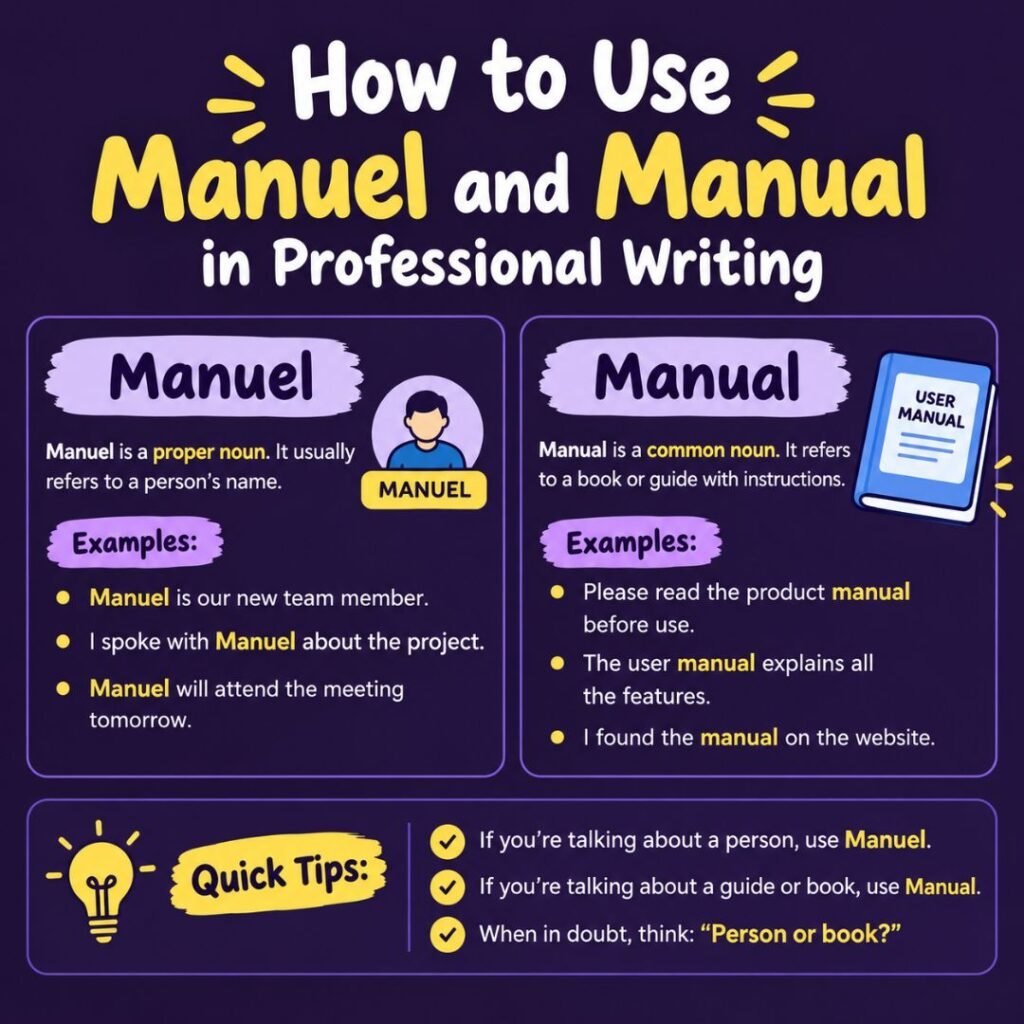
How to Use Manuel and Manual in Professional Writing
In professional writing, use manual for documents, processes, and tools, and use Manuel only when you are naming a specific person. A tiny typo here can make a polished document look careless.
How to Use Manuel and Manual in Casual Writing
In casual writing, the same rules apply: Manuel is a friend or family member, and manual is anything involving instructions or hands on effort. Texts and social posts are forgiving, but the mix up still gets noticed.
Some relaxed examples:
- I tried to fix the sink without the manual. Bad idea.
- Manuel brought snacks, so the movie night was saved.
- Driving a manual car makes me feel like a race driver and a nervous student at the same time.
- No Manuel, you cannot have the last slice.
In a text, a typo is harmless. In a caption, a review, or a post you are proud of, it is worth a second look.
Manuel vs Manual Comparison Table
The fastest way to separate the two is side by side: Manuel names a person, manual describes a guide or a hands on method. This table shows the main differences and the typical spelling errors.
| Feature | Manuel | Manual |
| Part of speech | Proper noun (name) | Noun, adjective |
| Meaning | A person’s given name | A handbook, or done by hand |
| Capitalized? | Always | Only at the start of a sentence or in a title |
| Origin | Hebrew, via Greek, Latin, Spanish | Latin manualis, from manus (hand) |
| Plural | Manuels (rare, names only) | Manuals |
| Correct example | Manuel is on the call. | Check the user manual. |
| Incorrect example | Check the user Manuel. | Manual is on the call. |
| Related words | Manny, Emanuel, Emmanuel | Manually, manual labor, manual transmission |
Notice that one extra letter is the whole story: Manuel has an “e” before the final “l,” while manual ends in “al.”
Common Mistakes with Manuel and Manual
The most common mistake is swapping the two because of how they look, and the second most common is forgetting the capital M on Manuel. Here are the ones that pop up most often.
- Writing “user Manuel” instead of “user manual.” This is the classic. Product pages and reviews are full of it.
- Writing “manuel labor” instead of “manual labor.” Nobody named Manuel is being drafted for heavy lifting.
- Writing “manuel transmission” instead of “manual transmission.” Car forums see this a lot.
- Writing “manuel” in lowercase for a name. Names need capital letters.
- Spelling the adverb as “manuelly.” The correct form is manually.
- Typing “manul” or “manuall.” Both are plain spelling errors. The word is manual.
There is also a language wrinkle. In French, the word for a handbook or textbook is also spelled manuel, and in Spanish, manual means the same as in English. English writers who speak or study those languages sometimes carry the spelling over. In English, though, use manual for the guide and keep Manuel for the person.
Real Life Example: The Email That Went Sideways
A single wrong letter can turn a simple request into a confusing message, as this short story shows. It is based on the kind of slip that happens in offices every week.
Dana ran customer support for a small appliance company. One Friday she sent a quick note to her team: “Please send customers the Manuel for the new air fryer.”
On Monday, three people replied. One asked who Manuel was. Another assumed he was a new hire and offered to introduce him to the shipping team. The third forwarded the email to HR, since a person had apparently been added to the product line without paperwork.
Meanwhile, customers still had no instructions, and the air fryer questions kept rolling in. Dana fixed the problem with a one line correction, but she lost half a day and gained a lifelong habit of proofreading the word “manual.” Small slip, real cost. The fix takes two seconds.
Data and Trends: How Often People Mix Them Up
People confuse Manuel and manual mostly in search queries, product reviews, and quick messages, where speed beats careful proofreading. The patterns are easy to spot even without exact numbers.
Search behavior points to a few common groupings:
- People type “manuel” when looking for an owner’s guide, usually after misreading or mistyping the word.
- Searches like “manuel vs manual” come from writers, students, and ESL learners checking which spelling fits.
- In the other direction, people searching for a person named Manuel sometimes type “manual” followed by a surname, because autocorrect nudges the name toward a dictionary word.
Autocorrect is a big factor. Because Manuel is a valid name, many spell checkers accept it without a flag, so a wrong “Manuel” slips through. Manual is a standard dictionary word, so a typo like “manuel” in lowercase may be changed, but not always.
You can see the pattern yourself with a free tool like Google Trends. Compare the two terms and notice how the name and the guide behave differently across regions and seasons. Spikes for “manual” often line up with holiday shopping, when people unbox new gadgets and go hunting for instructions.
Memory Trick: How to Remember the Difference
The easiest memory trick is to link the “a” in manual to “hand” and the “e” in Manuel to the name’s “e” for a person. A short mental picture does the rest.
Try these:
- Manual has “a” for “at hand.” A manual is the guide you keep at hand, and manual work is done by hand.
- Manuel is a man. Both start with “man,” and both are people.
- Capital letter means person. If it would be capitalized in the middle of a sentence, it is a name.
- Ask the swap test. Replace the word with “instructions” or “by hand.” If the sentence still makes sense, you want manual.
And if all else fails, picture a very confused waiter trying to read an air fryer booklet. That image will stay with you.
Step by Step Guide to Using Manuel and Manual Correctly
To choose the right word, check whether you are talking about a person or about instructions and hands on work. Follow these five steps whenever you are unsure.
- Look at the meaning. Is it a person? Use Manuel. Is it a guide or a hands on method? Use manual.
- Run the swap test. Replace the word with “instructions” or “by hand.” If it fits, write manual.
- Check the capital letter. A name starts with a capital M. The guide or the adjective does not, unless it opens a sentence.
- Watch the ending. Manual ends in “al.” Manuel ends in “el.”
- Proofread once more. Read the sentence out loud. A sentence like “the Manuel transmission” sounds odd immediately.
To practice, try correcting this sentence: “Manuel labor is tiring, said manual.” The fixed version is: “Manual labor is tiring, said Manuel.”
- Read More: Natzi or Nazi
- Read More: Nosey or Nosy
- Read More: Goodmorning or Good Morning?
Mini Quiz: Manuel vs Manual
This quiz has seven short questions, and the answers are right below so you can check yourself. Pick the correct word for each blank.
- Please read the user ______ before using the machine.
- A) Manuel
- B) manual
- My cousin ______ lives in Madrid.
- A) Manuel
- B) manual
- She prefers a ______ transmission over an automatic.
- A) Manuel
- B) manual
- The company stopped ______ labor after buying new equipment.
- A) manual
- B) Manuel
- Which spelling is correct for the adverb?
- A) manuelly
- B) manually
- True or false: Manuel is capitalized even in the middle of a sentence.
- A) True
- B) False
- Which word comes from the Latin word for “hand”?
- A) Manuel
- B) manual
Answers:
- B) manual. It is the instruction booklet.
- A) Manuel. It is a person’s name.
- B) manual. It describes the type of transmission.
- A) manual. It describes hand done work.
- B) manually. The adverb is built from manual.
- A) True. Names always take a capital letter.
- B) manual. It comes from manus, meaning hand.
FAQ: Manuel vs Manual
Is it Manuel or manual?
Use Manuel for a person’s name, and use manual for instruction guides or for anything done by hand.
Is Manuel a word in English?
No, Manuel is not a dictionary word in English, but it is a very common given name worldwide.
What does manual mean in Spanish and French?
Manual means a handbook or something done by hand in Spanish, and French spells the same idea manuel.
Is it “manual labor” or “manuel labor”?
Manual labor is correct, with an “a” before the final “l,” meaning physical work done by the hands.
How do you spell the person’s name?
Manuel is the standard spelling, with one “l” at the end, while Manuell is not a normal form.
Conclusion
Manuel is a person, and manual is a guide or something done by hand. That is the whole difference. Remember the capital M, the “al” ending for the handbook, and the swap test with “instructions” or “by hand,” and you will rarely trip over this pair again.
The next time you write about a product guide, a stick shift, or hands on work, reach for manual. When you mean a friend, a colleague, or a goalkeeper, reach for Manuel. Your readers, and probably a few confused teammates, will thank you.

Albert is a dedicated meaning expert with over 6 years of experience researching word meanings, language usage, and definitions. At Mean Grid, he creates clear, accurate, and easy-to-understand content that helps readers explore the true meaning of words and phrases.