

You are filling out a tax form, writing about your kids, or explaining why your cat depends on you for a 4 a.m. breakfast, and your spellchecker suddenly hesitates. Dependent or dependant? The dependent vs dependant question trips up native speakers every single day, mostly because both spellings are real words.
The twist is that your location and the way you use the word decide which one is right. Here is the fast answer, followed by meanings, origins, examples, a comparison table, a memory trick, and a quiz.
Quick Answer: Dependent vs Dependant
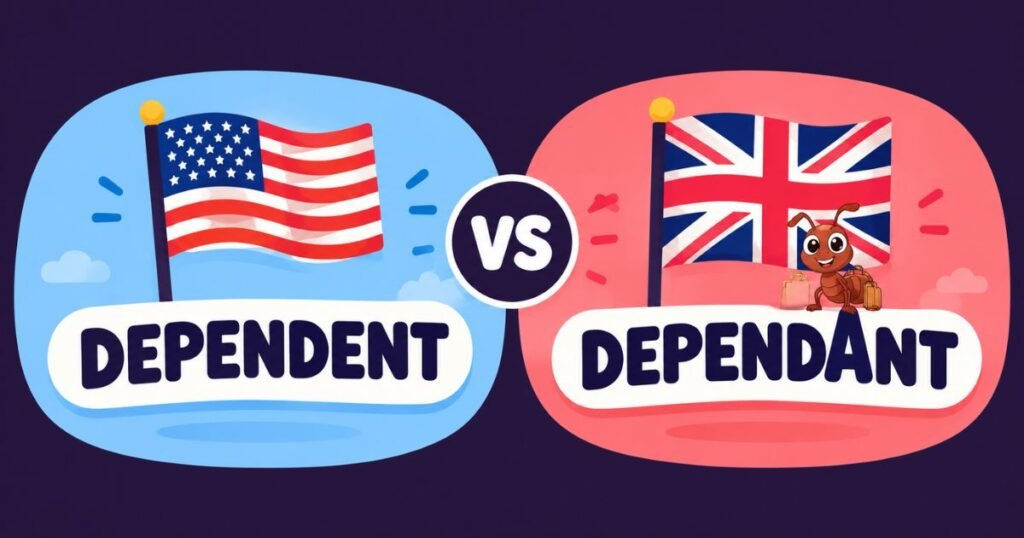
Dependent is correct in American English for both the adjective and the noun.
Dependant is a British English spelling used only as a noun, meaning a person who relies on someone else for financial support. If you write for a US audience, use dependent every time and you will never be marked wrong.
What Do Dependent and Dependant Mean?
Dependent as an adjective means relying on something or someone else, or being determined by something else. As a noun, it means a person who relies on another person for support, such as a child or a spouse.
Here are the main meanings in plain terms:
- Adjective: relying on or controlled by something else. Example: “My mood is dependent on how much coffee I had.”
- Adjective: conditional. Example: “The bonus is dependent on meeting the quarterly target.”
- Noun (US): a person supported by someone else. Example: “She claimed two dependents on her tax return.”
- Noun (UK): the same person, spelled dependant. Example: “He listed his dependants on the insurance form.”
That is the whole picture. One word, two spellings in the noun slot, and a regional split.
Where Do These Words Come From?
Both words trace back to the Latin verb dependere, which means “to hang from.” That image still works today, since a dependent person or thing literally hangs on something else for support.
The Latin root combines de (down) and pendere (to hang). English picked up the adjective form first, and later the noun sense appeared for a person who relies on another. The French present participle dependant also influenced English, which is why the noun spelling with an a stuck around in British usage. American English later simplified things by using one spelling for both roles. Less to memorize, fewer red squiggles.
The Grammar Breakdown: Adjective vs Noun
The easiest grammar rule is this: dependent can be an adjective or a noun, while dependant can only be a noun. If a word describes something, it must be dependent. If it names a person you support, either spelling may apply depending on your region.
Look at how the words behave in a sentence:
- “The project is dependent on funding.” (adjective, always dependent)
- “Each dependent must have a Social Security number.” (noun, US)
- “Each dependant must be named on the policy.” (noun, UK)
If the word sits before a noun or after a linking verb like is, seems, or remains, you are dealing with an adjective. That means dependent, with no exceptions in any country.
American English vs British English
In American English, dependent is the standard spelling for everything. In British English, dependant is the common spelling for the noun, and dependent stays for the adjective.
So a UK writer might use both in one sentence: “Her dependants are dependent on her salary.” A US writer would write: “Her dependents are dependent on her salary.”
It helps to know that Canadian, Australian, and Irish writers often follow the British pattern, though many Canadian style guides accept dependent for the noun too. When in doubt, check the style guide of the publication or client. For a US reader, dependent is always safe.
How to Use Dependent and Dependant at Work and in Daily Life
In professional writing, use dependent for taxes, insurance, contracts, and HR documents aimed at a US audience, and use dependant only when a UK source or style guide requires it. In casual writing, dependent works everywhere in the US.
Professional examples:
- “Add your dependents to the health plan during open enrollment.” (US)
- “Dependants may be eligible for a survivor’s pension.” (UK)
- “The launch date is dependent on legal approval.”
Casual examples:
- “I am totally dependent on my phone’s GPS.”
- “My dog is dependent on me for snacks and emotional support.”
Notice that the casual examples are all adjectives. Most everyday use falls here, which is why dependent wins the popularity contest by a wide margin.
Dependent vs Dependant Comparison Table
The table below shows which spelling fits each role and region at a glance.
| Use Case | American English | British English |
| Adjective (relying on) | dependent | dependent |
| Noun (person supported) | dependent | dependant |
| Plural noun | dependents | dependants |
| Opposite (adjective) | independent | independent |
| Related noun (state of relying) | dependence | dependence |
The last two rows are worth noticing. The opposite of dependent is always independent, never independant. The related noun dependence ends in ence in both countries.
Common Mistakes With Dependent and Dependant
The most common mistake is using dependant as an adjective, as in “I am dependant on coffee.” That is wrong in every English variety. Adjectives always take the e spelling.
Here are the slip ups to watch for:
- Dependant as an adjective: “The result is dependant on the weather.” Correct: dependent.
- Independant: The correct spelling is independent. Yes, this one gets people constantly.
- Dependance: The correct noun is dependence. Dependency is also valid and means a state of reliance or, in tech, a required software package.
- Mixing styles in one document: Using dependents in one paragraph and dependants in the next looks sloppy. Pick one regional style and keep it.
- Using dependant in a US tax or legal document: Forms from the IRS use dependent, so your copy should match.
A Real Life Example of Getting It Wrong
A wrong spelling will not ruin your life, but it can make a professional document look careless. Here is a small story that shows how.
Maya runs a small consulting business in Texas. She sends an onboarding guide to a new hire that says, “Your pay is dependant on completing your training and adding your dependants to the benefits form.” The new hire, who works in HR at his previous company, spots both errors immediately. He does not say anything, but he quietly wonders what else in the guide might be sloppy. Maya never finds out. A single letter changed the first impression.
The fix was easy: dependent in both spots for a US audience. One letter, one second, zero awkwardness.
Data and Trends: How Common Is This Mistake?
Dependent is far more common than dependant in published writing, news, and web content, and searches for the two terms often spike during tax season in the United States. That pattern makes sense, since people look up form terminology when deadlines get close.
General language corpus patterns point to a few useful takeaways:
- Dependent appears much more often than dependant because it covers the adjective, which is the most common use.
- Dependant shows up mainly in UK legal, insurance, and government writing.
- Misspellings like dependance and independant remain among the most searched spelling errors in this word family.
In short, if you pick dependent, you are using the form most readers expect.
A Memory Trick to Remember the Difference
The simplest memory trick is this: dependANT ends with ant, like assistant, servant, and tenant, which are all words for people. Dependent ends with ent, like student, which is also a person, but ent is the form that handles adjectives too.
Here is an easier version for US writers: forget the trick and just use dependent. Seriously. If you only ever write dependent, you are correct in American English every time.
For British writers, the memory trick helps in one specific case. When you mean a person you support, think of a tiny ant carrying food back to the colony. The little ant has dependants waiting. When you mean anything else, go with the e.
Step by Step Guide to Using Dependent and Dependant Correctly
To choose the right spelling, decide whether you need an adjective or a noun, then check which English your audience reads. This takes about five seconds once you practice.
- Ask what the word does. If it describes something or follows is, seems, or remains, write dependent.
- Check if it names a person. If it does, move to step three.
- Identify your audience. For US readers, write dependent. For UK readers, write dependant.
- Stay consistent. Apply the same choice to the plural and to the whole document.
- Run a quick search. Search your document for dependant and make sure each one is a noun in UK content.
Related Words: Dependence, Dependency, and Independent
Dependence and dependency are nouns that describe a state of relying on something, while independent is the adjective for the opposite. All three use the ence, ency, or ent endings, and none of them ever takes an a.
- Dependence: the state of relying on something. Example: “Our dependence on cloud storage keeps growing.”
- Dependency: a relationship of reliance, or a required component in software. Example: “The project has one outstanding dependency.”
- Independent: not relying on others. Example: “She runs an independent bookstore.”
Read More: Cacoon or Cocoon? Correct Spelling, Meaning & Memory Trick
Mini Quiz: Dependent vs Dependant
Try these seven questions before you scroll to the answers.
- In US English, which spelling names a child you financially support? (dependent or dependant)
- Pick the correct sentence: “The trip is dependant on the weather” or “The trip is dependent on the weather.”
- In British English, what is the noun spelling for a person who relies on you for support?
- Choose the correct opposite of dependent: independant or independent.
- Which is the correct noun for reliance: dependance or dependence?
- True or false: Dependant can be used as an adjective.
- A UK insurance form asks for your “dependants.” Which spelling would a US form use?
Answers:
- Dependent
- “The trip is dependent on the weather.”
- Dependant
- Independent
- Dependence
- False
- Dependents
Scored 6 or 7? You are officially more reliable than most spellcheckers.
FAQs
Is it dependent or dependant in American English?
It is dependent. American English uses this spelling for the adjective and the noun, so dependents is also the correct plural for people you support.
Is dependant ever correct?
Yes, but only as a noun in British English. It means a person who relies on another for financial support, such as a child or elderly parent. It is never correct as an adjective.
What is the difference between dependent and dependant in the UK?
In the UK, dependent is the adjective, and dependant is the noun. A sentence might read, “Her dependants are dependent on her income.”
Is it dependents or dependants on tax forms?
US tax forms use dependents. UK government forms use dependants. Always match the spelling used on the official form you are filling out.
Is dependent a noun or an adjective?
It can be both. As an adjective it means relying on something else. As a noun it means a person supported by someone else, which is the standard noun in American English.
Wrapping Up
Use dependent for the adjective in every English variety, and use it for the noun in American English. Reserve dependant for UK writing where the noun form is required. When you want to stay safe, remember that a US reader will never fault you for writing dependent.
Keep the independent and dependence spellings in mind too, since those catch writers off guard just as often. One letter, a few seconds of attention, and your writing looks sharp.

Albert is a dedicated meaning expert with over 6 years of experience researching word meanings, language usage, and definitions. At Mean Grid, he creates clear, accurate, and easy-to-understand content that helps readers explore the true meaning of words and phrases.