

You typed a sentence, stared at it, and suddenly both spellings looked wrong. Welcome to the club. English loves handing us pairs of words that look like twins and behave like strangers. The losing vs loosing question trips up students, professionals, and plenty of confident writers who swear they “just know” the answer.
The good news is that the rule is short. Once you see how each word works, you will spot the right one in about two seconds.
Quick Answer: Losing vs Loosing
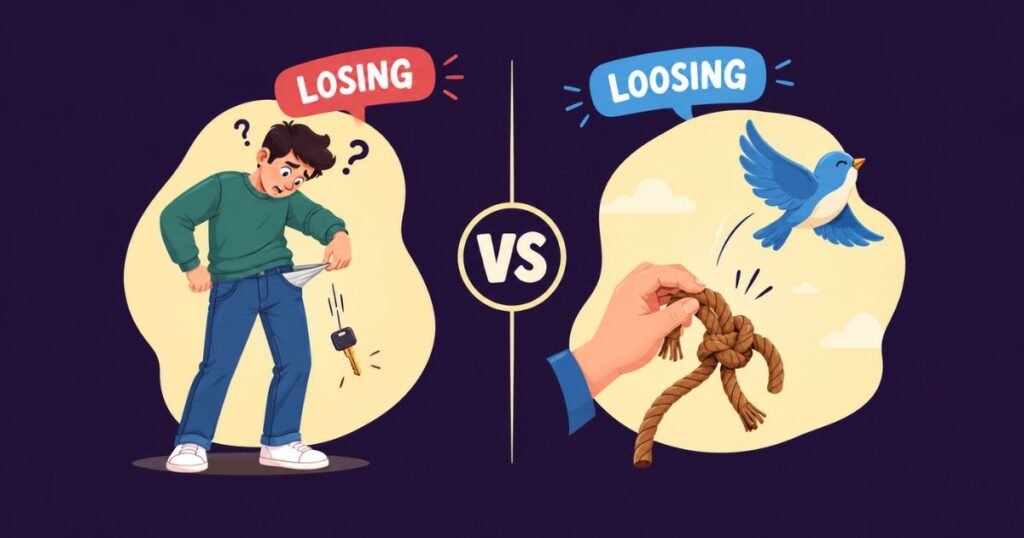
Losing means failing to win, misplacing something, or no longer having it.
Loosing means letting something go or setting it free. Most of the time, you want “losing.”
Example:
- “We keep losing our keys.”
- “He was loosing the dog from its leash.”
What Does Losing Mean?
Losing is the present participle of the verb “lose.” It describes the act of failing to keep, find, or win something.
You can use it in several ways:
- Defeat: “Our team is losing by two points.”
- Misplacing: “I am losing my mind looking for my phone.”
- Reduction: “She is losing weight.” “The company is losing money.”
- Emotional loss: “He is losing a close friend to a cross country move.”
- Time or ground: “The bus is losing time in traffic.”
As an adjective, it also appears in phrases like “a losing streak” or “a losing battle.” Both mean the outcome is heading in the wrong direction.
What Does Loosing Mean?
Loosing is the present participle of the verb “loose,” which means to release, untie, or set free. It is a real word, just a rare one.
Here is where it shows up:
- “The archer was loosing arrows at the target.”
- “The farmer is loosing the horses into the field.”
- “She spent the morning loosing the knots in the rope.”
- “The speech ended up loosing a wave of angry replies.”
Notice the pattern. Something is being freed, fired, or unfastened. If nothing is being released, “loosing” is almost certainly the wrong choice.
Read More: Cancellation vs Cancelation: Which Spelling Is Correct?
Where Do Losing and Loosing Come From?
The two words have different roots, which explains why they feel so different. “Lose” comes from the Old English word losian, which meant to perish or be destroyed. Over time, it settled into the idea of failing to keep something.
“Loose” arrived from Old Norse, where lauss meant free, untied, or without restraint. That is why “loose” still carries the sense of slack and freedom today.
So one word grew from the idea of losing something, and the other grew from the idea of being free. Different families, different jobs.
How the Grammar Works
Both words are present participles, so they follow the same pattern: base verb plus “ing.” The difference lies in the base verb.
- Lose (rhymes with “snooze”) becomes losing. The silent “e” drops before “ing.”
- Loose (rhymes with “goose”) becomes loosing. The “e” drops here too.
Here is the trap. “Loose” is also an adjective meaning not tight, as in “loose jeans.” That adjective is what most people reach for when they misspell “lose,” and it is why “loosing” sneaks in where “losing” belongs.
A quick related check: “loser” and “loss” both pair with “lose.” They never pair with “loose.”
How to Use Each Word in Real Life
Use “losing” for nearly every everyday situation, and save “loosing” for rare moments of releasing or untying something.
At work or in professional writing:
- “We are losing market share to a smaller competitor.”
- “The team is losing momentum on the project.”
- “Customers are losing patience with the delay.”
In casual conversation:
- “I’m losing it. That joke was too good.”
- “My dog keeps losing his favorite ball.”
- “Are we losing the game again?”
For “loosing,” the formal or literary side:
- “The captain ordered the crew to start loosing the sails.”
- “Loosing the straps made the load easier to carry.”
If you cannot picture something being untied, fired, or set free, switch to “losing.”
Losing vs Loosing Comparison Table
A side by side look makes the difference obvious. The table below covers the main forms people mix up.
| Word | Part of Speech | Meaning | Example Sentence |
| Lose | Verb | To fail to win or keep | “I always lose my umbrella.” |
| Losing | Verb or adjective | Failing to win or keep | “They are losing the match.” |
| Loose | Adjective | Not tight or not fixed | “This screw is loose.” |
| Loose | Verb | To release or set free | “They loose the balloons at noon.” |
| Loosing | Verb | Releasing or setting free | “He is loosing the rope.” |
| Loosen | Verb | To make less tight | “Loosen your tie.” |
| Loser | Noun | One who loses | “Nobody likes being the loser.” |
Common Mistakes with Losing and Loosing
The most common error is writing “loosing” when you mean “losing.” Spellcheck often misses it, because “loosing” is a legitimate word.
Watch for these slip ups:
- “I’m loosing my mind.” Correct: “I’m losing my mind.”
- “We are loosing customers.” Correct: “We are losing customers.”
- “She keeps loosing her glasses.” Correct: “She keeps losing her glasses.”
- “My jeans are losing.” Correct: “My jeans are loose.”
- “He is loosening the game.” Correct: “He is losing the game.”
Another frequent mix up is “lose” and “loose.” People write “I don’t want to loose,” when the sentence needs “lose.” Same cause, same fix.
A Real Example of Getting It Wrong
A small spelling slip can cost more than a red face. Picture Dana, a marketing manager, sending a quarterly update to her executive team.
She wrote: “We are loosing ground in the Midwest region.” The sentence went out to forty people. One executive replied, kindly, asking whether the company was setting its ground free. The thread turned into a joke, and the real message about falling sales got buried.
Dana fixed it in the next email. Lesson learned: a typo can steal attention from the point you are trying to make.
How Common Is This Mistake?
The confusion is common enough that style guides and grammar sites cover it regularly. Search behavior shows the pattern clearly: people look up “losing vs loosing,” “lose vs loose,” and “is loosing a word” again and again.
Three reasons explain why it keeps happening:
- The words look nearly identical, with only one letter “o” of difference.
- “Loose” is a very common word, so the brain autocompletes it.
- Spellcheck rarely flags “loosing,” since it is a valid spelling.
The mistake appears in emails, social posts, and student essays alike. You are in good company. You just do not want to stay there.
An Easy Memory Trick
Here is the shortcut: loose has extra room, and lose has lost an “o.”
Lose has one “o,” like something that went missing. Loose has two “o” letters, like a pair of loose jeans with space to spare.
You can also remember that “loosing” belongs to “loose,” so it needs a sense of freeing or untying. No release, no “loosing.”
Step by Step: Picking the Right Word
You can choose correctly in four quick steps.
- Ask yourself: is something being freed, untied, or fired? If yes, use loosing.
- If not, ask: is something being missed, misplaced, or defeated? Use losing.
- Say the word out loud. “Losing” sounds like “LOO zing.” “Loosing” sounds like “LOO sing.”
- When in doubt, choose losing. It fits about 95 percent of everyday sentences.
Read More: Manuel vs Manual: What’s the Difference and Which One Do You Need?
Mini Quiz: Losing or Loosing?
Pick the correct word for each sentence. Answers sit at the bottom.
- “Our team is ___ again this season.”
- a) losing
- b) loosing
- “The archer kept ___ arrows into the target.”
- a) losing
- b) loosing
- “I am ___ my patience with this traffic.”
- a) losing
- b) loosing
- “She spent an hour ___ the knots in the rope.”
- a) losing
- b) loosing
- “He worries about ___ his job.”
- a) losing
- b) loosing
- “The company is ___ money every month.”
- a) losing
- b) loosing
- “The farmer is ___ the cattle into the pasture.”
- a) losing
- b) loosing
Answers: 1) a, 2) b, 3) a, 4) b, 5) a, 6) a, 7) b.
FAQs
Is “loosing” a real word?
Yes. Loosing is the present participle of the verb “loose,” meaning to release or untie. It is rare, which is why it looks like a typo in most sentences.
Is it “losing” or “loosing” weight?
It is losing weight. Weight loss is about reducing or no longer having something, which always calls for “lose.”
What is the difference between lose and loose?
Lose is a verb that means to misplace or fail to win. Loose is usually an adjective that means not tight, and it can also be a verb that means to set free.
Is “loosing my mind” correct?
No. The correct phrase is losing my mind. You are not setting your mind free, at least not in the grammatical sense.
Do British and American English spell these differently?
No. Both varieties use the same spellings for losing and loosing, and the meanings are identical in both. The only difference is how often each word appears in writing.
Wrapping Up
The rule really is that simple. Losing is about failing to win or keep something, and loosing is about setting something free. Since the first covers almost every sentence you will write, default to it and you will be right far more often than wrong.
Next time your fingers hover between the two spellings, run the quick test. Is anything being untied or released? If not, go with losing and move on with your day.

Albert is a dedicated meaning expert with over 6 years of experience researching word meanings, language usage, and definitions. At Mean Grid, he creates clear, accurate, and easy-to-understand content that helps readers explore the true meaning of words and phrases.