

You are typing a quick email, your fingers outrun your brain, and suddenly you stare at a word that looks slightly off. Was it “wich” or “which”? That tiny doubt hits everyone, from students to seasoned editors.
The good news is that the answer is short and the rule never changes. This guide settles the wich or which question, shows you how to use the right word in real sentences, and gives you a few tricks so you never second guess it again.
Quick Answer: Wich or Which?
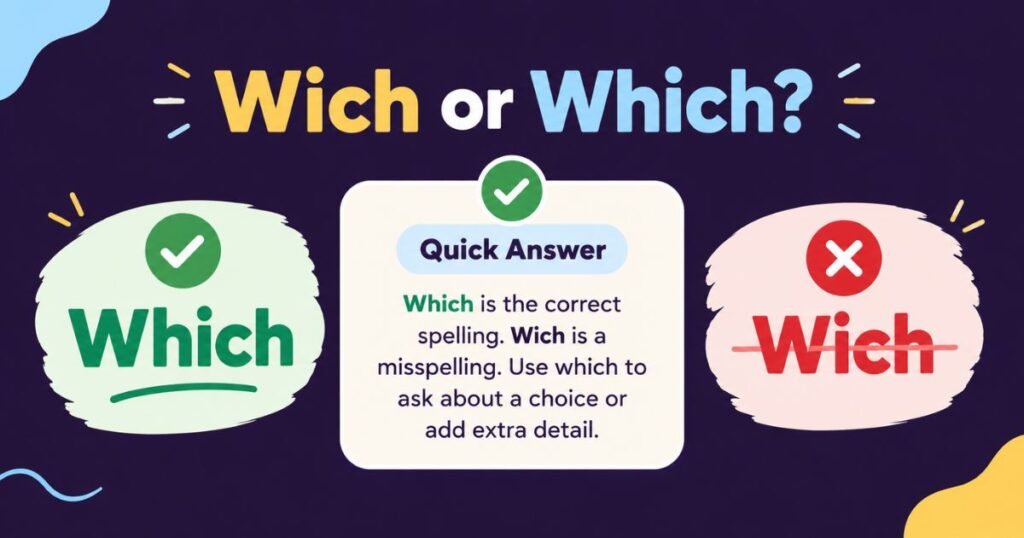
“Which” is the correct spelling. “Wich” is a misspelling in standard English, usually a typo caused by dropping the letter “h” in the middle. You use “which” to ask about a choice (“Which one do you want?”) or to add information to a sentence (“The book, which I loved, is on the table”).
What Does “Which” Mean?
“Which” is a word that points to a specific person, thing, or option out of a group. It works in three main ways.
- As a question word: “Which road leads to the airport?”
- As a relative pronoun: “My phone, which is three years old, still works fine.”
- As a determiner: “We stayed a week, during which time it never stopped raining.”
In every case, “which” narrows things down. It answers the quiet question, “Out of all the options, which one?”
Is “Wich” a Word?
No, “wich” is not a standalone word in standard English. You will not find it as an entry in major American dictionaries as a stand alone term, and spell checkers flag it right away.
So why does it look so familiar? Because the letters show up inside real words. “Sandwich,” “Greenwich,” “Norwich,” and “Ipswich” all end in “wich.” Your brain has seen that chunk a thousand times, so it feels legitimate. Inside those words it is fine. On its own, it is a typo.
You may also see “wich” as a brand name, a username, or a nickname. That is a creative choice, not a spelling rule.
Where Does “Which” Come From?
“Which” comes from Old English “hwilc,” which blended “hwi” (who or how) with “lic” (like). The original idea was something close to “of what kind?”
Over the centuries the spelling drifted through forms like “whilk” and “which” in Middle English before settling into the version we use now. The “wh” at the start is a leftover from the Old English “hw” sound. Many speakers today say “which” with the same sound as “witch,” because the old breathy “hw” sound faded in most American accents. That is exactly why people mix up the spelling: the ear hears “witch,” and the fingers guess.
How Does “Which” Work in Grammar?
“Which” is a pronoun and determiner used for things and choices, not usually for people. Here is the quick breakdown.
- Interrogative use: asks a question about a limited set. “Which flavor should we order?”
- Restrictive and nonrestrictive clauses: adds detail about a noun. “The car, which was red, sped past.”
- Determiner use: appears before a noun. “Which movie did you pick?”
A small but useful rule: when you add extra information that could be removed without breaking the sentence, “which” usually follows a comma. When the information is essential, American style guides often prefer “that” with no comma.
- Extra detail: “The report, which took two weeks, is finished.”
- Essential detail: “The report that took two weeks is finished.”
- Read More: Copy That vs Roger That: What’s the Difference?
How Do You Use “Which” in Professional and Casual Writing?
In both settings, “which” keeps its job: it picks something out of a group or adds extra detail. Only the tone around it changes.
Professional examples:
- “Please confirm which date works best for the meeting.”
- “The proposal includes three options, which are outlined below.”
- “We reviewed the contract, which was signed on Monday.”
Casual examples:
- “Which pizza place are we hitting tonight?”
- “I forgot my charger again, which is so typical of me.”
- “Which one of you ate my leftovers?”
Notice that nobody ever needs “wich” in any of these. Not in a boardroom, not in a group chat.
Wich vs Which vs Witch vs Whitch: What Is the Difference?
Only “which” is a correct spelling for the question and pronoun word; “witch” is a different word entirely, and “wich” and “whitch” are errors. This table puts the common versions side by side.
| Spelling | Correct? | Meaning or Use | Example |
| Which | Yes | Picks from a group or adds detail | “Which shirt looks better?” |
| Wich | No | Typo of “which” | “Wich shirt looks better?” (wrong) |
| Witch | Yes, but different word | A person who practices magic | “The witch stirred the pot.” |
| Whitch | No | Mix of “which” and “witch” | “Whitch one is mine?” (wrong) |
| Sandwich | Yes | A food made with bread | “I packed a turkey sandwich.” |
British and American English agree here. There is no regional variation of “which” that drops the “h.”
What Are the Most Common Mistakes With “Which”?
The most common mistakes are dropping the “h,” confusing it with “witch,” and misplacing commas. Watch for these.
- Typing “wich” instead of “which.” Usually a speed typo.
- Writing “witch” when you mean “which.” Spell check will not catch this because “witch” is a real word. “Witch one do you want?” is a classic.
- Using “which” for people. Use “who” instead. “The teacher who helped me” sounds right; “the teacher which helped me” does not.
- Skipping the comma before extra detail. “My laptop which is old still works” needs a comma after “laptop” and after “old.”
- Mixing up “which” and “that.” If the detail is essential, “that” often fits better in American English.
Real Life Example: When a Tiny Typo Costs You
A single missing letter can make a professional message look careless. Picture Dana, who runs a small bakery and is emailing a wedding client about cake options.
She writes: “Please let me know wich flavor you prefer.” She hits send without rereading. The client, who is already nervous about her wedding details, notices it. Then she notices another small slip further down. By the third one, she starts wondering whether the bakery is as careful with ingredients as it is with emails.
Dana did not lose the order. But she did spend a follow up call rebuilding confidence that one proofreading pass would have protected. Small errors rarely sink anything, but they quietly change how people read the rest of your work.
How Common Is the “Wich” Mistake?
“Wich” is a frequent typo, and it shows up often enough that search engines and word processors treat it as a known misspelling. People looking up “wich or which” are usually not struggling with grammar. They are doing a quick sanity check.
A few patterns explain why the mistake sticks around.
- Dropped letters: The “h” in the middle is easy to skip when typing fast.
- Sound based spelling: “Which” and “witch” sound identical for most American speakers, so spelling by ear leads to guesses.
- Look alike words: “Sandwich,” “Norwich,” and similar words make “wich” look normal.
Autocorrect catches “wich” in most apps. The trouble starts when you turn it off or write in a plain text field.
What Is an Easy Memory Trick for “Which”?
Remember that “which” has “wh” at the front, just like the other question words: who, what, when, where, and why. If you are asking a question, it almost always starts with “wh.”
Here is a second trick. Look at the middle of the word. It has an “h” that sits in the center, almost like a little chair. “Which” has two h’s, one at the start (in “wh”) and one inside “ch.” If your version has only one, you wrote “wich.”
A third one, if you like silly memory aids: “Which witch is which?” Three spellings, two meanings, and one very confusing sentence. If you can write that sentence correctly, you have mastered the word.
Step by Step: How to Use “Which” Correctly
To use “which” correctly, decide whether you are asking a question or adding detail, then spell it with “wh” and “ch.” Follow these steps.
- Check your sentence goal. Are you asking about a choice, or adding extra information?
- Spell it “w h i c h.” Count the letters: five, with an “h” in the middle and at the end.
- Make sure you are not talking about a person. If you are, use “who.”
- Check for commas. Extra detail usually needs a comma before “which.”
- Reread once. Take ten seconds to look for “wich” or “witch” before you hit send.
Read More: Losing vs Loosing: Which Is Correct? Easy Rules + Examples
Mini Quiz: Wich or Which?
Test yourself with these seven questions, then check the answers below.
- “Please tell me ___ option you prefer.” (which / wich)
- “The ___ in the story flew on a broom.” (which / witch)
- Which spelling is correct: “Wich one is yours?” or “Which one is yours?”
- “The movie, ___ I watched twice, was great.” (which / who)
- True or false: “Wich” is accepted in standard American English.
- “I ate a turkey ___ for lunch.” (sandwich / sandwhich)
- “The coach ___ trained us was patient.” (which / who)
Answers:
- which
- witch
- “Which one is yours?”
- which
- False
- sandwich
- who
If you got six or seven right, you are in great shape. Five or fewer? Reread the memory trick section and try again.
FAQs
Is it “wich” or “which”?
It is “which.” “Wich” is a spelling mistake and not a word in standard English, except inside words like “sandwich” or place names like “Greenwich.”
What is the difference between “which” and “witch”?
“Which” is a question word and pronoun used to pick from a group. “Witch” is a noun for a person who practices witchcraft. They sound the same, but the meanings have nothing in common.
When should I use “which” instead of “that”?
Use “which” for extra information set off by commas, and “that” for essential information with no comma. “The bike, which is blue, is mine” adds a detail. “The bike that is blue is mine” identifies the bike.
Can you use “which” for people?
Generally no. Use “who” or “whom” for people. The one exception is when you are choosing from a group, as in “Which of the candidates do you support?”
Is “wich” ever correct in British English?
Not as a standalone word. British English also spells it “which.” You will see “wich” only in place names and words like “sandwich,” where it is a normal ending.
Conclusion
The wich or which debate has a simple winner: “which” every time. “Wich” belongs inside “sandwich” and on road signs for English towns, not in your emails, essays, or captions.
If you remember one thing, make it the “wh” family of question words. Add a quick proofread, and the typo disappears. Keep this guide handy, and you will never have to type “wich or which” into a search bar again.

Albert is a dedicated meaning expert with over 6 years of experience researching word meanings, language usage, and definitions. At Mean Grid, he creates clear, accurate, and easy-to-understand content that helps readers explore the true meaning of words and phrases.