
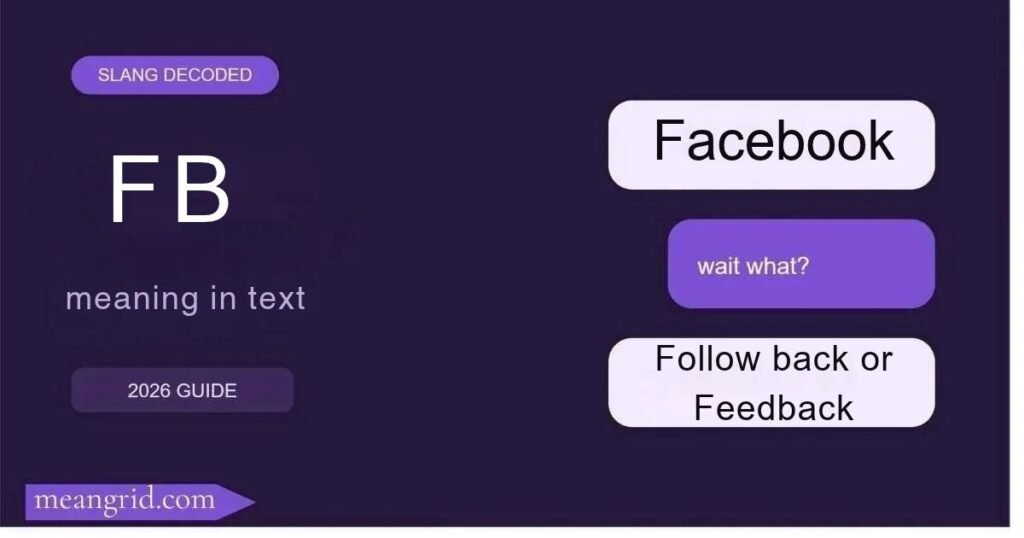
FB most often stands for Facebook. On Instagram, TikTok, and X, it usually means follow back, and in work chats it can mean feedback. Say a friend texts, “Did you see it on FB?” That’s Facebook.
A stranger comments “Love this! FB” under your post? That’s a request to follow back. Same two letters, very different jobs. The trick is knowing where the message shows up and what’s around it. This guide covers every real meaning, where each one fits, and how to reply without sounding confused.
FB Meaning in Text and Definition
FB is a two letter abbreviation with three everyday meanings. Facebook is the default, follow back is the social media favorite, and feedback is the work version.
| Meaning | Where it shows up | Example |
| Texts, DMs, captions | “Add me on FB.” | |
| Follow back | Instagram, TikTok, X comments | “Love this! FB?” |
| Feedback | Work chats, marketplaces | “Need your FB by Friday.” |
| Casual sexual partner | Adult dating chat, rare | “Not looking for an FB.” |
The last one is adult slang, and you’ll rarely meet it outside dating conversations.
What Does FB Mean on Facebook?
On Facebook itself, FB is just a nickname for the site. You’ll see it in group posts and Marketplace listings, like “Selling this on FB Marketplace.”
It also works as a verb. “I’ll FB you” means “I’ll message you on Facebook,” and “FB stalking” means scrolling through someone’s profile. Profiles on Facebook can be followed too, so a follow back request can pop up there as well.
Read More: GC Meaning in Text: Group Chat Explained With Reply Examples
Where Does FB Come From?
Facebook launched in 2004 as a college network, and people shortened the name the way they shorten anything they type every day. The company renamed its parent business Meta in 2021, but the app kept the name Facebook, so the nickname stuck around.
Follow back arrived later, once apps built around follower counts turned returning a follow into a social habit. Feedback has been trimmed to FB in reviews and seller ratings for years.
Examples of FB in Conversation
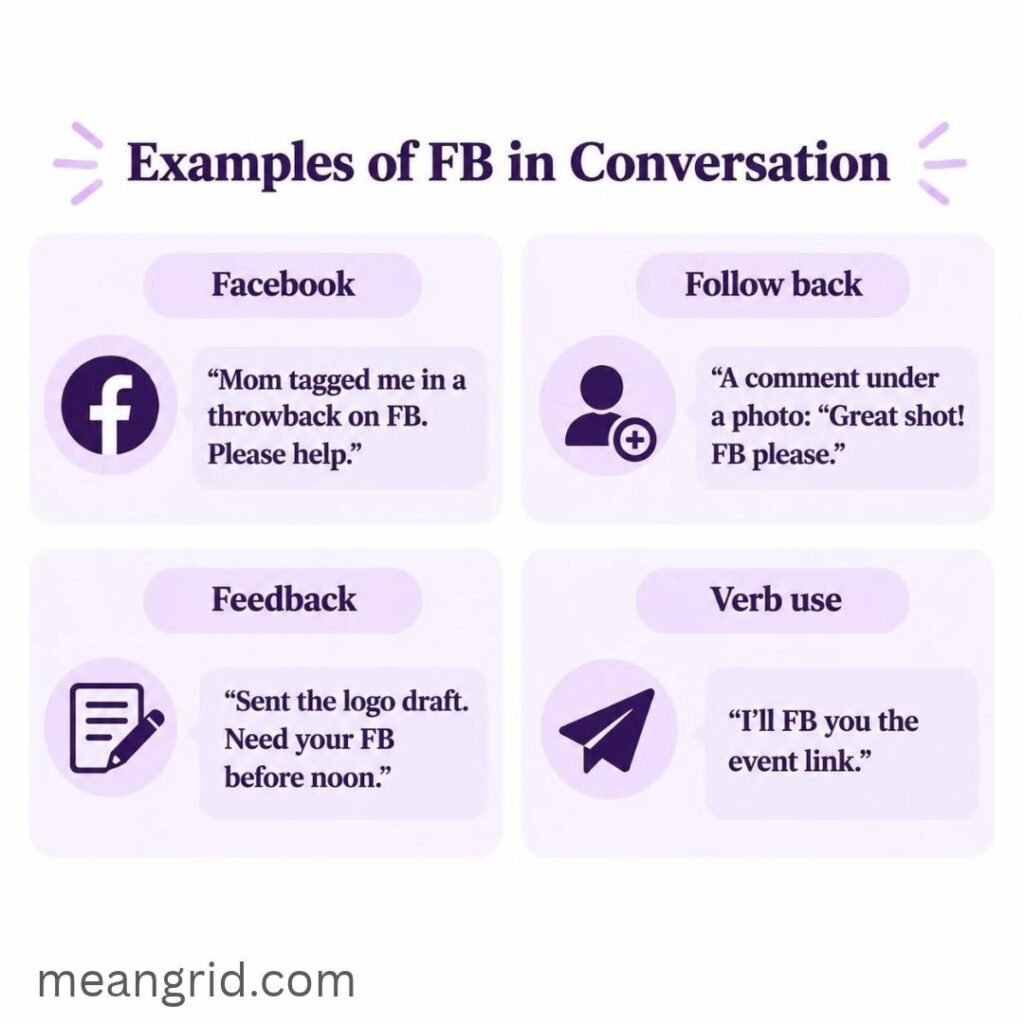
- Facebook: “Mom tagged me in a throwback on FB. Please help.”
- Follow back: A comment under a photo: “Great shot! FB please.”
- Feedback: “Sent the logo draft. Need your FB before noon.”
- Verb use: “I’ll FB you the event link.”
Each line points to a different meaning, and none of them needs an explanation once you see where it was sent.
When to Use and When Not to Use FB
Shorthand works when both people share the code. That goes for any abbreviation, from FB to WYTB.
Use it when:
- You’re texting friends who already use Facebook
- You’re commenting on a peer’s post
- You’re in a casual group chat
Skip it when:
- You’re writing a work email (write out “feedback”)
- You’re messaging a stranger on a dating app, where it can be misread
- Your reader may not know slang, like a relative or a customer
How Is FB Used in Different Contexts?
The fastest shortcut is to think about who you’re talking to.
- Friends and family: Almost always Facebook. “Check the family group on FB.”
- Buying and selling: Facebook Marketplace or seller feedback. “Please leave FB after pickup.”
- Work: Feedback. “Can I get your FB on the deck?”
- Dating chat: Usually Facebook, as in swapping profiles. If the tone is flirty and the talk is already about casual hookups, it can be the adult slang.
FB Meaning on Snapchat, TikTok, Instagram, WhatsApp
| Platform | Most likely meaning | Why |
| Snapchat | People move chats to another app. “Add back” is Snapchat’s own phrase. | |
| TikTok | Follow back | Comments and bios are built around growing followers. |
| Follow back | Same habit, often dropped under a post. | |
| Facebook or feedback | The app is built around contacts, not followers, and it shares a parent company with Facebook. |
These are tendencies, not rules. Read the sentence, not just the app.
FB Meaning in Professional or Technical Fields
A few real alternate meanings exist, but you’ll only meet them in specific settings:
- Feedback in workplace chats and reviews
- Fullback in football position shorthand
- Foreign body in medical notes
- Facebook’s old stock ticker. Meta switched its Nasdaq ticker from FB to META in December 2022.
None of these will show up in a normal text. If you see one, the setting makes it obvious.
How to Tell What FB Means: A Four Check Decoder
Most guides list the meanings and stop. Here’s the method you actually need when a message lands and you can’t tell which FB you’re looking at. Run these four checks in order.
- Platform. A public comment on Instagram or TikTok leans follow back. A private text leans Facebook.
- Words next to it. “On FB,” “my FB,” “FB me,” and “FB link” mean Facebook. A bare “FB” after a compliment means follow back. “FB by Friday” means feedback.
- Sender. A friend probably means Facebook. A stranger commenting on your post probably wants followers. A coworker means feedback.
- Punctuation and timing. “FB?” right after someone follows you is a request. “Thanks for the FB” comes after you followed someone back.
| Clue | Likely meaning |
| FB right after a compliment | Follow back |
| “On FB” or “FB me” | |
| FB plus a deadline | Feedback |
| Flirty tone on a dating app | Adult slang, so confirm before replying |
One more thing most guides skip: you don’t owe anyone a follow back. Accounts that drop FB on dozens of posts are commonly chasing numbers, so check their profile before you decide.
Common Misunderstandings About FB
- “FB always means Facebook.” It doesn’t. Context decides.
- “It changes with the sender’s gender.” It doesn’t. A girl and a guy use it the same way.
- “It’s rude.” Not by itself. Tone matters, the same way a blunt IHY can read as a joke between close friends and an insult from someone else.
- “It’s the same as FWB.” It isn’t. FWB always means friends with benefits, while FB has several meanings.
FB vs Similar Terms
| Term | Meaning | How it differs from FB |
| F4F | Follow for follow | Offers a trade up front. FB asks after you’ve followed. |
| LB | Like back | Asks for likes, not follows. |
| FBF | Flashback Friday | A hashtag for old photos. |
| FWB | Friends with benefits | One meaning, always about relationships. |
How to Respond to FB
Match your reply to the meaning:
- “Are you on FB?” → “Yep, search my name and send a request.”
- “Just followed you, FB?” → “Following you now.” (Or skip it if you’re not interested.)
- “Need your FB on this draft.” → “Looks solid. Tighten the intro and you’re set.”
- A lone “FB?” you can’t place → “FB as in Facebook or follow back?”
Tips for Using FB Naturally
- Match the platform. Use it for follow back on Instagram, not in a work email.
- Add a context word. “FB link” or “on FB” removes the doubt.
- Keep the tone relaxed, like a quick reply such as NTM.
- Don’t copy and paste it under strangers’ posts. It reads as spam.
- Spell it out when you’re unsure your reader will get it.
FAQs
What does FB mean in text?
FB usually means Facebook. In comments on Instagram or TikTok it means follow back, and at work it can mean feedback.
What does FB mean on Instagram?
On Instagram, FB means follow back. Someone followed you and wants you to return the favor.
Does FB mean Facebook or follow back?
Both, depending on where it appears. Mentions of profiles, messages, or posts point to Facebook, while a lone FB in a comment points to follow back.
Is FB slang for something inappropriate?
Sometimes. In adult dating chat, FB can be slang for a casual sexual partner, but that’s uncommon outside that setting.
What does FB mean in a text from a girl or a guy?
Nothing different. FB means the same thing no matter who sends it, so check the platform and the words around it.
Conclusion
FB looks simple, but it carries at least three real meanings. Facebook is the default in plain texts, follow back rules comment sections on Instagram and TikTok, and feedback shows up in work and marketplace chats.
Check the platform, read the words around it, and think about who sent it. When you still can’t tell, ask. A quick “Facebook or follow back?” costs five seconds and saves you an awkward reply. Spell it out for anyone outside your circle.

Albert is a dedicated meaning expert with over 6 years of experience researching word meanings, language usage, and definitions. At Mean Grid, he creates clear, accurate, and easy-to-understand content that helps readers explore the true meaning of words and phrases.