
🥰 meaning in text refers to the smiling face with hearts emoji, officially known as “Smiling Face with Smiling Eyes and Three Hearts.” It shows warm, positive feelings like love, affection, or deep appreciation. People send it when a message feels too sweet for plain words, whether that’s romantic, friendly, or just wholesome.
Say your best friend sends a photo of her new puppy and you reply “🥰,” you’re not confessing your love for her. You’re saying the picture melted your heart. That’s the range this emoji covers, and it’s why context always decides what it actually means.
🥰 Meaning & Definition
At its core, 🥰 shows a face with closed, happy eyes and three small hearts floating around it. It sits between a simple smile and a full-on declaration of love. Think of it as warmer than 😊 but softer than ❤️ or 😍.
People use it to express:
- Romantic affection or a crush
- Gratitude toward a friend or family member
- Excitement over something adorable, like a pet or a baby
- General admiration for a photo, outfit, or achievement
The emoji doesn’t have one fixed meaning. It has a mood, and that mood shifts depending on who sends it and why.
Where Does 🥰 Come From?
The emoji was approved under Unicode 11.0 in 2018, alongside a wave of new emotional expressions added that year. Before 🥰 existed, people leaned on 😍 or multiple heart emojis stacked together to show that same soft, affectionate tone.
Once 🥰 launched, it filled a real gap. It let people express warmth without sounding overly intense like ❤️ or overly excited like 😍. Its popularity grew fast on dating apps and social platforms, where a gentler way to say “this makes me happy” was missing.
Examples of 🥰 in Conversation
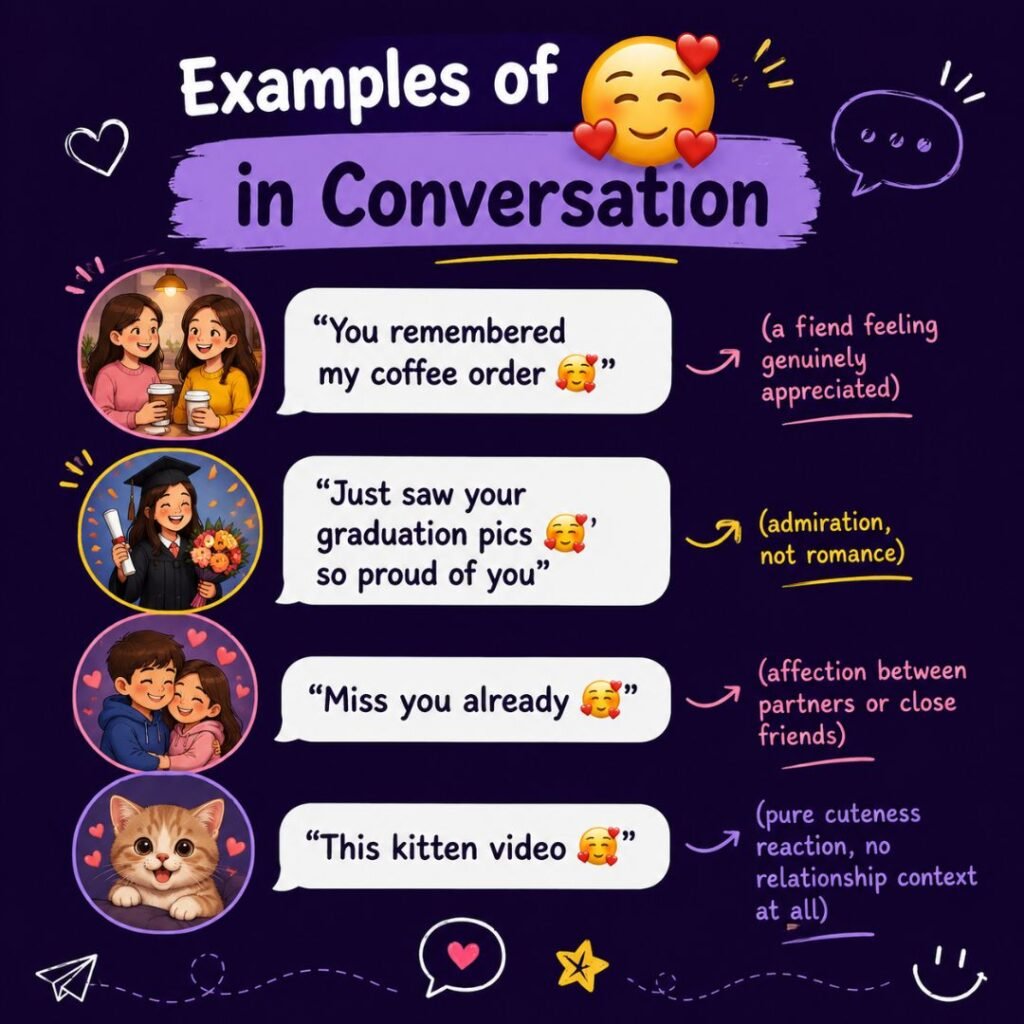
Real texting scenarios make the meaning click faster than any definition. Here’s how it plays out:
- “You remembered my coffee order 🥰” (a friend feeling genuinely appreciated)
- “Just saw your graduation pics 🥰 so proud of you” (admiration, not romance)
- “Miss you already 🥰” (affection between partners or close friends)
- “This kitten video 🥰” (pure cuteness reaction, no relationship context at all)
Notice how none of these require a romantic backstory. The emoji flexes to match the emotional temperature of the message it’s attached to.
When to Use and When Not to Use 🥰
Use 🥰 when a message needs extra warmth that plain words can’t fully carry. It works well after a compliment, a kind gesture, or something genuinely touching.
Skip it in situations where tone matters a lot, like a first message to someone you barely know, a formal work email, or a serious conversation. Dropping 🥰 into a tense text can come across as dismissive or confusing, since it signals softness the moment doesn’t call for.
How Is 🥰 Used in Different Contexts?
Context changes everything with this emoji. Here’s a quick breakdown:
| Context | Typical Meaning |
| Between close friends | Appreciation, comfort, inside-joke warmth |
| Early dating or flirting | Interest without pushing too hard |
| Established couples | Comfortable affection, a digital hug |
| Family group chats | Love, pride, or excitement over updates |
| Social media comments | Public admiration for a post or photo |
The same three-hearts face can mean “I adore you” in one thread and “that’s adorable” in another. That flexibility is the whole point of the emoji.
🥰 Meaning on Snapchat, TikTok, Instagram, WhatsApp
Platforms shape tone even when the emoji itself never changes.
- WhatsApp: Feels more personal since conversations tend to be one-on-one. A 🥰 here usually signals real, direct affection.
- Instagram: Common in comments under photos. It’s often a public compliment rather than a private confession.
- TikTok: Used casually to react to cute or funny content. It rarely carries deep emotional weight here.
- Snapchat: Fits the platform’s fast, casual pace. It shows an in-the-moment reaction more than a planned statement.
Reading the platform alongside the message helps you avoid overthinking a single emoji.
🥰 Meaning in Professional or Technical Fields
There’s no official technical or professional definition tied to 🥰. It carries no meaning in fields like medicine, aviation, or finance. In workplace chat tools, it occasionally shows up in casual, friendly exchanges between coworkers who already have an informal rapport, but it stays rare in anything formal.
The Official Name, Unicode Code, and How to Type 🥰
Most guides skip the technical side of this emoji entirely, but it helps to know the basics. The official Unicode name is “Smiling Face with Smiling Eyes and Three Hearts,” registered under code point U+1F970 as part of Unicode 11.0.
Rendering differs slightly by platform. Apple’s version mirrors its regular smiling face design, while the heart color and placement shift a bit across Microsoft, Google, and Samsung devices. Microsoft, for example, has used pink-toned hearts instead of the more common red.
Typing it is simple once you know the shortcut:
- iPhone: Open the emoji keyboard and search “hearts” or “love”
- Android: Tap the emoji icon and search “smiling face with hearts”
- Windows: Press Windows key + period, then search “hearts”
- Mac: Press Control + Command + Spacebar, then search “hearts”
You can also copy and paste it directly: 🥰
Common Misunderstandings About 🥰
A few myths keep circulating around this emoji, so it’s worth clearing them up.
Myth: 🥰 always means romantic interest. Reality: friends, siblings, and coworkers use it constantly without any romantic angle attached.
Myth: sending it a lot means someone is desperate or overly attached. Reality: emoji frequency usually reflects someone’s texting style more than the intensity of their feelings.
Myth: 🥰 and ❤️ mean the exact same thing. Reality: ❤️ reads as more direct and serious, while 🥰 carries a lighter, gentler tone.
🥰 vs Similar Terms and Alternatives
Comparing 🥰 to its closest emoji relatives makes its specific tone easier to pin down.
| Emoji | Tone | Best Used For |
| 🥰 Smiling Face with Hearts | Warm, gentle affection | Everyday appreciation or soft romance |
| 😍 Heart Eyes | Intense attraction or excitement | Reacting to something visually striking |
| ❤️ Red Heart | Direct, serious love | Clear romantic or deep emotional statements |
| 😊 Smiling Face | Friendly, mild positivity | Casual, low-key kindness |
🥰 sits comfortably in the middle of that scale, more expressive than a plain smile but softer than a full heart.
How to Respond to 🥰
A reply doesn’t need to overthink the moment. A few natural options:
- Mirror it back with your own 🥰 or ❤️
- Reply with a short, warm line like “you’re too sweet”
- Keep it light with “aww, stop it” if you want to stay playful without escalating
If the message feels one-sided or confusing, a simple “that’s so kind of you” keeps things friendly without committing to a tone you’re not sure about.
Tips for Using 🥰 Naturally
Let the words carry most of the meaning and use 🥰 to add a finishing touch, not to replace the message entirely. Save it for moments that genuinely feel warm rather than sprinkling it into every text out of habit.
Pay attention to how the other person uses emojis too. Matching their style, whether that’s minimal or expressive, keeps the conversation feeling natural instead of mismatched.
FAQs
What does 🥰 mean from a friend?
From a friend, 🥰 usually shows appreciation, comfort, or excitement, not romantic interest.
Is 🥰 more serious than ❤️?
No, 🥰 is generally softer and lighter than ❤️, which reads as more direct and intense.
Can 🥰 be used in a professional setting?
It’s uncommon in formal settings, though it sometimes appears in casual chats between coworkers who already have a relaxed rapport.
Does using 🥰 a lot mean someone likes you more?
Not necessarily. Frequency often reflects someone’s general texting style rather than the strength of their feelings.
What’s the difference between 🥰 and 😍?
🥰 shows gentle affection and warmth, while 😍 shows stronger excitement or attraction toward something.
Conclusion
🥰 is a flexible emoji that signals warmth, affection, or admiration depending on who sends it and where. It works for romance, friendship, family, and everyday kindness alike.
Reading the relationship and platform around it is the real key to understanding what someone means.

Albert is a dedicated meaning expert with over 6 years of experience researching word meanings, language usage, and definitions. At Mean Grid, he creates clear, accurate, and easy-to-understand content that helps readers explore the true meaning of words and phrases.