
Two words that look like twins and sound like cousins, yet they have almost nothing in common. That is the whole problem with eminent vs imminent. Your spellchecker won’t save you, because both are real words, and a single wrong letter can turn a respected scholar into a looming disaster.
Maybe you’re proofreading a press release. Maybe you just heard “eminent domain” on the news and wondered why it isn’t “imminent domain.” Either way, this guide sorts it out fast, with examples, a memory trick, and a quiz at the end.
Quick Answer: Eminent vs Imminent
Eminent means famous, respected, or standing out in a field.
Imminent means about to happen very soon, usually something threatening or important.
An eminent surgeon has a great reputation. An imminent storm is about to hit. One describes status, the other describes timing. If you can swap in “distinguished,” use eminent. If you can swap in “about to happen,” use imminent.
What Does Eminent Mean?
Eminent is an adjective meaning high in rank, reputation, or achievement, someone or something that stands above others in a positive way.
It usually describes people, especially in professional or academic settings. You’ll see it attached to scientists, judges, authors, and historians. Here are a few examples:
- The eminent physicist gave the keynote speech.
- She became an eminent voice in modern architecture.
- Several eminent scholars signed the open letter.
Eminent can also describe qualities, as in “an eminent sense of fairness,” though that use is less common. Think of it as a polite way to say someone is a very big deal.
What Does Imminent Mean?
Imminent is an adjective meaning about to happen, close in time, and often unavoidable or threatening.
Nobody says “imminent” about a sale on socks. It carries a sense of pressure, like the thing is already on its way. Common pairings include imminent danger, imminent threat, imminent arrival, imminent collapse, and imminent deadline.
- Dark clouds meant rain was imminent.
- The company warned that layoffs were imminent.
- With the due date imminent, she finally opened the document.
The key idea is time. Imminent does not say how good or bad something is, only that it’s nearly here.
Read More: Sometime vs Some Time: What’s the Difference and When to Use Each
Where Do These Words Come From?
Both words trace back to Latin, and both share the root minere, which means “to jut out.” That shared root is exactly why they look so alike.
Eminent comes from the Latin eminere, meaning “to stand out” or “to project.” Picture a mountain peak rising above the rest of the range. A person who stands out in their field is eminent in the same way.
Imminent comes from the Latin imminere, meaning “to overhang” or “to threaten.” Picture a cliff leaning over your head. Something hanging over you is about to fall, which is how the word came to mean “about to happen.”
So one word sticks out upward, and the other looms overhead. Same bones, very different jobs.
Grammar Breakdown: Parts of Speech and Word Forms
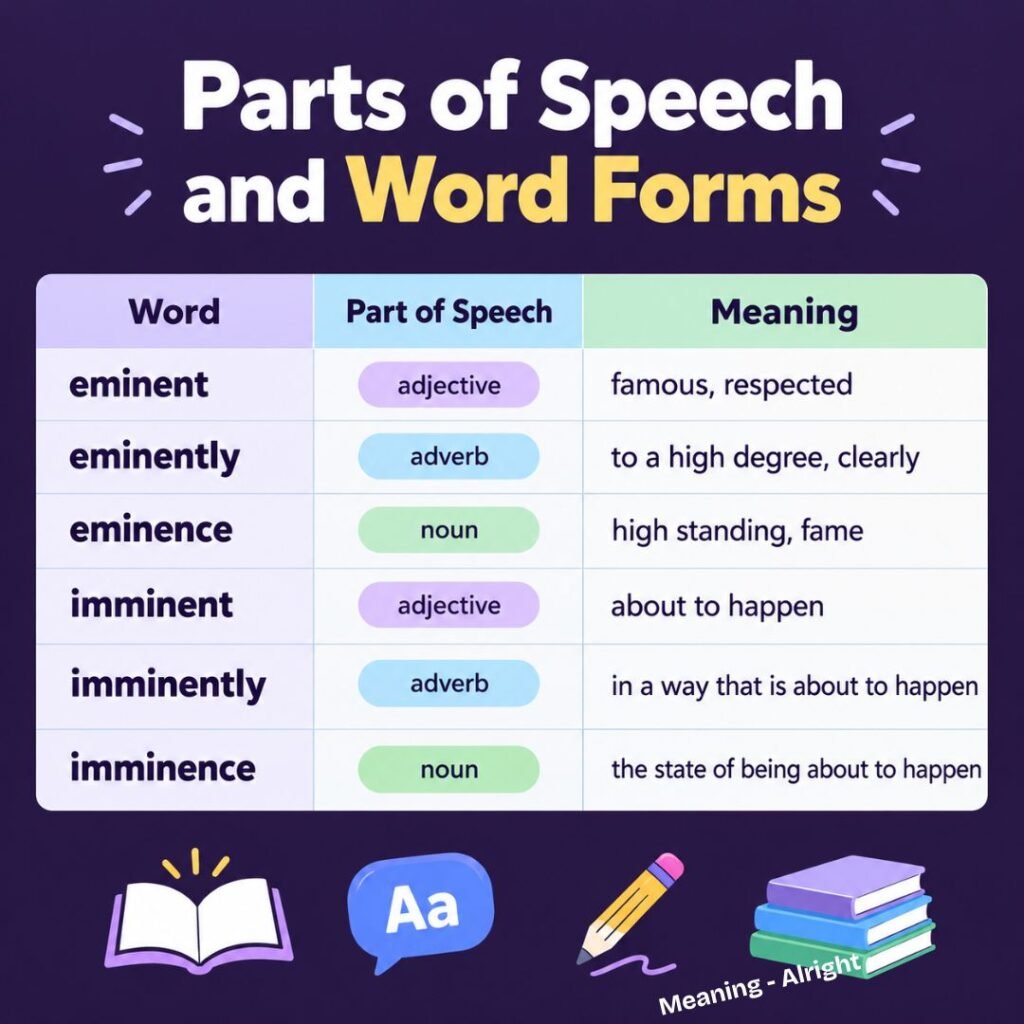
Both words are adjectives, which means they describe nouns. Each also has an adverb form and a noun form, and mixing those up causes its own set of errors.
| Word | Part of Speech | Meaning |
| eminent | adjective | famous, respected |
| eminently | adverb | to a high degree, clearly |
| eminence | noun | high standing, fame |
| imminent | adjective | about to happen |
| imminently | adverb | in a way that is about to happen |
| imminence | noun | the state of being about to happen |
A few grammar notes worth knowing:
- Eminent usually sits before a noun (an eminent author) or after a linking verb (she is eminent).
- Imminent works the same way (an imminent threat, the threat is imminent).
- “Eminently” is far more common than “imminently.” You’ll see phrases like “eminently qualified” or “eminently reasonable.”
- “Preeminent” means surpassing all others, a step above eminent.
How to Use Eminent and Imminent in Professional Writing
In professional writing, use eminent to praise credentials and imminent to flag urgency. Getting these right protects your credibility, especially in formal documents.
Eminent in professional contexts:
- “The panel includes three eminent economists.”
- “He is an eminent authority on maritime law.”
- “We are honored to welcome an eminent guest speaker.”
Imminent in professional contexts:
- “The system failure appears imminent, so please back up your files.”
- “The board announced that a merger was imminent.”
- “Legal counsel advised that action was imminent.”
There is also the legal phrase eminent domain, which is the government’s power to take private property for public use, with payment to the owner. It uses eminent because the power comes from the highest authority, the state. Nothing about it is “about to happen.”
- Read More: Imminent Danger vs Immediate Danger
How to Use Eminent and Imminent in Casual Conversation
In everyday talk, imminent shows up when something is about to go wrong or about to be awkward. Eminent tends to appear when you’re being a little fancy, or a little sarcastic.
- “My mom’s visit is imminent, so I’m cleaning like it’s a crime scene.”
- “Pizza delivery is imminent. Please act normal.”
- “He’s the eminent expert on who ate the last cookie.”
Using eminent in casual speech can sound formal, so a pinch of humor helps. Imminent fits naturally in almost any tone because everyone understands the feeling of something rushing toward them.
Eminent vs Imminent Comparison Table
This table shows the two words side by side so you can scan the differences in seconds.
| Feature | Eminent | Imminent |
| Core meaning | Famous, respected | About to happen |
| Focus | Reputation and rank | Timing |
| Tone | Positive, admiring | Often tense or urgent |
| Pronunciation | EM uh nunt | IM uh nunt |
| Latin root | eminere (stand out) | imminere (overhang) |
| Usually describes | People, authorities | Events, dangers, deadlines |
| Example | An eminent professor | An imminent deadline |
| Related adverb | eminently | imminently |
Common Mistakes with Eminent and Imminent
The most common mistake is writing one word when you mean the other, because one swapped letter looks harmless. Here are the errors that show up most often.
1. Using imminent for a famous person.
- Wrong: “The imminent author signed copies.”
- Right: “The eminent author signed copies.”
2. Using eminent for something about to happen.
- Wrong: “The eminent arrival of winter.”
- Right: “The imminent arrival of winter.”
3. Mixing up eminent domain.
- Wrong: “The city used imminent domain to build the highway.”
- Right: “The city used eminent domain to build the highway.”
4. Confusing both with immanent.
Immanent means existing within something, a more philosophical word. It rarely appears outside academic writing, but it trips people up because it’s a third lookalike.
5. Spelling slips.
People sometimes write “iminent,” “eminant,” or “immenent.” The correct spellings are eminent and imminent, with a double m in the second one.
- Read More: Learnt vs Learned
A Real Life Example: When One Letter Changes Everything
Picture Marcus, a junior assistant at a small PR firm. His boss asks him to finish a press release before the weekend. He writes: “We are thrilled to announce the imminent Dr. Alvarez will speak at our gala.”
The release goes out. Within an hour, a reporter emails asking if Dr. Alvarez is, in fact, about to arrive at the gala or about to do something terrible to it. A colleague replies all with a single question mark. Marcus quietly considers a career in beekeeping.
The fix was one letter. “The eminent Dr. Alvarez” would have made her sound distinguished. “The imminent Dr. Alvarez” made her sound like a weather system. That is the real cost of this mix-up. It rarely ruins anything, but it can make a polished message look careless, and readers remember that.
Data and Trends: How Often Do People Confuse These Words?
Eminent and imminent are a classic confusable pair, and they appear on many usage guides and editing checklists for that reason. Because both are valid English words, standard spellcheck tools cannot catch the error. A sentence with the wrong choice still looks fine to software.
Search behavior around this pair tends to follow a few patterns:
- People search the comparison directly (“eminent vs imminent”) when editing a document.
- Many searches pair the two words with a third, “immanent.”
- Searchers often want a pronunciation, since the first vowel sounds are nearly identical.
- Legal phrases like “eminent domain” drive extra interest, because readers wonder why it isn’t “imminent.”
For exact monthly volumes, a tool like Google Trends or your preferred keyword platform will give you current numbers. What the pattern shows is that people don’t need a long lecture. They need a clean answer, a few examples, and a trick that sticks.
Memory Trick: How to Remember Eminent vs Imminent
The easiest trick is to link the first letters to the meaning. It takes about five seconds to learn and works every time.
- Eminent starts with E, like excellent or exalted. Think of someone with a great reputation.
- Imminent starts with I, like “It’s In a moment.” Think of something about to happen.
Here is a second option. Imminent has mm in the middle, which looks like two little waves rolling toward the shore. Something is coming. Eminent has just one m, a single peak standing tall above the rest.
Pick whichever feels more natural. Both work.
Step by Step Guide to Using Eminent and Imminent Correctly
Follow these four steps whenever you hit the choice in a sentence. It takes a few seconds once you get used to it.
- Read the sentence and find what you’re describing. Is it a person, a field, or a reputation? Or is it an event, a danger, or a deadline?
- Try swapping in “famous or respected.” If the sentence still makes sense, use eminent.
- Try swapping in “about to happen.” If that fits better, use imminent.
- Check your spelling. Eminent has one m in the middle, and imminent has two.
Quick test: “The ___ scientist arrived.” A scientist can be respected, so eminent works. But “The ___ storm arrived” needs imminent, because storms don’t have reputations (unless it’s a hurricane with a name).
Mini Quiz: Eminent vs Imminent
Choose eminent or imminent for each blank. Answers are listed at the end.
- The ___ historian published her tenth book.
- A thunderstorm seemed ___, so we packed up the picnic.
- The city used ___ domain to claim the land.
- His ___ departure left the team scrambling.
- She is an ___ authority on climate science.
- The warning said that danger was ___.
- The award went to an ___ chef from Chicago.
- With the deadline ___, he skipped lunch.
Answers:
- eminent (a respected historian)
- imminent (the storm was about to arrive)
- eminent (the legal term)
- imminent (the departure was about to happen)
- eminent (a respected authority)
- imminent (the danger was about to happen)
- eminent (a distinguished chef)
- imminent (the deadline was near)
FAQs
What is the difference between eminent and imminent?
Eminent means famous or highly respected, while imminent means about to happen very soon. One describes reputation, and the other describes timing.
How do you pronounce eminent and imminent?
Eminent is pronounced EM uh nunt, and imminent is pronounced IM uh nunt. Only the first syllable changes, so say it slowly.
Is it “eminent domain” or “imminent domain”?
It is eminent domain, the government’s power to take private property for public use with payment. Imminent domain is a common misspelling.
Can imminent be used for good things?
Yes. Imminent only means about to happen, so it fits good news too, like an imminent promotion, though it often sounds urgent.
What is the difference between eminent, imminent, and immanent?
Immanent means existing within something, mostly in philosophy. Eminent means respected, and imminent means about to happen. Everyday writing rarely needs immanent.
Conclusion
Eminent describes someone or something that stands out for being respected. Imminent describes something that is about to happen. That’s it.
When you’re stuck, ask whether you mean “distinguished” or “about to happen,” and remember that imminent has the double m, like two waves heading for shore. Get that right and your writing stays sharp, your press releases stay calm, and nobody mistakes a respected professor for an approaching storm.

Albert is a dedicated meaning expert with over 6 years of experience researching word meanings, language usage, and definitions. At Mean Grid, he creates clear, accurate, and easy-to-understand content that helps readers explore the true meaning of words and phrases.