

You see it in a text, a caption, or a song title, and suddenly your brain stalls. Is it feen or fein? Both look believable, and both get used all over the internet.
Here’s the good news. One of them is the common slang spelling, the other belongs mostly to German, and the “proper” English word is neither. Stick around and you’ll know exactly which one to type, why people mix them up, and how to never second guess it again.
Quick Answer: Feen or Fein?
Feen is the spelling most people use for the slang verb meaning to crave something badly, as in “I’m feening for tacos.” Fein is a German word meaning “fine,” plus a surname. In formal English, the standard word behind the slang is fiend.
So for casual writing, pick feen. For anything formal, write fiend or rephrase the sentence.
What Do Feen and Fein Actually Mean?
Feen means an intense craving or a person who can’t get enough of something, while fein means “fine” or “delicate” in German. They sound close in English, which is why the confusion exists.
Here’s how each one breaks down:
- Feen (slang): to crave, want, or chase something intensely. Also a noun for a person who does that.
- Fein (German): fine, delicate, elegant, or refined. Also a family name.
- Fein (slang variant): a less common spelling of feen, mostly found on social media.
- Feen (German): the plural of “Fee,” which means fairies.
Yes, that last one is real. If you ever land on a German fairy tale site, “Feen” is just a group of fairies minding their own business.
Where Did the Word Feen Come From?
Feen is a respelling of fiend, a word with roots in Old English and older Germanic languages. Over time, the slang pronunciation drifted into its own spelling.
Fiend comes from the Old English word fēond, which meant enemy or foe, and later the devil. It traces back to an ancient Germanic root tied to hatred. By the late 1800s, English speakers were attaching it to habits and obsessions, giving us phrases like “dope fiend” and later “fresh air fiend.”
The modern slang took off in American speech, especially in Black American English and hip hop culture. People started saying “fiend” as “feen” because that’s how it sounds when said fast: rhymes with “mean,” with the “d” quietly dropped. Social media then locked the spelling in place.
Fein has a completely separate history. It’s a German adjective that sits close to English “fine” in both sound and meaning. Same neighborhood of the alphabet, different planet.
How Does the Grammar Work?
Feen works as both a verb and a noun in casual English, and it follows regular verb rules. Fein, as a German word, stays an adjective.
Here’s the slang verb in action:
- Base form: feen (“I always feen for fries after midnight.”)
- Third person: feens (“She feens for new sneakers.”)
- Past tense: feened (“He feened for that burger all day.”)
- Present participle: feening (“Stop feening and just order it.”)
The word nearly always shows up with the preposition for. You feen for something. You don’t just feen something. As a noun, you’ll hear “a feen” or “such a feen,” usually teasing someone about their habit.
Quick grammar note: the same pattern applies to fiend. “Fiending for coffee” is correct, and it’s the safer spelling if you want to avoid arguments in the comments.
Read More: Swifty or Swiftie? The Correct Spelling for Taylor Swift Fans
How Do You Use Feen in Real Sentences?
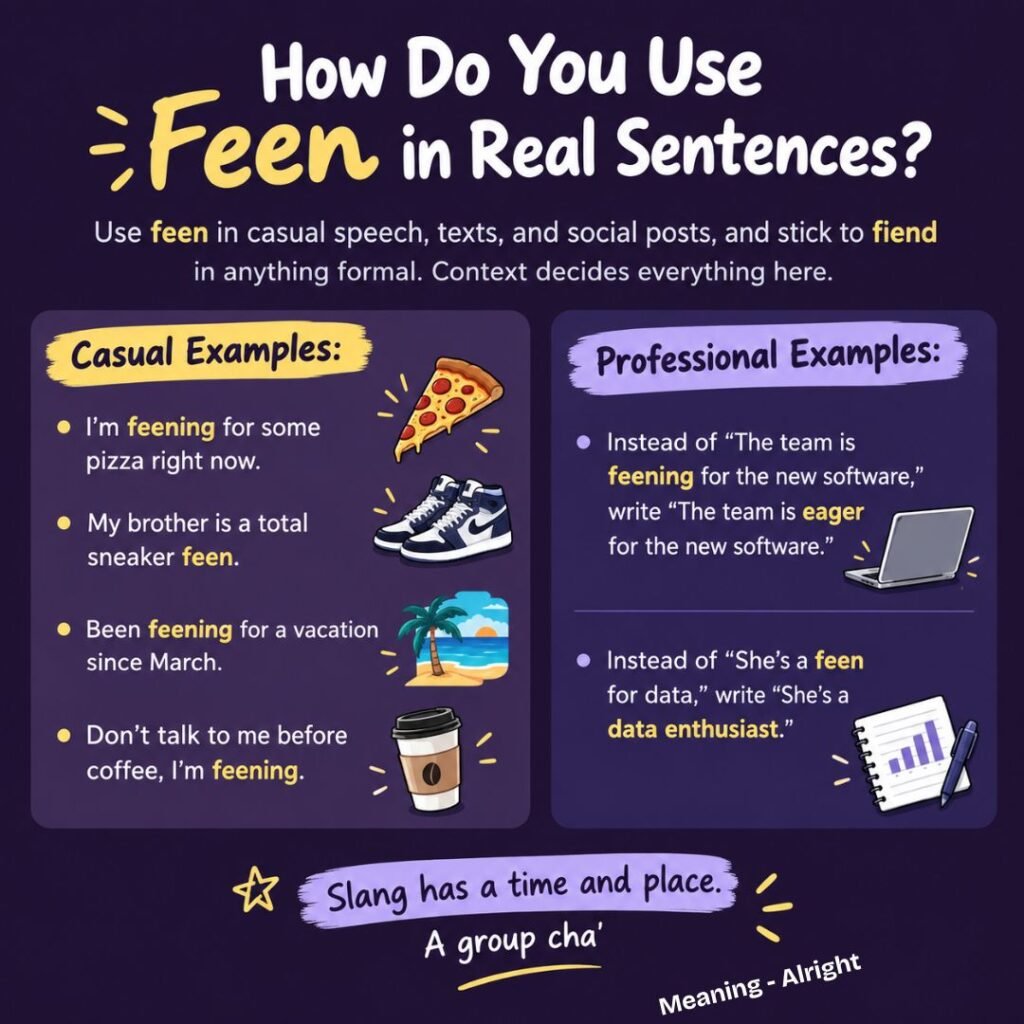
Use feen in casual speech, texts, and social posts, and stick to fiend in anything formal. Context decides everything here.
Casual examples:
- “I’m feening for some pizza right now.”
- “My brother is a total sneaker feen.”
- “Been feening for a vacation since March.”
- “Don’t talk to me before coffee, I’m feening.”
Professional examples:
- Instead of “The team is feening for the new software,” write “The team is eager for the new software.”
- Instead of “She’s a feen for data,” write “She’s a data enthusiast.”
Slang has a time and place. A group chat is fine. A cover letter is not. And your boss probably doesn’t want to read “feening” in a quarterly report, no matter how accurate it feels.
Feen vs Fein vs Fiend: A Quick Comparison Table
This table shows which word to use in each situation so you can scan and move on.
| Word | Language | Meaning | Example | Use it when |
| Feen | American slang | Crave intensely | “I’m feening for sushi.” | Casual writing |
| Fein | German | Fine, delicate | “Das ist fein.” | Writing German, or a surname |
| Fein | Slang variant | Same as feen | “He’s feining for a snack.” | Rare, usually avoidable |
| Fiend | Standard English | Devil, addict, or enthusiast | “A coffee fiend.” | Formal or edited writing |
| Feen | German | Fairies (plural of Fee) | “Die Feen tanzen.” | German context only |
| Fine | English | Good, thin, or a penalty | “That’s fine.” | The everyday English word |
If you only remember one row, remember this: slang gets feen, formal gets fiend, and fein belongs to German.
What Are the Most Common Mistakes?
The biggest mistake is writing fein when you mean the slang word, followed by mixing up fein with plain old “fine.” Both slip through spell check because they look like real words.
Watch for these:
- Writing “fein” in English slang. Both spellings float around online, but feen is the one most readers recognize first.
- Typing “feind” or “fien.” These are typos, not variants. Neither is correct.
- Using feen in formal writing. It reads as too casual almost everywhere outside social media.
- Confusing fein with Sinn Féin. The Irish political party uses the Irish word féin, meaning “self,” with an accent mark. It has nothing to do with the slang.
- Dropping the preposition. “I’m feening pizza” sounds off. “I’m feening for pizza” sounds right.
- Mixing it up with fiend in meaning. A “fiend” in standard English can be a cruel person. A “feen” in slang is usually just someone who really wants a snack.
What Does a Real Mistake Look Like?
A small spelling slip can change how people read you, and sometimes the cost is just a few raised eyebrows. Here’s a story that happens more than you’d think.
Maya runs a small bakery account on Instagram. One morning she posts, “We’re fein for fresh croissants, are you?” Within an hour, a follower comments, “Is this a German bakery?” Another writes, “Did you mean fine?” A third just drops a laughing emoji.
Her post was meant to sound playful and current. Instead, the caption sent people into a spelling debate under her photo. She edited it to “We’re feening for fresh croissants” and the comments calmed down, though one regular kept calling her “the fein lady” for a week. Nothing terrible happened. But the engagement she wanted, hungry customers, turned into a grammar side quest. That’s the quiet cost of picking the wrong version.
How Common Is the Feen vs Fein Confusion?
The confusion is common because the slang is widely used while its spelling has never been standardized. People search both versions because they’ve seen both.
Several things push the confusion along:
- Music and pop culture. Song titles and lyrics spell the slang in different ways, and fans copy what they see.
- Fast typing. On phones, “ee” and “ei” swap easily when you’re typing without thinking.
- German influence. Many people know “fein” from German class or words like “fein” in recipe names, which makes it look legitimate.
- No official dictionary rule. Because the slang is informal, dictionaries focus on fiend and leave the respelling to common usage.
Exact search volume numbers change month to month, so for the latest data, a free tool like Google Trends will show you how often each spelling gets searched in the US. What you’ll typically notice is that both forms show up, which is exactly why a clear answer is useful.
How Can You Remember Which One to Use?
Link feen to “extreme eager need.” The double e is the clue: two e’s, double the craving.
Here are a few tricks that stick:
- Feen has two E’s, and so does “need.” Double e means double desire.
- Fein has an I, like “fine.” If you see the I, think German or think “fine.”
- When in doubt, say fiend. It’s always correct, and nobody ever argues with a dictionary spelling.
- Rhyme check. Feen rhymes with “mean” and “green.” German fein rhymes with “mine” and “line.”
If your brain wants a one liner, try this: “Feen is for cravings, fein is for Germans.” It’s silly, which is exactly why it works.
What Is the Step by Step Way to Use It Correctly?
Decide your audience first, then pick the spelling that matches. It takes about five seconds once you get the hang of it.
- Check the setting. Is this a text, caption, or casual post? Or a report, email, or essay?
- Casual setting: use feen, and add “for” when you name the thing you want.
- Formal setting: use fiend or swap in a plain word like “eager,” “crave,” or “enthusiast.”
- German text: use fein for “fine” and Feen for fairies, capitalized because German nouns always start with capitals.
- Reread once. Make sure the word fits the tone around it.
Following those five steps will save you from 99 percent of embarrassing edits.
Can You Pass the Feen or Fein Mini Quiz?
Try these seven questions, then check the answers below. No cheating, though honestly, nobody’s watching.
1. Which spelling is the common slang form for craving something?
- A) Fein
- B) Feen
- C) Fien
2. What does the German word “fein” mean?
- A) Fairy
- B) Fine or delicate
- C) Friend
3. Which standard English word is the slang based on?
- A) Fiend
- B) Feign
- C) Fiend and feign are both correct
4. Pick the correct sentence.
- A) I’m feening pizza.
- B) I’m feening for pizza.
- C) I’m feening of pizza.
5. In German, what does “Feen” mean?
- A) Fairies
- B) Friends
- C) Fines
6. Which spelling should you use in a formal report?
- A) Feen
- B) Fein
- C) Fiend, or a plainer word
7. Does the Irish party name “Sinn Féin” relate to the slang word?
- A) Yes
- B) No
Answers
- B, feen is the common slang spelling.
- B, it means fine or delicate.
- A, fiend is the standard word.
- B, “for” is the natural pairing.
- A, Feen is the plural of Fee, meaning fairies.
- C, formal writing calls for fiend or a simpler word.
- B, no, féin is an Irish word meaning “self.”
Six or seven correct? You’re set. Four or five? Reread the memory trick section and try again.
FAQs
Is it feen or fein in slang?
Feen is the common slang spelling for craving something badly. Fein is a rarer variant that readers mistake for the German word.
Is feen a real word?
Yes, feen is real slang used widely in American English. Dictionaries list fiend as the standard form, so feen stays informal.
How do you pronounce feen and fein?
Feen rhymes with mean. The German word fein sounds like English fine, and the German plural Feen sounds like FAY en.
What does feening mean?
Feening means craving something intensely or acting obsessed with it, as in feening for pizza. It is usually playful, depending on context.
Is it fiend or feen?
Fiend is the dictionary spelling and works anywhere. Feen is the casual respelling for texts and captions, so choose fiend when unsure.
Conclusion
Feen is the slang spelling you want for cravings, fein is German for “fine,” and fiend is the dictionary word hiding behind it all. Match the spelling to the setting and you’re done.
Next time someone argues about it in your comments, you can calmly drop the Old English history and let them sort it out. And if you’re still feening for a little more grammar help, these are worth a look:

Albert is a dedicated meaning expert with over 6 years of experience researching word meanings, language usage, and definitions. At Mean Grid, he creates clear, accurate, and easy-to-understand content that helps readers explore the true meaning of words and phrases.