
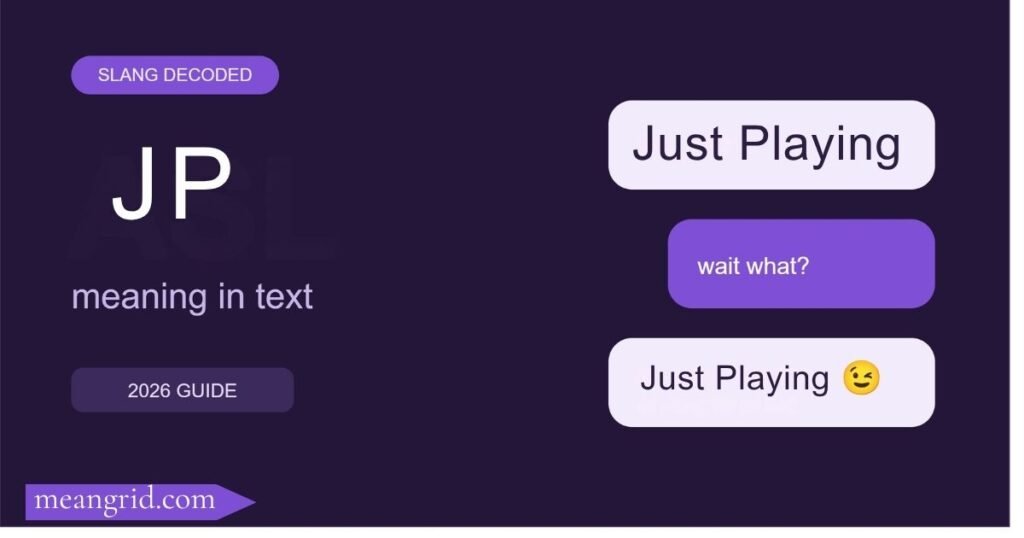
JP in a text almost always means “just playing.” People type it right after a joke, a tease, or a sarcastic comment to let you know they weren’t being serious. It can also stand for Japan in gaming or travel chats, though that meaning shows up far less often.
You’ll spot JP on Snapchat, TikTok, Instagram, and group texts where quick, casual replies are the norm. Once you know the context, it’s simple to read and even easier to use yourself.
JP Meaning & Definition
At its core, JP means “just playing.” It’s a small phrase with a big job: telling the other person that whatever was just said shouldn’t be taken to heart.
Think of it as a tone marker. Texting strips out facial expressions and voice inflection, so JP fills that gap. It works like a verbal wink, letting someone know a comment was meant to tease, not hurt.
JP does have a second, less common meaning. In gaming servers, anime forums, and travel talk, it can simply mean Japan. Context tells you which one applies almost instantly.
Where Does JP Come From?
JP grew out of the same texting habits that gave us LOL, BRB, and JK. As SMS character limits pushed people to shorten everything, playful phrases got trimmed down too.
“Just kidding” became JK first. JP followed a similar path, though it carries a slightly softer, more playful tone than its older cousin. Teens and young adults picked it up through instant messaging apps, then carried it into Snapchat and TikTok as those platforms took over casual communication.
By the mid-2020s, JP had settled into everyday digital language, especially among Gen Z users who value quick, low-effort ways to signal humor.
Examples of JP in Conversation
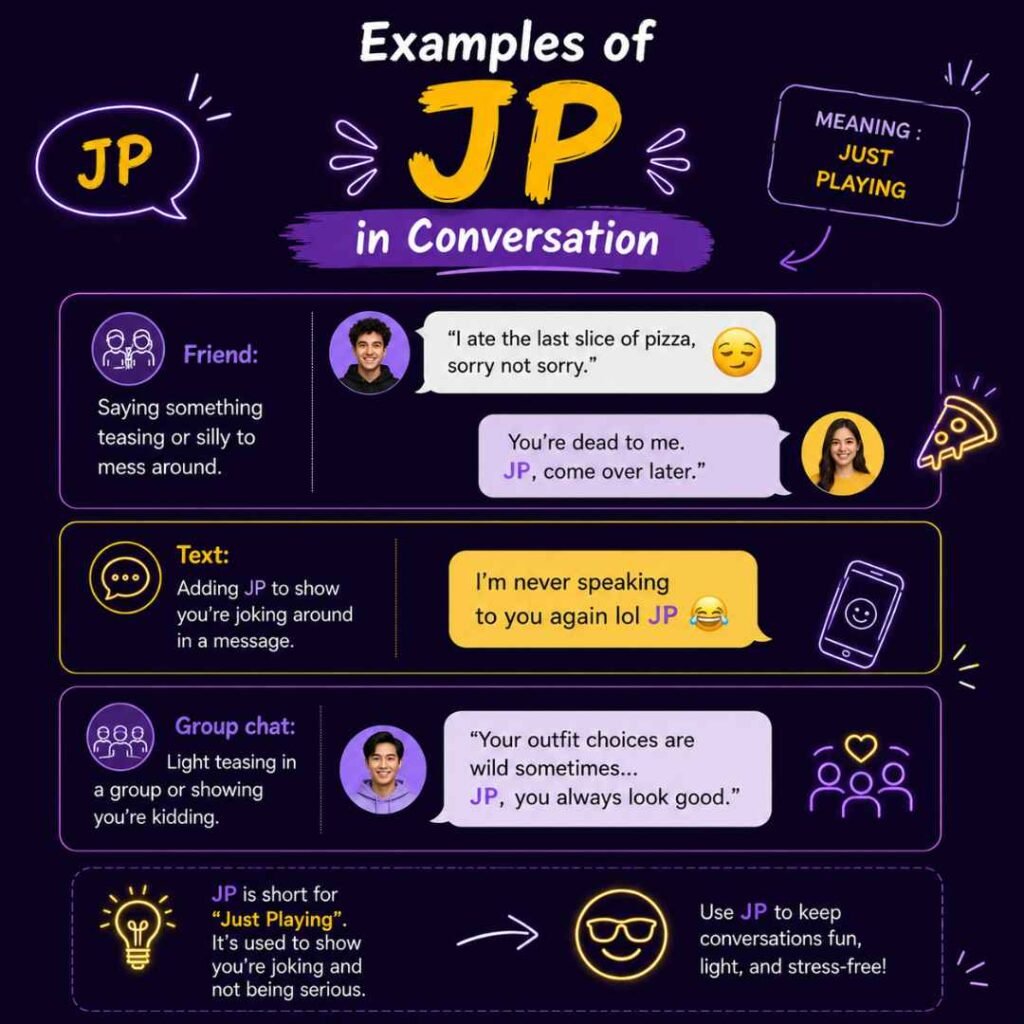
Seeing JP in action makes the meaning click fast. Here are a few real-style exchanges:
- Friend: “I ate the last slice of pizza, sorry not sorry.” You: “You’re dead to me. JP, come over later.”
- Text: “I’m never speaking to you again lol JP 😂”
- Group chat: “Your outfit choices are wild sometimes… JP, you always look good.”
In each case, JP softens a line that could otherwise sound harsh or too blunt in writing.
When to Use and When Not to Use JP
JP works best in casual, friendly settings where teasing is already part of the relationship. It’s great for lightening a joke that might land wrong without extra context.
Skip it in situations where tone confusion could cause real problems. Avoid JP with people you don’t know well, in formal emails, or in any conversation where sarcasm might not translate.
A quick rule: if you’d hesitate to tease someone in person, don’t rely on JP to soften it over text either.
How Is JP Used in Different Contexts?
JP shifts slightly depending on where you see it:
- Casual texting: The most common home for JP, usually paired with an emoji or “lol.”
- Gaming chats: Can mean Japan, especially with server names or regional game editions.
- Group chats: Often used to defuse group teasing before it feels personal.
- Comment sections: Signals that a bold statement was meant as a joke, not a real jab.
The surrounding words almost always make the intended meaning obvious within a sentence or two.
JP Meaning on Snapchat, TikTok, Instagram, WhatsApp
Each platform uses JP a little differently, but the “just playing” meaning dominates everywhere.
- Snapchat: Since snaps disappear fast, JP acts as a quick tone clarifier before the moment is gone.
- TikTok: Shows up in comments after exaggerated or sarcastic reactions, often layered with irony.
- Instagram: Common in comment threads to keep playful roasting from turning into an actual argument.
- WhatsApp: Used in group chats to soften teasing between friends or family members who know each other well.
Across all four, JP does the same basic job: it tells the reader not to take the last message too seriously.
JP Meaning in Professional or Technical Fields
Outside of slang, JP shows up in a few real-world contexts. In business documents, it can stand for job position, especially on forms or internal paperwork. In legal and government settings, JP sometimes refers to a justice of the peace.
These meanings have nothing to do with texting slang, and mixing them up rarely causes confusion since the settings are so different. Still, it’s worth knowing JP isn’t only internet shorthand.
How JP Shows Up on Dating Apps
This is where JP gets more interesting, and it’s a context most guides skip entirely.
On apps like Hinge, Tinder, and Bumble, JP carries a slightly different flavor than it does between old friends. Early in a match, teasing is risky since there’s no established rapport yet. JP acts as a safety net, letting someone flirt or joke without seeming too intense too fast.
Used well, it keeps banter light and low-pressure. Used badly, or too early, it can come across as someone testing the waters without committing to a real opinion.
A few dating-specific patterns worth knowing:
- Early matches often use JP to soften bold compliments: “You’re actually kind of perfect, JP… unless?”
- It can signal playful interest without full vulnerability.
- Overusing it can make a person seem unsure of their own jokes, which sometimes reads as low confidence.
If someone sends JP after a flirty line, it usually means they’re testing the vibe, not backing away from it entirely.
Common Misunderstandings About JP
The biggest mix-up happens when someone reads JP as cold or dismissive instead of playful. Tone is already hard to read in text, and a poorly timed JP can make a joke feel like it’s being taken back rather than softened.
Another common issue: using JP in a message that wasn’t actually a joke. If the sentence before it sounds genuine, adding JP afterward just creates confusion instead of clarity.
Age gaps matter too. Older users sometimes read JP as more formal or unclear, while younger users treat it as second nature. When in doubt, a quick follow-up like “haha for real though” can clear things up fast.
JP vs Similar Terms
JP isn’t the only tone-softening abbreviation out there. Here’s how it compares to its closest relatives:
| Term | Meaning | Typical Tone |
| JP | Just playing | Soft, playful teasing |
| JSP | Just playing | Slightly more direct, corrective |
| LOL | Laughing out loud | General humor marker |
| NP | No problem | Casual reassurance, not humor |
JK tends to feel like a correction, walking something back. JP feels more like a wink, letting the joke stand while softening the delivery.
How to Respond to JP
Replying to JP is easy once you know it’s just a tone signal. A few natural responses:
- “Lol you got me, ok.”
- “I know, I know, jp back at you.”
- “Rude but funny, I’ll allow it.”
There’s no wrong way to respond as long as you match the playful energy behind it.
Tips for Using JP Naturally
A few small habits keep JP from feeling forced or confusing:
- Use it right after the joke, not several messages later.
- Pair it with an emoji if the joke could still read as harsh.
- Save it for people who already know your sense of humor.
- Don’t overuse it in every message, or it loses its softening effect.
Used with a light touch, JP keeps conversations fun without extra explanation.
FAQs
What does JP mean in a text message?
JP means “just playing,” used to show a previous message was a joke, not a real statement.
Does JP always mean Japan?
No, Japan is a secondary meaning mostly seen in gaming or travel-related chats.
Is JP the same as JK?
They’re similar, but JP feels softer and more playful, while JK often sounds more like a correction.
Is it okay to use JP at work?
Generally no, since professional messages call for clearer, more direct language than casual slang.
What does JP mean on Snapchat?
On Snapchat, JP almost always means “just playing,” used to clarify a joke before the snap disappears.
Conclusion
JP is a simple way to keep texting light, mostly standing for “just playing” across Snapchat, TikTok, Instagram, and everyday group chats.
It softens jokes, prevents misunderstandings, and shows up a little differently depending on the platform or relationship. Once you recognize the context, using and responding to JP becomes second nature.

Albert is a dedicated meaning expert with over 6 years of experience researching word meanings, language usage, and definitions. At Mean Grid, he creates clear, accurate, and easy-to-understand content that helps readers explore the true meaning of words and phrases.