
LWK meaning in text is simple: it stands for “lowkey,” and it means something is felt or said quietly, mildly, or without much drama. If someone texts “I’m lwk tired,” they mean they’re a little tired, not exhausted.
People use it to admit a feeling or opinion without making a big deal out of it. It’s one of the most common pieces of texting slang you’ll see today.
LWK Meaning & Definition
At its core, LWK is just a shortcut for the word “lowkey.” Lowkey describes something that’s understated, quiet, or not meant to be obvious. When you add it into a sentence, it softens whatever comes next.
Say someone texts “lwk I miss him.” That reads a lot gentler than “I miss him.” The lwk works like a cushion. It lets the person admit something real while keeping the tone casual, like they’re not fully committing to the feeling out loud.
You’ll usually see it written in lowercase, mid-sentence, right before the word or phrase it’s softening. It rarely stands completely alone the way some slang terms do.
Where Does LWK Come From?
The word “lowkey” has been around for decades. It has roots in African American Vernacular English (AAVE), where it described keeping something quiet or under the radar rather than making a scene. Hip-hop culture picked it up and carried it into mainstream conversation through the 2000s and 2010s.
As texting and social media grew, people started shortening words to save time and fit character limits, especially on platforms like early Twitter. “Lowkey” became “lwk” the same way “you” became “u” or “because” became “bc.” It’s a texting-culture shortcut layered on top of an older, culturally rich word.
Examples of LWK in Conversation
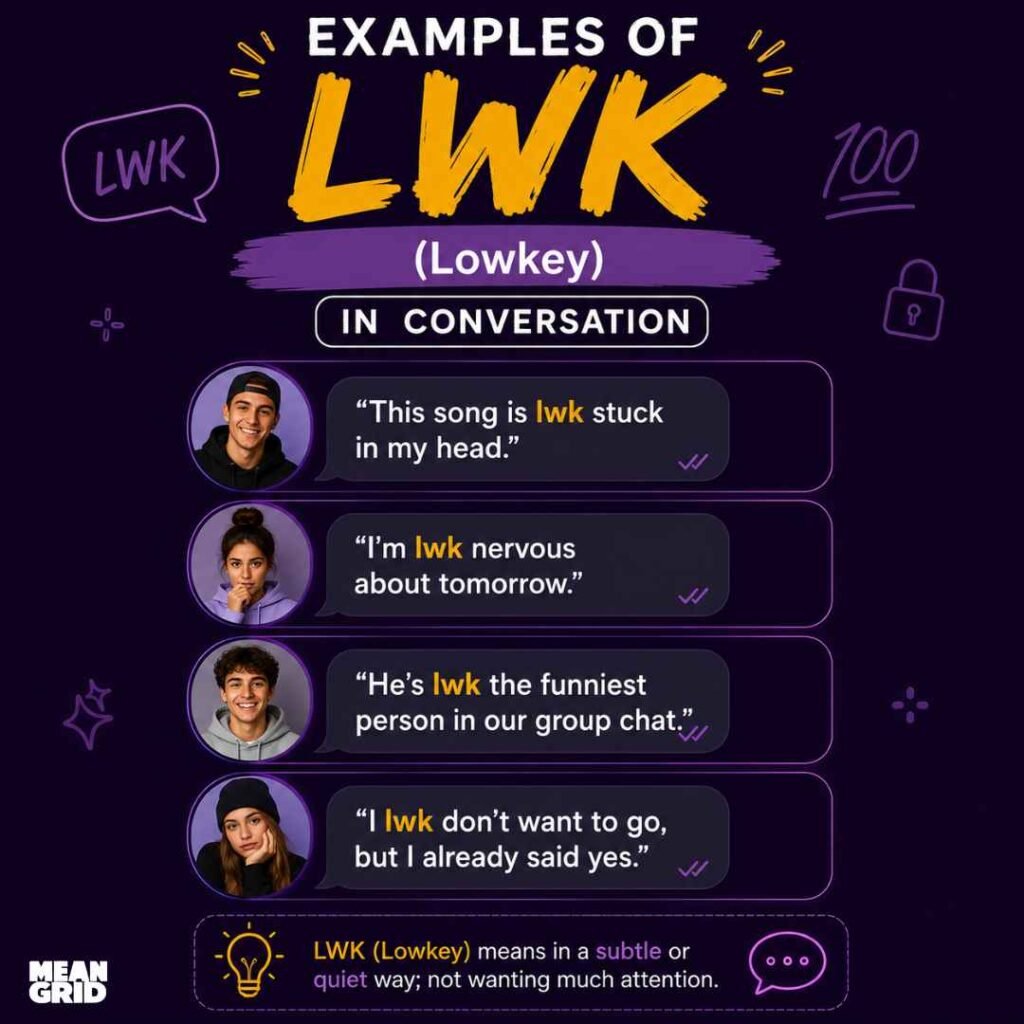
Seeing it in real texts makes the meaning click faster than any definition. Here are a few natural examples:
- “This song is lwk stuck in my head.”
- “I’m lwk nervous about tomorrow.”
- “He’s lwk the funniest person in our group chat.”
- “I lwk don’t want to go, but I already said yes.”
Notice the pattern. Each sentence would still make sense without the lwk, but the word changes the tone. It signals “I’m telling you this, but I’m keeping it casual.”
When to Use and When Not to Use LWK
LWK fits naturally into texts, group chats, captions, and comments between friends. It’s built for casual, low-stakes communication where a relaxed tone is expected.
It does not belong in formal writing. Skip it in work emails, job applications, school papers, or messages to someone you don’t know well. Using it there can come across as unprofessional or confusing, especially to someone unfamiliar with slang.
A simple rule: if you’d use emojis or all-lowercase texting with that person, lwk is probably fine. If you’d write in full, proper sentences, leave it out.
How Is LWK Used in Different Contexts?
The meaning stays mostly consistent, but the emotional weight shifts depending on the situation. In a compliment, it softens praise so it doesn’t sound over the top, like “lwk you’re really talented.” In a confession, it gives someone a way to admit something without fully committing to how they feel, like “lwk I still think about that.”
In arguments or disagreements, lwk can soften a criticism so it feels less harsh, such as “lwk that wasn’t cool of you.” It rarely shows up in serious, high-stakes conversations, since the whole point of the word is to keep things light.
LWK Meaning on Snapchat, TikTok, Instagram, WhatsApp
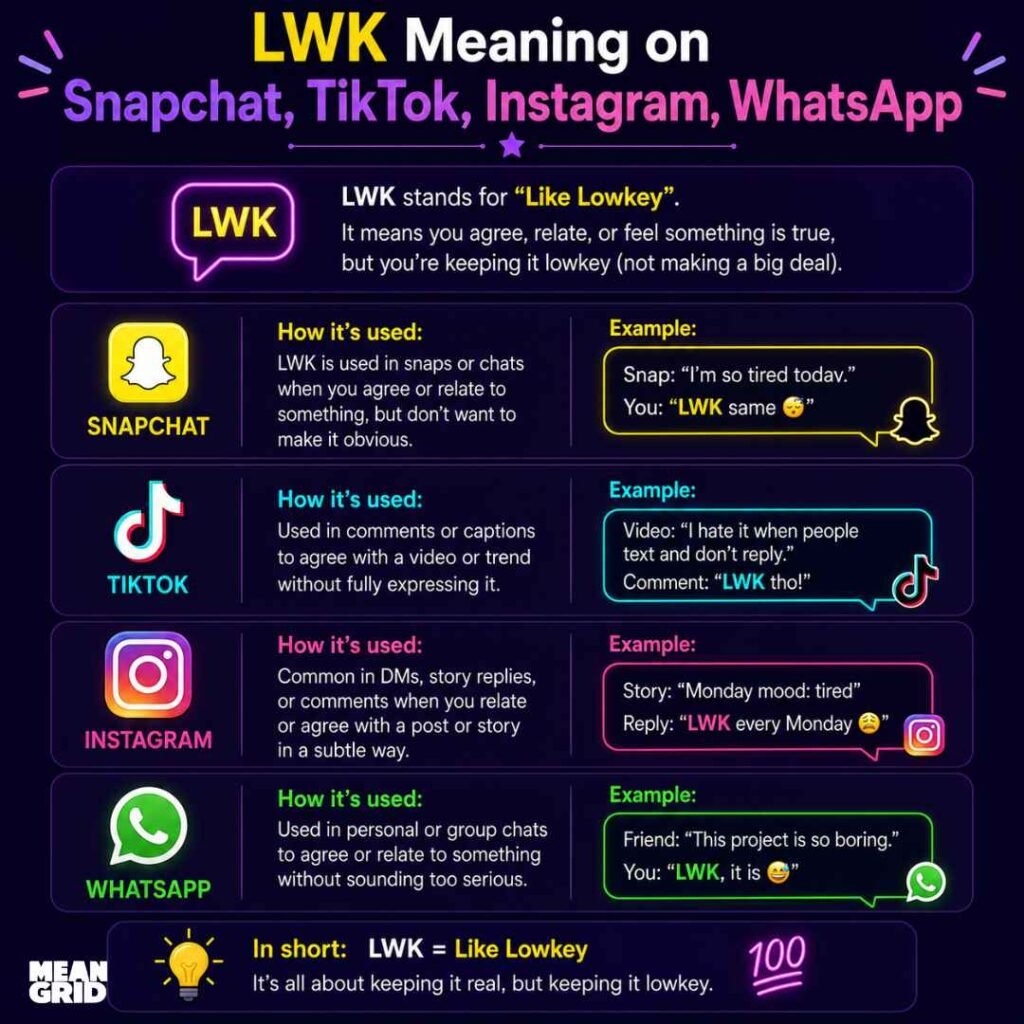
LWK shows up across nearly every major messaging and social platform, but the flavor changes slightly by app.
- Snapchat and TikTok: Used constantly in captions and comments, often paired with humor or self-deprecating jokes.
- Instagram: Common in captions and DMs, usually to admit a genuine feeling in a low-pressure way.
- WhatsApp and iMessage: More common in one-on-one chats between friends than in group settings, often used to soften an honest opinion.
- Discord and gaming chats: Used in reactions, like “lwk that play was clean,” to react without sounding too hyped.
Across all of these, the underlying tone stays the same: casual, honest, and a bit understated.
LWK Meaning in Professional or Technical Fields
There isn’t a widely recognized technical or business meaning for LWK the way there is for some acronyms. In everyday professional settings, it doesn’t stand for anything official, and you won’t find it in industry glossaries. If you ever see it used that way, it’s almost always a coincidence or a niche internal shorthand specific to one company or team, not a general standard.
Where You Place LWK Changes What It Means
Most guides explain what lwk stands for but skip something that actually matters: placement changes the message. Put it at the start of a sentence, like “Lwk, I think we should talk,” and it softens the whole statement, almost like a warning that something honest is coming.
Put it in the middle, like “I lwk think you’re right,” and it softens just the opinion, not the entire sentence. Put it right before an adjective, like “that’s lwk kind of funny,” and it downgrades the intensity of that one word specifically.
Punctuation matters too. A comma after lwk at the start of a sentence gives it a pause, almost like a breath before admitting something. No comma makes it feel quicker and more offhand. There’s also a rare non-slang use where LWK appears in gaming clan tags or usernames as initials for something unrelated to lowkey entirely, so context always matters more than the letters themselves.
Common Misunderstandings About LWK
A lot of people assume lwk is a typo for “like” or “look,” especially if they’ve never seen it before. It’s not. It’s a deliberate abbreviation with its own specific meaning.
Some also think it’s rude or dismissive. In most cases, it’s the opposite. It’s a way of being honest while staying gentle. Others assume it only expresses negative feelings, but it works just as often with excitement, affection, or agreement.
LWK vs Similar Terms and Alternatives
LWK sits in a family of hedging slang that Gen Z and millennials use to soften how strong a statement feels. Here’s how it compares to similar terms:
| Term | Meaning | Intensity |
| LWK | Quietly, mildly, understated | Low |
| HWK (highkey) | Openly, strongly, obviously | High |
| NGL | “Not gonna lie,” admitting something honestly | Medium |
| Deadass | Completely serious, no exaggeration | High |
| No cap | No lying, telling the truth | High |
| Fr fr | “For real,” emphasizing sincerity | Medium-high |
LWK and HWK sit on opposite ends of the same scale. LWK downplays a feeling, while HWK amplifies it. Some people even combine them, like “lwk hwk,” to say they’re being subtle about something that’s actually a big deal.
How to Respond to LWK
Responding is usually easy since lwk doesn’t demand a formal reply. A few natural options:
- If a friend texts “lwk I miss you,” you might reply, “lwk miss you too.”
- If someone says “lwk that test was hard,” you could respond, “fr, I barely finished.”
- If they text “lwk kinda nervous for this,” a supportive reply like “you’ll be fine, promise” works fine too.
You don’t need to use lwk back. Matching the casual tone is what actually matters.
Tips for Using LWK Naturally
Keep it lowercase in casual texts since that matches how most people actually type it. Use it once per message rather than stacking it repeatedly, since overuse makes it feel forced.
Save it for people you already text casually with. Read the room before using it with someone new, since not everyone will know what it means right away.
FAQs
What does LWK mean in a text message?
LWK means “lowkey.” It’s used to express a feeling, opinion, or fact in a quiet, understated way instead of a dramatic one.
Is LWK the same as saying “kind of” or “a little”?
Yes, in most sentences you can swap lwk for “kind of” or “slightly” and the meaning holds up.
Is LWK rude to use?
No, it’s not rude. It’s neutral slang, and tone depends entirely on the words around it.
What’s the opposite of LWK?
HWK, short for “highkey,” is the opposite. It means something is felt openly and strongly instead of quietly.
Can I use LWK in a work email?
No, it’s too casual for professional writing. Stick to it in texts, DMs, and social captions instead.
Conclusion
LWK simply means “lowkey,” a casual way to admit a feeling or opinion without making it sound too intense.
It comes from AAVE roots, moved through hip-hop culture, and now lives comfortably in everyday texting across nearly every platform. Once you know the meaning and where to place it, you’ll never second-guess it in a chat again.

Albert is a dedicated meaning expert with over 6 years of experience researching word meanings, language usage, and definitions. At Mean Grid, he creates clear, accurate, and easy-to-understand content that helps readers explore the true meaning of words and phrases.