
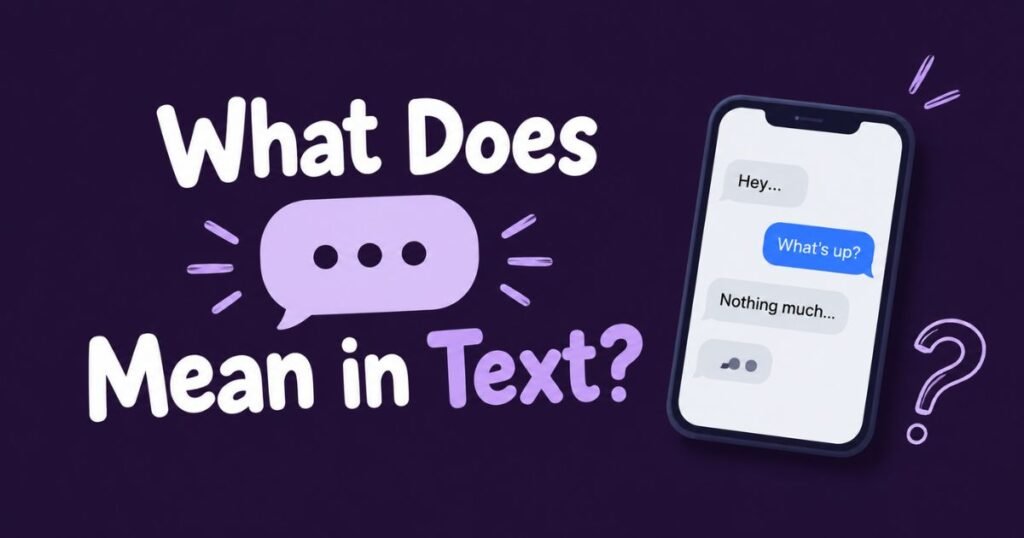
Got a text that says just “…” and now you are overthinking it? You are not alone. Those three dots look simple, but they can change the feel of a whole message.
Quick answer: in text, … (an ellipsis) usually means a pause, hesitation, or an unfinished thought. Depending on the context, it can also show shock, awkwardness, suspense, or a passive aggressive tone.
This guide explains each meaning, how to tell which one fits, and how to reply without making things worse. The examples come from everyday US texting habits.
What does … mean in text?
The ellipsis is a punctuation mark made of three dots. In formal writing, it shows that words were left out of a quote. In a text message, it works more like a spoken pause. The sender stops, trails off, or lets you fill in the rest.
Short definition: in texting, “…” means the sender is pausing, feeling unsure, or leaving something unsaid. The exact meaning depends on who sent it, where the dots sit, and what was said before.
The word comes from a Greek term for “omission,” and that idea still fits. Something is missing, and you are being asked to notice it. Because texting has no tone of voice or facial expression, the dots end up carrying a lot of weight.
Ellipsis in text: profile summary
| Detail | Summary |
| Term | Ellipsis (…) |
| Also called | Dot dot dot, three dots, ellipsis points |
| Plain meaning | A pause or an unfinished thought |
| Common tones | Hesitant, awkward, suspenseful, passive aggressive, playful |
| Where it appears | iMessage, WhatsApp, SMS, Instagram DMs, Snapchat, group chats |
| Who uses it | All ages, especially older texters |
| Misreading risk | High, because there is no vocal tone |
| Best way to check | Read the full conversation, then ask if still unsure |
| Last reviewed | October 2026 |
Common meanings of … in text
The same three dots can carry very different feelings. These are the six you will see most often.
Hesitation or uncertainty
“I guess we could go…” The sender is not sure, or does not want to commit. They may be waiting for you to push the plan forward or let it drop. If you want to know which one, ask a direct question.
Awkwardness or shock
Sent alone, “…” often means the sender is stunned or speechless. It can follow awkward news, an odd question, or an overshare. Think of it as the text version of an awkward silence.
Passive aggressive tone
After a disagreement, “Fine…” or “Sure, if you say so…” can sound annoyed. The dots hint at a feeling the sender is not saying out loud. Many younger texters read this as irritation, even when the sender did not mean it that way.
Suspense or a cliffhanger
“You will not believe who I ran into…” builds curiosity. The dots tell you more is coming. This use is playful and very common in friendly chats and group chats.
Flirty or playful tone
“Maybe I will see you tonight…” The dots invite you to fill in the blank, which can feel coy. Whether it is flirting depends on the relationship and the rest of the conversation, not on the dots alone.
Trailing off or a thought in progress
Some people use dots as a habit, the way others use commas. Their message just ends, and nothing is hidden behind it. If a person sends dots in every message, treat it as their writing style.
Read More Meaning:
SMTH Meaning in Text & How to Use It (with Examples)
MHM Meaning in Text: Tone Decoder and Best Replies
Quick comparison
| Example text | Likely meaning | Tone |
| “Okay…” | Not fully fine with it | Unsure or annoyed |
| “…” (sent alone) | Shocked or speechless | Awkward |
| “Guess what happened…” | A story is coming | Playful |
| “We need to talk…” | A serious topic ahead | Tense |
| “See you soon…” | Habit, or a hint of excitement | Neutral or flirty |
| “Interesting…” | Doubt or sarcasm | Skeptical |
Real conversation examples
Three short chats show how the same dots change meaning with the situation.
Example 1: plans with a friend
Friend: “Want to grab dinner Friday?”
You: “Sure…”
The dots hint at doubt. You may be tired or already booked. A kind reply from your friend: “No pressure, we can pick another day.”
Example 2: a message from a parent
Parent: “Call me when you can…”
This is usually a habit, not anger. Many parents add dots to almost every text. A quick “Calling you now” settles it.
Example 3: a date
Date: “I had a great time tonight…”
Here the dots feel warm and a little coy. They leave room for you to answer in kind. A simple “Me too, let’s do it again” works.
How to read the dots by context
Linguists often describe punctuation in texting as a stand in for tone of voice. Since you cannot hear the sender, the dots are your only hint. Do not judge them by themselves. Check these clues first.
Where the dots sit
| Position | Usual feel | Example |
| End of a message | Trailing off, doubt, or mild annoyance | “Sure…” |
| Middle of a message | A pause for effect, or thinking aloud | “I was going to say… never mind” |
| Alone | Shock, silence, or no words | “…” |
| Four or more dots | A longer pause or stronger emphasis | “Okay….” |
Some people read four dots as a period plus an ellipsis, which can sound like “end of discussion.” Others just see a longer pause.
Clues to check first
- Relationship. Close friends joke around. A boss, a new date, or an ex may mean something else.
- Recent conversation. After an argument, every dot gets heavier.
- Sender’s habits. Scroll up and compare with their older texts.
- Other cues. Emojis, exclamation marks, and capital letters soften or sharpen the tone.
- Timing. A slow reply ending in “…” often signals hesitation.
Age and platform differences
Older and younger texters
Many older texters use dots as a gentle pause or a way to add one more thought. They rarely mean anything negative. Many younger texters skip periods altogether, so trailing dots feel heavy and cold to them. Neither group is wrong. They simply learned texting in different places.
Typed dots and typing dots
On iMessage, three bouncing dots are the typing indicator, which is an app signal and not a message. If they vanish without a text arriving, the person just stopped typing. Typed dots, on the other hand, are punctuation the sender chose on purpose.
On work chats and email, dots can look sharp or unprofessional. Use them sparingly there.
How to reply to a text with …
- Pause first. Do not read the worst into one punctuation mark.
- Answer the words, not the dots. Respond to the actual question or topic.
- Ask a light question. “Everything okay?” or “Want to talk about it?” works well.
- Match the mood. If the message is playful, play along. If it is tense, stay calm and clear.
- Switch to a call. If the confusion keeps repeating, a quick call clears up tone faster than a long thread.
When to use the dots yourself
Dots work well for:
- Building suspense in a story
- Softening a hard sentence
- Showing that you are thinking
Skip them when you text your boss, someone who is upset, or a person you just met. They can look cold or annoyed even when you feel fine.
Common mistakes to avoid
- Treating every dot as anger. Most of the time it is just a pause.
- Sending dots back to match. This can start a silent standoff.
- Ignoring the sender’s habits. Some people use dots in every message.
- Writing a long, defensive reply. Keep it short and calm.
- Assuming one meaning for all ages. A parent and a teen may use the same dots for different reasons.
Tips for clearer texting
- Say the feeling in words: “I am not sure about Friday.”
- Use an emoji or an exclamation mark when you want a warm tone.
- Save the dots for suspense or a real pause.
- Reread your message once before you send it.
FAQs
What does … mean when a crush texts it?
It often means shyness, hesitation, or light flirting. Read the whole chat, or ask directly if you are unsure.
Is … in text rude or passive aggressive?
Not always. It can sound annoyed after a disagreement, but in friendly chats it is usually just a pause.
What does it mean when someone replies with only …?
Usually shock, confusion, or having no words. It can also mean they are upset and need a moment.
What is the difference between … and the typing dots?
Typed dots are punctuation the person wrote. The typing indicator is an app signal showing that someone is writing.
How many dots should I use in a text?
Use three. More dots can feel dramatic or annoyed.
Conclusion
The three dots mean something different in nearly every chat, so no single answer is right. Most of the time, … is a pause, a doubt, or a hint of more to come. Look at the relationship, the topic, and the sender’s usual style before you decide how to feel.
When you cannot tell, ask. One short, friendly question saves a lot of guessing. And if you want your own texts to be clear, say what you mean in words and keep the dots for real pauses.

Albert is a dedicated meaning expert with over 6 years of experience researching word meanings, language usage, and definitions. At Mean Grid, he creates clear, accurate, and easy-to-understand content that helps readers explore the true meaning of words and phrases.