
You open a message and see only two letters: PU. No details, no emoji, nothing else. Is it a smell joke, a call request, or an invite to chat? The answer depends on who sent it and where.
This guide explains the PU meaning in text, its full form, real examples, and the mistakes that lead to awkward replies. By the end, you will read it correctly and use it with confidence.
Featured Snippet Answer: What Does PU Mean in Text?
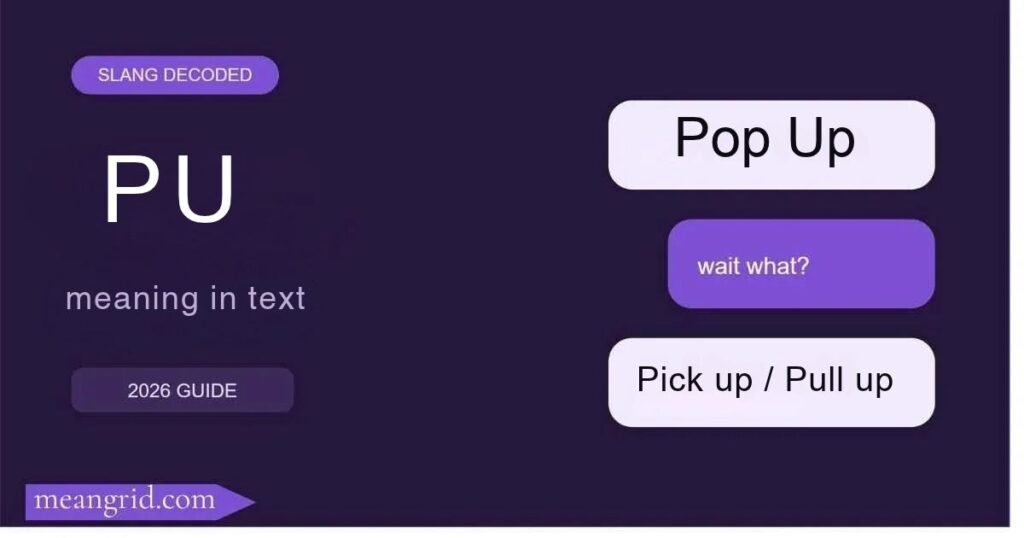
PU in text most often means “pop up”, which is an invite to message or join in, especially on Snapchat. It can also mean “pick up” (answer a call or collect someone) or “pull up” (show up in person). Written as P.U., it is a classic way to say something smells bad.
What Does PU Mean in Text Slang?
In text slang, PU is a short abbreviation with several uses. Most of them are casual invites or requests, so context decides the meaning.
The four common meanings are:
- Pop up: message me or start a chat
- Pick up: answer the phone or collect someone
- Pull up: arrive at a place
- P.U.: a reaction to a bad smell
The hidden meaning often sits in the tone. A cheerful “PU” under a story is an open invite to anyone. A private “PU” sent to one person at night is usually more personal. The same two letters can feel playful, flirty, or urgent.
No dictionary lists an official text meaning for PU, so usage is community driven and can vary by region and friend group. The stinky “P.U.” meaning has the longest record, with dictionary entries tracing similar exclamations back to the early 1600s.
What Does PU Mean in Text From a Guy?
When a guy texts PU, he usually means pull up, pop up, or pick up. The right one depends on the clues around it.
Check these signals:
- Timing: a late night “PU” often means come over
- Place: under a story, it usually means message me
- Words nearby: “PU, I’m outside” differs from “PU if you’re free”
- Your history: friends use it casually, while a crush may mean it as a flirty invite
A friend usually means a casual hangout or chat. Repeated PU texts from someone you are dating tend to suggest he wants to see you.
No rule works every time, and you cannot read someone’s intent from two letters alone. If the meaning is unclear, ask a quick question such as “PU as in message you or come over?” If a meetup is involved, confirm the place and time first and tell a friend where you are going. A clear answer costs you nothing.
What Does PU Mean in Text on Snapchat?
On Snapchat, PU usually means pop up. People post it on a story to invite friends to message them. Parade, a US lifestyle outlet, described this meaning in 2025 as a casual way to start a chat without asking directly.
A typical caption reads “New shoes just dropped, PU for the link.” The same meaning shows up on Instagram and TikTok, where short captions and quick replies are normal. In private chats on iMessage or WhatsApp, pick up and pull up appear more often.
To respond to a PU story:
- Reply with a snap or chat message
- Mention the story so the sender knows why you wrote
- Keep it short and friendly
PU Full Form in Text
There is no single full form. This table shows the most common ones.
| Full Form | Meaning | Where You See It | Example |
| Pop up | Message me | Snapchat, Instagram | “PU if you want details” |
| Pick up | Answer a call or collect someone | iMessage, WhatsApp | “PU, I’m calling you” |
| Pull up | Show up in person | Friend group chats | “PU at the park at 6” |
| P.U. | Something smells bad | Speech, jokes | “P.U., what is that?” |
Pick the right full form by reading the sentence, platform, and sender.
Why PU Is Popular in the United States
Slang spreads fast when it is short, flexible, and fun to use. PU checks all three boxes.
1. Saves Time
Two letters replace a full sentence like “message me if you want to talk.” Fast typing matters on phones, and shorter texts get quicker replies.
2. Social Media Trends
Stories and short captions reward brief wording. PU fits in a single line and still gets people to respond.
3. Casual Communication
It sounds relaxed, not demanding. An invite feels lighter when it is two letters instead of a formal request.
4. Gen Z Internet Slang
Younger users like shared codes that feel insider. PU works as one because its meaning shifts with the group, which keeps it playful.
Read More: JFC Meaning in Text: What It Stands For (2026 Guide)
Real Life Examples of PU in Text Messages
Casual Chat
- “Posted the full recipe on my story. PU if you want it.”
- “Got extra tickets. PU if you’re in.”
Meaning: pop up, message me.
Relationship Texts
- “PU tonight? I miss you.”
- “PU after work, I’ll cook.”
Meaning: pull up, come see me. The tone is warm and personal.
Pick Up Context
- “PU please, I’m lost and need directions.”
- “I’m calling now, PU.”
Meaning: pick up, answer my call.
Disgust Context
- “Someone left fish in the fridge. P.U.!”
- “P.U., open a window.”
Meaning: that smells terrible.
PU vs Other Popular Text Slang
PU often gets mixed up with similar short terms. This table separates them.
| Slang | Meaning | Tone | How It Differs From PU |
| PU | Pop up, pick up, pull up | Casual | An invite or request |
| HMU | Hit me up | Casual | Closest match to “pop up” |
| DM | Direct message | Neutral | A channel, not an invite |
| OTW | On the way | Informal | Reports travel, while PU asks for it |
| WYD | What are you doing | Friendly | Asks for status |
| PMO | Pissed me off | Negative | Unrelated to invites |
Common Mistakes People Make With PU
Using It in Professional Messages
PU belongs in friendly chats. To a boss or client, write “Please call me” or “Please stop by my desk.” Clear wording protects your credibility.
Ignoring Context
Guessing the wrong meaning creates awkward moments. Walking over to someone’s house when they only wanted a message is a good example. Read the platform, the timing, and the sender before you reply.
Overusing Slang
A message packed with abbreviations is hard to read and easy to misread. Use PU once, and keep the rest of the sentence in plain words.
How to Use PU Naturally
Step 1: Know Your Audience
Friends and peers your age will understand it. Older relatives may think you mean a bad smell.
Step 2: Add Context
Pair PU with a clear detail, such as “PU for the link” or “PU at 7 at the diner.” One extra phrase removes the guesswork.
Step 3: Use It on Casual Platforms
Snapchat, Instagram, and friend group chats are the right places. Skip email and work apps.
Is PU the Same as PMO?
No. PMO usually means “pissed me off,” which is a negative reaction. PU is mostly an invite or a smell reaction. They look alike on screen but serve different purposes. Mixing them up can turn a friendly text into an accidental complaint.
Expert Insight on Text Slang
Short abbreviations survive because they do two jobs: they save time and they signal belonging. PU is a clear case. It carries several meanings at once, and the group using it decides which one counts.
The safest habit is simple. Read the context first, reply second, and ask when unsure. Slang also changes fast, so treat any meaning, including those in this guide, as common usage rather than a fixed rule.
PU Slang Profile Summary
| Detail | Information |
| Term | PU |
| Type | Text slang abbreviation |
| Most common meaning | Pop up (message me) |
| Other meanings | Pick up, pull up, P.U. (bad smell) |
| Main platforms | Snapchat, Instagram, TikTok, iMessage, WhatsApp |
| Tone | Casual, friendly, sometimes flirty |
| Typical users | Teens and young adults in the US |
| Safe for work | No |
| Status in 2026 | Active, meanings vary by group |
FAQs About PU in Text
What does PU mean on Snapchat?
It usually means pop up, an invite to message the sender.
What does PU mean in a text from a guy?
Usually pull up, pop up, or pick up. Timing and nearby words show which one.
Is PU rude?
Not by itself. It is casual, so avoid it in work or formal chats.
Is PU the same as HMU?
Close, but not identical. Both invite contact, yet PU can also mean show up or answer a call.
How should I reply to PU?
Reply based on context. If it is unclear, ask “PU as in message you or come over?”
Final Thoughts
PU is tiny, but it carries a lot of meaning. It can invite a chat, ask for a call, request a visit, or react to a bad smell. The sender, the platform, and the tone tell you which one applies.
Use it with friends, add a short detail, and keep it out of professional messages. When you are unsure, one quick question beats a wrong guess every time.

Albert is a dedicated meaning expert with over 6 years of experience researching word meanings, language usage, and definitions. At Mean Grid, he creates clear, accurate, and easy-to-understand content that helps readers explore the true meaning of words and phrases.