
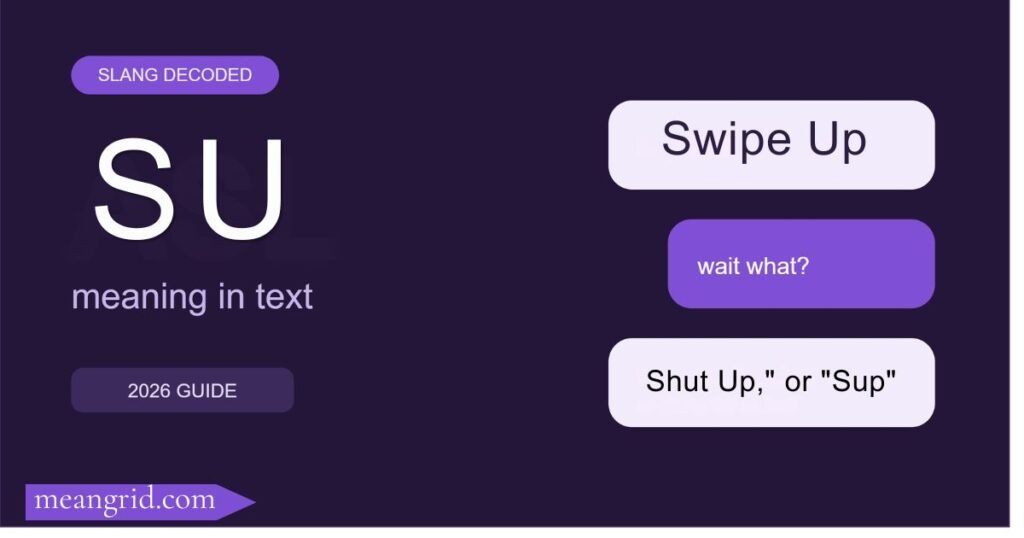
SU meaning in text usually points to one of three things: “swipe up,” “shut up,” or “sup” (what’s up). The correct one depends entirely on where you see it. On Instagram or Snapchat, SU almost always means swipe up.
In a casual DM between friends, it’s more often shut up or sup, said with zero real anger behind it. A friend texts “lol su” after you send something funny, and they’re not mad. They’re just being playful.
SU Meaning & Definition
SU is a text abbreviation with three main definitions, and none of them is the “one true meaning.” Think of it as three different words wearing the same two letters.
- Swipe up – a call to action on social media stories, usually pointing to a link
- Shut up – a reaction to something surprising, funny, or annoying, almost always said in a light tone between friends
- Sup / what’s up – a quick, casual greeting
There’s also a fourth, smaller use: straight up, meaning “honestly” or “for real.” You’ll see this less often, but it shows up in phrases like “su, that movie was terrible.”
Where Does SU Come From?
Text abbreviations like SU didn’t appear out of nowhere. They came from decades of people trying to type less. Early SMS plans charged by the message or limited characters, so shortening words became a habit. LOL, BRB, and TTYL all came from that same pressure.
SU as “shut up” and “sup” predates social media, going back to instant messaging platforms where speed mattered more than spelling. The “swipe up” meaning is newer. It took off once Instagram and Snapchat gave verified accounts and larger creators the ability to add a swipeable link to their stories. Typing “swipe up for the link” over and over got old fast, so creators shortened it to SU, and it stuck.
Examples of SU in Conversation
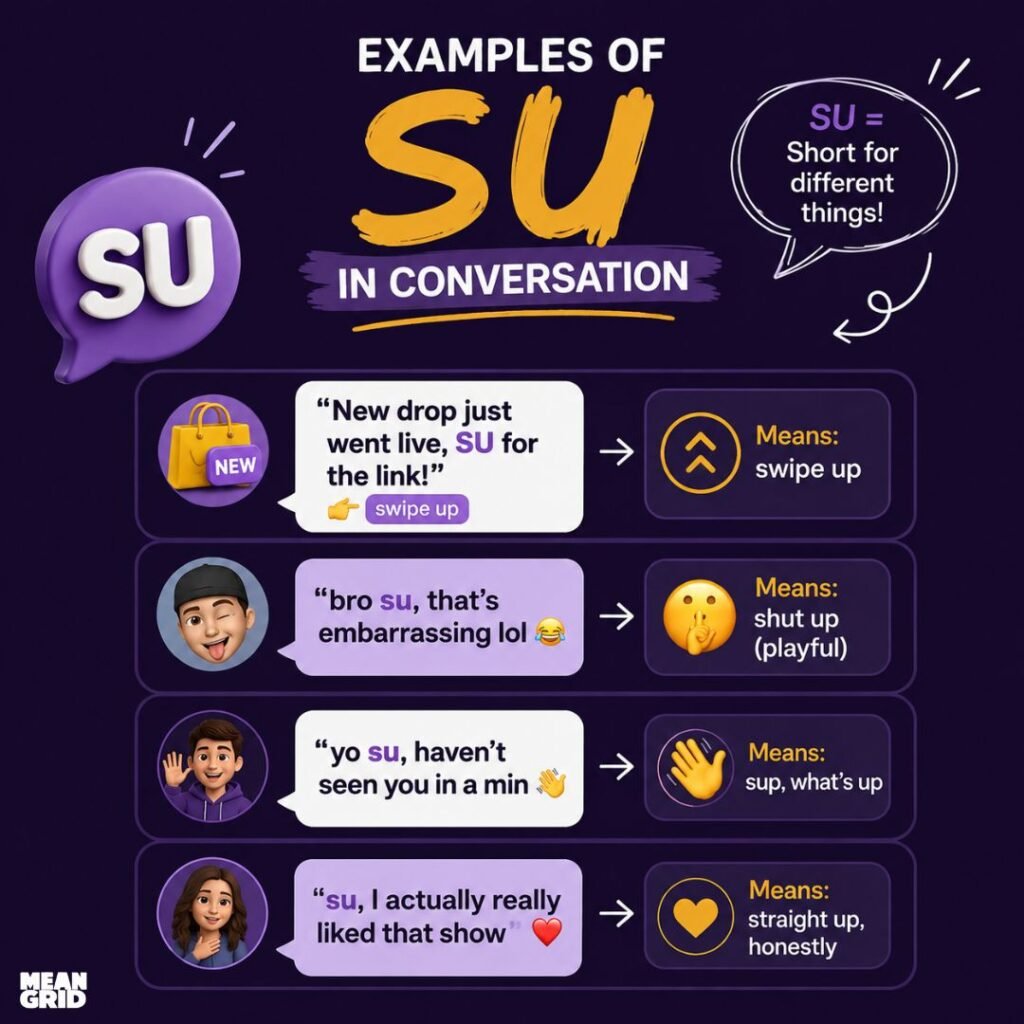
Seeing SU used in context makes the meaning obvious almost every time.
- “New drop just went live, SU for the link!” → swipe up
- “bro su, that’s embarrassing lol” → shut up (playful)
- “yo su, haven’t seen you in a min” → sup, what’s up
- “su, I actually really liked that show” → straight up, honestly
Notice the pattern. Marketing-style captions almost always mean swipe up. Casual one-line texts between friends usually mean shut up or sup.
When to Use and When Not to Use SU
SU works fine in casual texting, group chats, and social captions aimed at a young or online-savvy audience. It does not work in professional emails, job applications, customer service messages, or any writing where clarity matters more than speed. A recruiter reading “SU for details” in a cover letter isn’t going to know what that means, and guessing wrong makes a bad impression.
A simple rule: if you’d feel weird saying the full phrase out loud in that setting, don’t abbreviate it either.
How Is SU Used in Different Contexts?
Context changes everything about how SU lands. The same two letters can sound sweet, rude, or purely functional depending on where they show up.
| Setting | Likely Meaning | Tone |
| Story caption with a link | Swipe up | Promotional, neutral |
| Reply to a funny text | Shut up | Playful |
| Opening line of a chat | Sup / what’s up | Friendly greeting |
| Reacting to a claim | Straight up | Emphatic, honest |
SU Meaning on Snapchat, TikTok, Instagram, WhatsApp
- Instagram: SU is tied almost entirely to swipe up, especially in Stories and Reels captions promoting a link, product, or announcement.
- Snapchat: Same story. SU on a Snap story points to a link or attached content, though it can occasionally mean shut up in a Snap chat reply.
- TikTok: Less about links and more about comments. On TikTok, SU in a comment section usually means shut up, used as a joking reaction to something in the video.
- WhatsApp: This is the most personal of the four. Since WhatsApp is mostly one-on-one or small group chats rather than public content, SU here almost always means sup or shut up, never swipe up, since WhatsApp doesn’t have a swipe-up feature.
SU Meaning in Professional or Technical Fields
Outside of texting slang, SU has a couple of legitimate technical meanings worth knowing so you don’t confuse them with the slang version.
In Unix and Linux computing, “su” is an actual command that stands for “substitute user” or “switch user,” letting someone log in as another account, often the administrator.
In academic contexts, SU is also a common shorthand for university names like Syracuse University or Stanford University. Neither of these has anything to do with texting, but they explain why someone searching “SU meaning” might land on very different answers depending on what they actually typed into Google.
The One Thing Most Guides Skip: Capitalization as a Clue
Here’s a detail almost nobody explains clearly: how SU is typed often hints at what it means before you even read the sentence around it.
- “SU” in all caps, especially inside a story caption or promotional post, leans heavily toward swipe up. Brands and creators write it in caps because it’s a command, similar to how “DM ME” or “LINK IN BIO” gets capitalized.
- “su” in lowercase, dropped casually into a text message, leans toward sup or shut up. It reads like a spoken word, not an instruction.
- “S/U” with a slash is almost exclusively a marketing shorthand for swipe up, rarely used for anything else.
This isn’t a hard rule, but it’s a genuinely useful shortcut when the surrounding text doesn’t make the meaning obvious right away.
Common Misunderstandings About SU
The biggest mix-up is assuming SU always means shut up and reacting defensively when it doesn’t. Someone posting “SU for 20% off” isn’t being rude, they’re running a promotion. The second common mistake is using SU in a formal setting because it feels harmless online.
It isn’t harmless in an email to a boss or teacher. The third mistake is missing tone entirely in text form, since “su” typed in anger reads very differently from “su” typed with a laughing emoji right after it.
SU vs Similar Terms and Alternatives
| Term | Meaning | Common Platform |
| SU | Swipe up / shut up / sup | Instagram, Snapchat, texting |
| BRB | Be right back | Texting, gaming chat |
| TTYL | Talk to you later | Texting |
| STFU | Shut the… up (stronger version) | Texting, gaming |
| SUS | Suspicious | Gaming, TikTok, Among Us culture |
SU and SUS look related but mean completely different things. SUS comes from “suspicious” and is tied heavily to gaming culture, especially Among Us, while SU has nothing to do with suspicion at all.
How to Respond to SU
- If it’s a caption: no reply needed, just tap the link if you’re interested.
- If a friend texts “su” after a joke: reply with something like “lol my bad” or another joke back.
- If someone opens with “su”: a simple “not much, you?” works fine.
Tips for Using SU Naturally
Match SU to the setting, not the other way around. Use it in stories when you want people to check a link. Use it in casual chats when the tone is already light.
Skip it entirely in anything formal, and when in doubt, add an emoji or a follow-up word so the meaning isn’t left to guesswork.
FAQ’s
What does SU mean in a text message?
SU in a text message most often means shut up or sup (what’s up), depending on the tone of the conversation.
Does SU always mean shut up?
No, SU does not always mean shut up. On social media captions, it almost always means swipe up instead.
What does SU mean on Instagram?
On Instagram, SU almost always means swipe up, pointing people to a link in a story or post.
Is SU rude to say?
SU isn’t inherently rude. It’s usually playful between friends, though tone and emojis can change how it lands.
What does SU mean in computing?
In computing, SU stands for substitute user or switch user, a Unix and Linux command unrelated to texting slang.
Conclusion
SU doesn’t have one fixed meaning, and that’s exactly why it trips people up. Swipe up, shut up, and sup are all correct, just in different places.
Read the platform, the tone, and the punctuation around it, and the right meaning becomes obvious almost every time.

Albert is a dedicated meaning expert with over 6 years of experience researching word meanings, language usage, and definitions. At Mean Grid, he creates clear, accurate, and easy-to-understand content that helps readers explore the true meaning of words and phrases.