
TBC stands for “To Be Confirmed.” It’s used when a date, time, plan, or detail hasn’t been finalized yet. You’ll see it in group chats, event posts, and even work emails whenever someone needs to signal “this isn’t locked in yet.”
Say your friends are planning a birthday dinner but haven’t picked a restaurant. Someone might text, “Dinner Saturday, spot TBC.” That one word does the job of a whole sentence. It shows up just as often on Instagram captions and TikTok comment threads as it does in a boring work calendar invite.
TBC Meaning & Definition
In texting, TBC almost always means “To Be Confirmed.” It tells the reader that something is expected to happen, but the exact details still need to be locked down.
You’ll see it attached to things like:
- Meeting times (“Call at 3pm, TBC”)
- Event locations (“Party at my place, address TBC”)
- Prices (“New price TBC once shipping is sorted”)
- Plans in general (“We’re doing something this weekend, TBC”)
It’s not really slang in the playful sense. It’s more of a practical shortcut that happens to be popular in texting because it saves time.
Where Does TBC Come From?
TBC didn’t start on phones. It comes from older shorthand used in event programs, printed schedules, and business documents, long before texting existed. Organizers needed a quick way to mark something as “coming, but not locked in yet” without leaving a blank space.
That habit carried over naturally into email, then into texting and social media once phones took over daily communication. The phrase never really changed meaning. It just moved from paper to screens.
Examples of TBC in Conversation
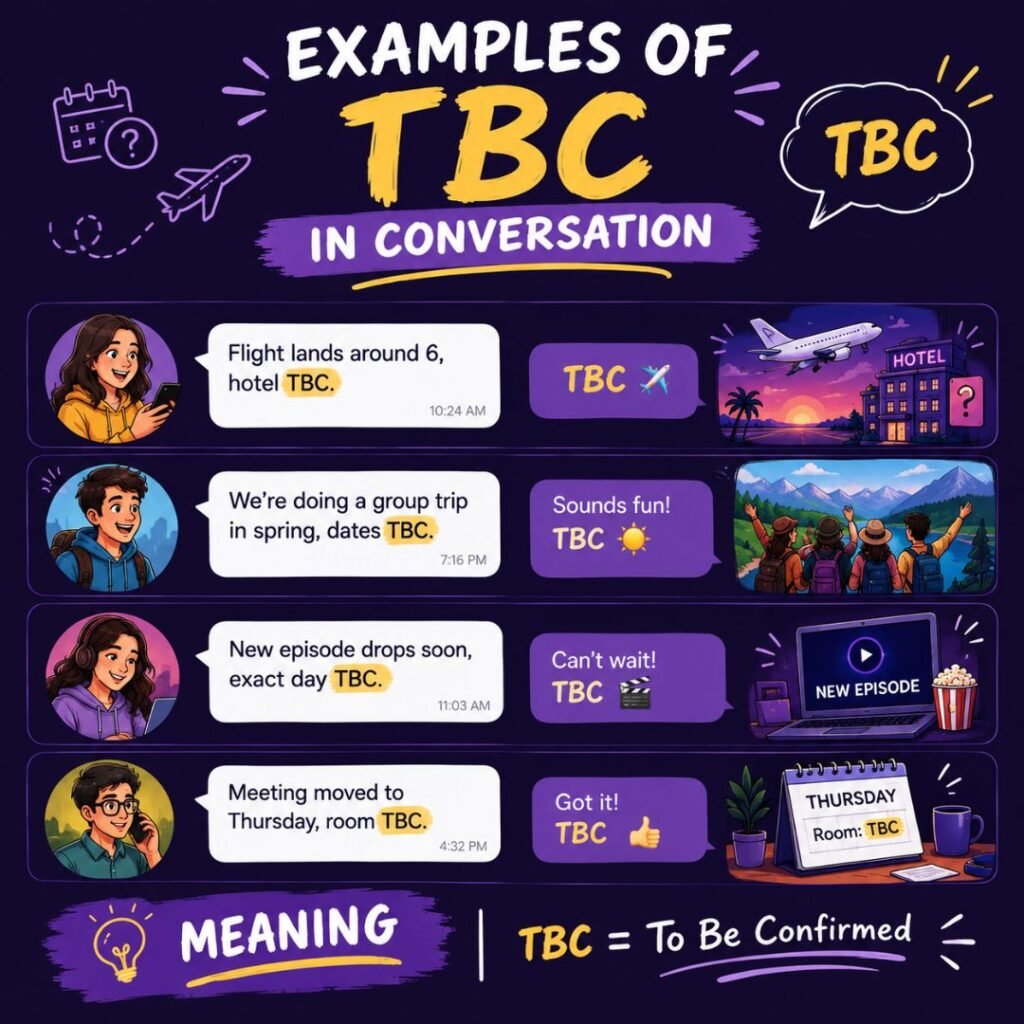
Seeing TBC in context makes it click faster than any definition. Here are a few real-style examples:
- “Flight lands around 6, hotel TBC.”
- “We’re doing a group trip in spring, dates TBC.”
- “New episode drops soon, exact day TBC.”
- “Meeting moved to Thursday, room TBC.”
Notice the pattern. TBC always attaches to one missing piece, not the whole plan.
When to Use and When Not to Use TBC
TBC works well when something is genuinely still pending and you want to be upfront about that instead of guessing. It’s honest and quick.
Where it can go wrong is in emotional or serious conversations. If someone asks whether you’re okay after bad news, replying “TBC” can come across as cold or dismissive, even if that’s not what you meant. Same with anything urgent. If someone needs an answer right now, “TBC” can feel like you’re avoiding the question instead of just being unsure.
A simple rule: use TBC for logistics, not for feelings or decisions that affect someone else’s day.
How Is TBC Used in Different Contexts?
TBC shifts slightly depending on where you see it, but the core meaning stays the same.
- In friend groups, it usually means plans are loose and still forming.
- In event listings, it means one detail is missing while the rest is locked in.
- In work chats, it signals that a decision is coming but hasn’t been made official yet.
- In social media captions, it’s often used to build a little anticipation, like a teaser for something coming soon.
TBC Meaning on Snapchat, TikTok, Instagram, WhatsApp
The meaning stays the same across apps, but the tone shifts.
- On Snapchat and WhatsApp, TBC usually shows up in personal planning, like nailing down a meetup time.
- On Instagram, it often sits in a caption to hint that more details are coming, like a product drop or event date.
- On TikTok, creators use TBC to build suspense around a follow-up video or reveal. It reads less like uncertainty and more like a hook.
Read More Blog: ASF Meaning in Text Explained: Full Guide With Examples
TBC in Gaming: The Burning Crusade
Outside of texting, TBC has a completely different meaning that a lot of people run into online, especially gamers. In World of Warcraft, TBC refers to The Burning Crusade, the game’s first major expansion. Players still use “TBC” constantly when talking about that version of the game, its content, and its community.
If you come across TBC in a gaming forum or Discord server, it’s worth checking the context before assuming it means “To Be Confirmed.” A sentence like “just started leveling in TBC” is almost certainly about the game expansion, not a pending plan.
TBC Meaning in Professional or Technical Fields
TBC also shows up in fields far outside casual texting, usually meaning the same core idea of “not finalized yet.”
| Field | What TBC Typically Means |
| Sports schedules | Match time, venue, or lineup still pending |
| Corporate or banking | Final terms or figures not yet locked in |
| Academic settings | Grades, dates, or results awaiting confirmation |
| Event planning | Venue, speaker, or date still being arranged |
The core idea never really changes. Only the setting does.
Common Misunderstandings About TBC
A few mix-ups come up again and again. First, people sometimes assume TBC means something is canceled. It doesn’t. It just means confirmation hasn’t happened yet.
Second, capitalization confuses people. You’ll see it written as TBC, tbc, or tucked in parentheses like “(TBC)” after a name or detail, especially in British and formal writing. All three mean the same thing. Lowercase just feels more casual, while the parenthesis style is common in professional or published writing.
Third, some readers confuse TBC with “To Be Continued,” which is a real but less common secondary meaning, mostly used in stories, shows, or serialized posts rather than everyday plans.
TBC vs Similar Terms and Alternatives
TBC, TBD, and TBA look alike but aren’t quite the same.
| Term | Meaning | Best Used For |
| TBC | To Be Confirmed | Details expected soon, just not official yet |
| TBD | To Be Decided | No decision has been made at all |
| TBA | To Be Announced | Info exists but hasn’t been shared publicly |
If a decision hasn’t happened yet, TBD fits better. If it’s decided but not public, TBA is the right call. TBC sits in between, when something is basically expected but still needs a final nod.
How to Respond to TBC
Replying to TBC doesn’t need to be complicated. A few natural options:
- “Okay, keep me posted.”
- “Got it, let me know when it’s locked in.”
- “Sounds good, just tell me once it’s confirmed.”
Each of these keeps the conversation open without pushing for an answer that isn’t ready yet.
Tips for Using TBC Naturally
Keep TBC attached to one specific detail instead of the whole plan, so people know exactly what’s still pending. Avoid using it back to back in the same conversation, since it can start to sound like nothing is ever settled. And if a decision actually affects someone’s schedule, follow up with a real answer as soon as you have one instead of leaving it hanging too long.
FAQs
What does TBC mean in a text message?
TBC means “To Be Confirmed.” It tells the reader that a detail, like a time or place, isn’t finalized yet.
Is TBC the same as TBD?
No. TBC means confirmation is coming, while TBD means no decision has been made at all.
Does TBC always mean To Be Confirmed?
Mostly, yes, though it can also mean “To Be Continued” in stories or shows, and in gaming it can refer to World of Warcraft’s Burning Crusade expansion.
Is it rude to reply with just TBC?
Not usually, but it can feel cold in emotional or urgent conversations where someone expects a real answer.
Is TBC formal or casual?
It works in both. You’ll see it in casual texts and in formal event listings or business emails.
Conclusion
TBC almost always means “To Be Confirmed,” a simple placeholder for details that are expected but not locked in yet.
It shows up everywhere from group chats to sports schedules to gaming communities, and once you know the context, it’s never really confusing. The key is using it for logistics, not feelings, and following up once the real answer is ready.

Albert is a dedicated meaning expert with over 6 years of experience researching word meanings, language usage, and definitions. At Mean Grid, he creates clear, accurate, and easy-to-understand content that helps readers explore the true meaning of words and phrases.