
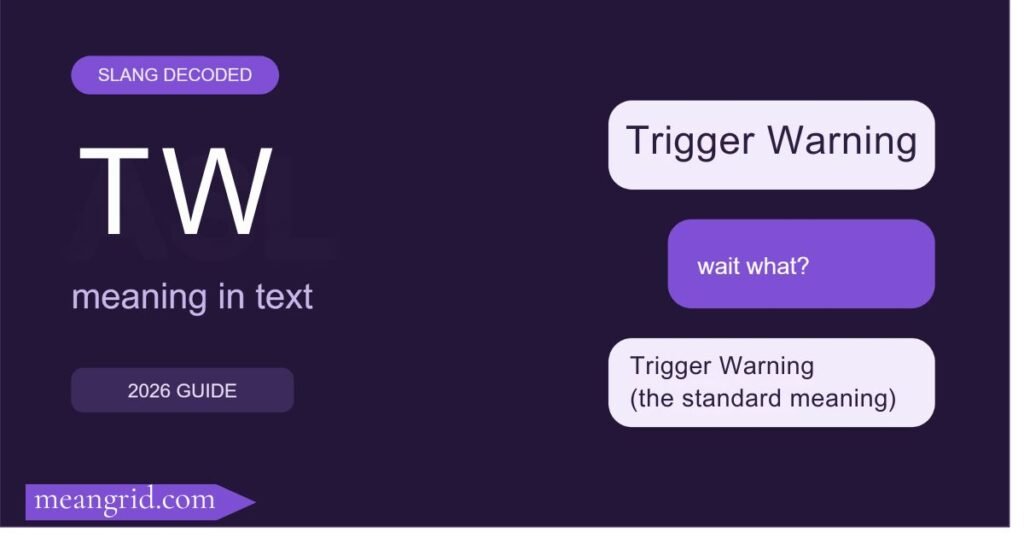
TW stands for “trigger warning.” It’s a short heads-up people add before content that might upset someone, especially content tied to trauma, mental health, or violence. You’ll see it written as TW, tw, or even Tw in captions, texts, and social posts, and it always means the same thing no matter how it’s capitalized.
This guide breaks down where it came from, how people actually use it today, and where it still trips people up.
TW Meaning & Definition
At its core, TW means “trigger warning.” It tells the reader that what comes next might bring up a strong emotional reaction, particularly for someone who has lived through something similar.
Think of it as a small courtesy flag. It doesn’t hide the content or stop the conversation. It just gives the reader a second to decide if they’re ready to read on.
- TW = Trigger Warning (the standard meaning)
- Occasionally short for Twitter, teamwork, or “this week” in unrelated contexts
- Almost always placed right before the sensitive topic, not after
Where Does TW Come From?
TW started in online spaces built around trauma recovery and mental health support, back in the early 2000s. Feminist blogs and message boards used it first, mostly around discussions of assault and abuse.
The term really took off on Tumblr in the early 2010s. From there it spread to Reddit, then Twitter, and eventually became a normal part of how people write captions on TikTok and Instagram. What began as a niche safety practice is now something most internet users recognize on sight.
Examples of TW in Conversation\
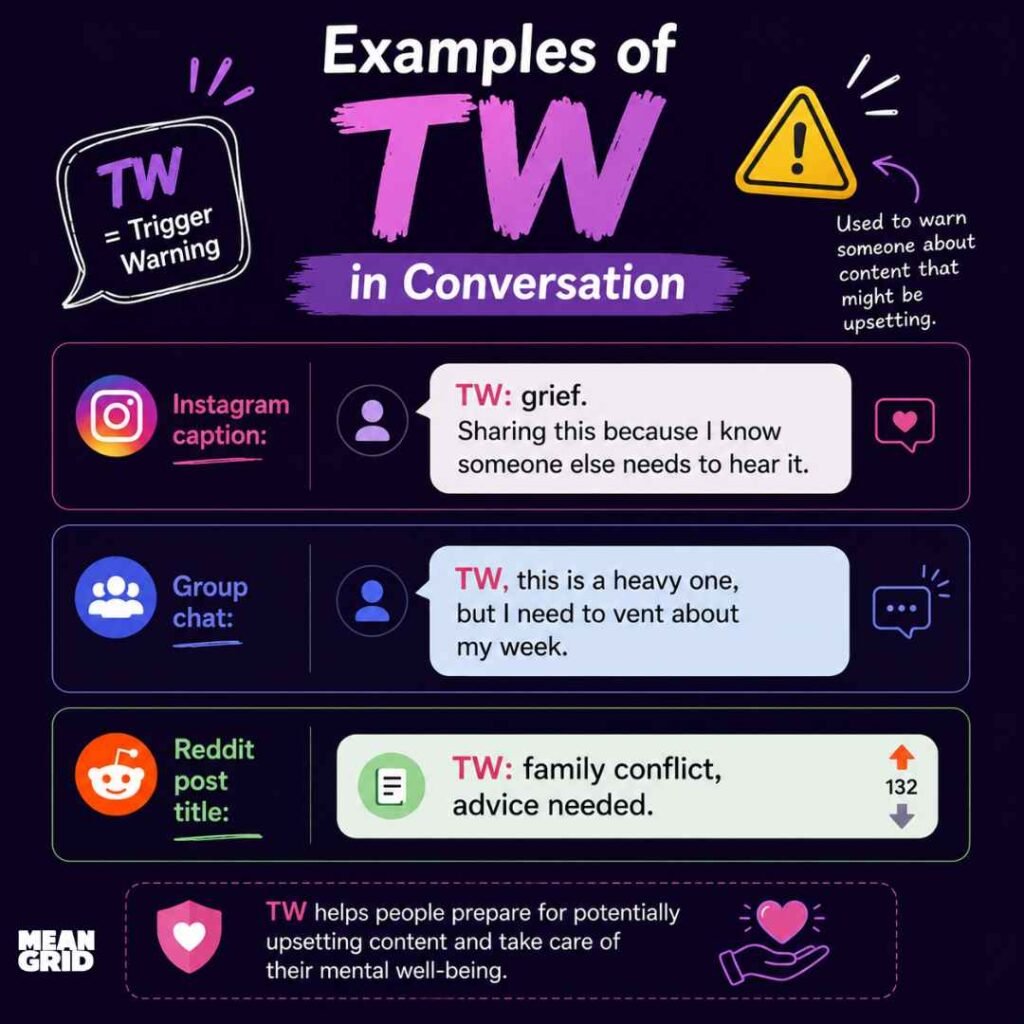
Seeing TW in context makes it click faster than any definition. Here’s how it shows up in real messages:
- Instagram caption: “TW: grief. Sharing this because I know someone else needs to hear it.”
- Group chat: “TW, this is a heavy one, but I need to vent about my week.”
- Reddit post title: “TW: family conflict, advice needed.”
Notice the pattern. TW always comes first, then a short topic label, then the actual content. That order matters, since the whole point is giving the reader a choice before they’re already reading.
When to Use and When Not to Use TW
Use TW when you’re about to talk about something that could genuinely distress someone, like self-harm, abuse, sudden loss, or graphic violence. It’s also fair to use it for topics like eating disorders or panic attacks, since those hit certain readers harder than others.
Skip TW for things that are just mildly annoying or awkward. Slapping a trigger warning on a bad haircut story or a work complaint waters down the term and makes people take it less seriously when it actually matters.
Good use cases:
- Talking about a death in the family
- Discussing past abuse or assault
- Sharing content about self-harm or suicidal thoughts
Not necessary:
- Venting about a rude coworker
- Complaining about traffic
- Posting spoilers (that’s what CW or “spoiler alert” is for)
How Is TW Used in Different Contexts?
TW shows up a little differently depending on where you see it. In casual texting between friends, it’s often short and informal, like “tw: rough day.” In public posts, people tend to be more specific, naming the exact topic so readers can make an informed choice.
In support communities and mental health forums, TW is sometimes a required part of posting rules. Moderators expect it before certain topics, and posts without one may get removed or flagged. In everyday group chats, it’s more of a personal habit than a rule, but it still shows the same care for the other person’s headspace.
TW Meaning on Snapchat, TikTok, Instagram, WhatsApp
Each platform has its own texture, even though the meaning stays the same.
| Platform | How TW Typically Appears |
| TikTok | Text overlay at the start of a video or in the caption |
| First line of a caption, often before a longer personal story | |
| Snapchat | Rare, usually typed directly in a chat before sending something heavy |
| Used in personal messages, often before a long or emotional voice note |
On TikTok and Instagram, TW is more public-facing since creators are warning a wide audience. On Snapchat and WhatsApp, it’s more personal, usually one friend giving another a quick warning before a private message.
TW Meaning in Professional or Technical Fields
Outside of casual texting, TW rarely carries the same meaning. In physics, TW can stand for terawatt, a unit of power. In some workplace chats, TW has been used loosely for “this week,” though this is far less common than the trigger warning meaning.
In HR or corporate messaging, a trigger warning style heads-up is sometimes used before sensitive announcements, like layoffs or difficult company news, but people usually write it out fully instead of using the short form. The abbreviated TW mostly stays in casual and social spaces.
The Tw Bracket Format: What Makes It Different
Here’s something most guides skip entirely. When you see the term written as Tw with brackets, it’s not always someone typing a manual warning. On several platforms, bracketed tags like this get auto-generated by moderation bots, stream overlays, or app labeling systems, especially on Discord and in live chat during streams.
A [Tw] tag inserted by a bot or auto-caption tool means the exact same thing as a manually typed TW, but it signals that a system flagged the content rather than a person choosing to warn you themselves. This matters because bracketed auto-tags are usually broader and less specific than a human-written one. A person might write “TW: my dad’s funeral,” while an automated tag might just show “Tw” with no topic attached.
If you’re building a habit of writing your own warnings, skip the bare brackets and always add the topic. It gives your reader far more useful information than an empty tag ever could.
Common Misunderstandings About TW
A lot of confusion around TW comes from assuming it always means the same thing everywhere. Here are the mix-ups people run into most.
- Thinking TW is only for Twitter. That usage exists, but it’s old and mostly faded out.
- Assuming TW is meant to be funny. It’s not slang for jokes. Using it sarcastically can come across as dismissive of people who genuinely need the warning.
- Believing a TW means the topic is being hidden. It’s the opposite. The content still gets shared, just with a heads-up attached.
- Overusing it until it loses meaning. If everything gets tagged TW, readers stop paying attention to it.
TW vs Similar Terms
TW isn’t the only warning label floating around online. Here’s how it stacks up against the terms people often confuse it with.
| Term | Meaning | Typical Use |
| TW | Trigger Warning | Trauma-related topics, mental health, abuse |
| CW | Content Warning | Broader, less intense sensitive topics |
| NSFW | Not Safe For Work | Explicit or graphic visual content |
| Spoiler | Story detail warning | Movie, show, or book plot reveals |
TW and CW get used interchangeably by a lot of people, but there’s a subtle difference. TW tends to point at content that could cause a real emotional reaction tied to past trauma, while CW is more of a general courtesy flag for anything heavy or mature.
How to Respond to TW
Responding well is simple. You don’t need a perfect reply, just an honest one.
- If you’re okay reading on: “Thanks for the heads-up, I’m here.”
- If you need to skip it for now: “Appreciate the warning, I’ll come back to this later.”
- If you want to check in: “Saw your TW, are you doing alright?”
There’s no wrong way to respond as long as you respect the choice the warning is giving you.
Tips for Using TW Naturally
- Keep it short: “TW: [topic]” is all you need.
- Be specific when you can. A vague TW helps less than a clear one.
- Don’t bury it in the middle of a post. It only works if it comes first.
- Save it for topics that could genuinely affect someone emotionally.
- Avoid using it as a joke or an exaggeration.
FAQs
What does TW mean in a text message?
TW means “trigger warning,” a short heads-up before content that might be emotionally difficult to read.
Is TW the same as CW?
They’re similar, but TW usually signals trauma-related content while CW covers broader sensitive topics.
Can TW mean something other than trigger warning?
Yes, though rarely. It can occasionally stand for Twitter, teamwork, or terawatt depending on context.
Is it rude to ignore a TW?
No. A TW exists to give you a choice, and skipping the content afterward is a completely normal response.
Why do some TW tags appear in brackets like Tw?
Bracketed tags are often generated automatically by bots or platform tools rather than typed manually by a person.
Conclusion
TW simply means “trigger warning,” a quick signal that gives readers a chance to prepare before they see something heavy.
Whether it’s typed by a friend in a group chat or auto-generated as a bracketed Tw tag, the goal stays the same: a little consideration before a hard topic lands. Once you know the pattern, spotting and using TW the right way becomes second nature.

Albert is a dedicated meaning expert with over 6 years of experience researching word meanings, language usage, and definitions. At Mean Grid, he creates clear, accurate, and easy-to-understand content that helps readers explore the true meaning of words and phrases.