
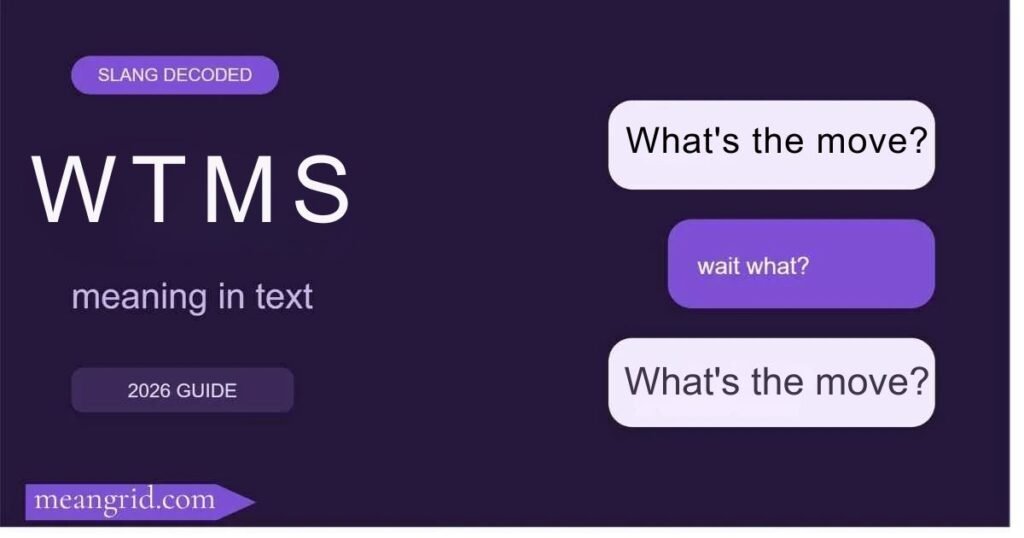
WTMS most often means “What’s the move?” You send it to ask about plans, as in “Everyone’s off work. WTMS?” Some people read the S as “sis” (“What’s the move, sis?”), and a smaller group uses it as a flirty “What that mouth say?” The WTMS meaning in text depends on who sends it and when.
Picture a Friday at 6 p.m. Your friend drops “WTMS tonight?” in the group chat. Nobody’s confused. Now picture the same four letters from a crush at 1 a.m. That one lands differently.
WTMS Meaning in Text & Definition
WTMS is a texting abbreviation that usually stands for “What’s the move?” In this slang, “the move” means the plan. So the message asks what everyone’s doing next.
You’ll run into three readings:
- What’s the move? A neutral plan question. This is the most common one.
- What’s the move, sis? The same question with a friendly tag.
- What that mouth say? A teasing, flirty line that has nothing to do with plans.
The first two ask for a plan. The third is banter, and it only fits with people who already joke that way with you.
Where Does WTMS Come From?
WTMS grew out of “What’s the move?”, a spoken phrase from casual American speech that people shortened for texting. Slang references trace the shorter WTM to at least the early 2010s. The phrase is often linked to Black American slang, and social media carried it everywhere else.
The extra S is the murky part. Major slang references document WTM, while WTMS lives mostly in user-reported usage. That’s why the readings above exist side by side.
Early 2000s online slang entries also gave WTMS unrelated meanings. Those versions rarely show up in current chats.
Examples of WTMS in Conversation
Real chats show WTMS doing three jobs: inviting, checking in, and teasing.
The group invite
Mia: Finals are finally over.
Jay: WTMS tonight?
Mia: Tacos first, then bowling.
The solo check-in
“Got my shift covered. WTMS?”
The playful tease
“You’ve been quiet all day. WTMS 👀”
The first two want a plan back. The last one wants a smile, a joke, or a flirty reply.
When to Use and When Not to Use WTMS
Use WTMS with friends your age in casual chats, and skip it almost everywhere else.
Good moments to use it:
- Starting plans in a friend group chat
- Checking what a close friend wants to do this weekend
- Kicking off a spontaneous hangout
Better to skip it when:
- You’re writing to a boss, teacher, or client
- The other person is upset and needs a real question, not a slang one
- You barely know them and don’t want the flirty reading to creep in
- The reader might not follow texting slang at all
How Is WTMS Used in Different Contexts?
The same four letters shift tone based on your relationship with the sender.
| Context | Likely reading | Tone |
| Friend group chat | What’s the move? | Upbeat, open |
| Close friend DM | What’s the move, sis? | Warm, familiar |
| Crush or dating app | Plan question or flirty line | Playful, loaded |
| Gaming chat | What are we doing next? | Quick, casual |
A group chat nearly always means plans. A one-on-one thread with a romantic edge leaves more room for the teasing version.
WTMS Meaning on Snapchat, TikTok, Instagram, WhatsApp
WTMS means the same thing on every app, but each platform changes how people use it.
- Snapchat: Fast, throwaway chats and story replies. People fire off WTMS to see who’s free right now.
- TikTok: Common in DMs and comment sections. Under someone’s post, it can read as a playful or flirty poke rather than a plan.
- Instagram: Story replies and DMs. It works as a low-pressure way to start talking to someone who just posted.
- WhatsApp: Strong for organizing plans in group threads. Many people keep mixed circles there, so check who’s reading before you type it.
Read More: How Are You Fairing or Faring? Differences + Examples
WTMS in Professional or Technical Fields
Yes, WTMS has real alternate meanings, but none of them overlap with texting. Acronym directories list entries such as World Tourism Marketing Summit, Waste Tire Management System, and Wireless Temperature Monitoring System. A school name abbreviation shows up too.
You’ll spot these on event pages, industry documents, and technical reports. A text thread from a friend won’t use any of them.
How to Tell Which WTMS Meaning You Got
Check five clues: the sender, the time, the platform, any emojis, and the message right before it. Most guides say “read the context” and stop there. This is what that actually looks like.
| Clue | Points to a plan question | Points to the flirty reading |
| Sender | Friend, group, classmate | Crush, someone you’re talking to romantically |
| Time | Daytime, early evening | Late at night |
| Platform | Group chat, Snapchat group | Private DM, comment under a photo |
| Emojis | 🍕 🎳 📍 or none | 👀 😏 😈 |
| Message before it | Free time, events, food | A photo, a compliment, a joke |
Two or more clues in one column usually settle it. If the clues split, treat it as a plan question first. That’s the safer reply, and you can always escalate the tone later.
The “sis” version is easy to catch. If the sender calls you sis in other messages, it’s the friendly plan question.
Common Misunderstandings About WTMS
The biggest mistake is assuming WTMS has one fixed meaning.
- “Sis” isn’t a gender rule. Friends often use it as a general warm tag, not a literal label.
- It doesn’t mean “What’s the matter?” That reading belongs to WTM in some chats, not to WTMS.
- It isn’t a statement. WTMS is a question, so leaving it on read stalls the plan for everyone.
- It isn’t a formal abbreviation. Slang that works in a DM can look careless in an email.
WTMS vs Similar Terms/Alternatives
WTMS asks about future plans, while most look-alike abbreviations ask about right now.
| Term | Meaning | What it asks | Example reply |
| WTMS | What’s the move? | Plans | “Pizza at 8?” |
| WTM | What’s the move? | Plans (shorter) | “Park, then food” |
| WYD | What are you doing? | Right now | “Nothing, bored” |
| WBU | What about you? | A return question | “Same, you?” |
| HMU | Hit me up | Contact me | “Will do” |
WTM and WTMS point at the same question. WTMS tends to feel looser and more playful.
How to Respond to WTMS
Answer with a plan, a counter-question, or a polite pass.
- Ready to go: “Tacos at 7, then the arcade. You in?”
- Still deciding: “No plans yet. What are you feeling?”
- Not tonight: “Staying in tonight. Next weekend?”
- Unsure of the tone: “Ha, which WTMS are we doing? 😄”
That last line works well in a flirty gray area. It keeps things light and lets the sender show their hand.
Tips for Using WTMS Naturally
Pair WTMS with a time or a clue, and it never feels vague.
- Add a time frame: “WTMS tonight?” beats a bare “WTMS?”
- Drop in an option: “WTMS? I’m thinking food.”
- Match the group’s energy. Lowercase and loose punctuation are normal here.
- Save the “sis” version for people you’re genuinely close to.
- Follow up with a real plan once someone answers, so the chat doesn’t stall.
FAQs
What does WTMS mean in text?
WTMS most often means “What’s the move?” It asks what the plan is.
What does WTMS mean from a guy?
From a friend, it asks about plans. From a crush late at night, it can lean flirty, so read the tone before you reply.
Is WTMS the same as WTM?
Yes. Both ask “What’s the move?”, and WTMS simply feels a bit looser.
Is WTMS a bad word?
No. The plan meaning is harmless, and only the flirty reading calls for care.
How do you reply when someone texts WTMS?
Share a plan or ask what they feel like doing. A line like “Tacos at 7, you in?” works.
Conclusion
WTMS usually asks “What’s the move?“, a quick way to ask what everyone’s doing next. Two other readings exist: a friendly “sis” version and a flirty “What that mouth say?” line. You can tell them apart by checking the sender, the time, the platform, and any emojis.
Plan questions fit group chats and daytime messages, while teasing fits late-night DMs. When you’re unsure, answer with a simple plan or a quick question, and keep the whole tone light and friendly.

Albert is a dedicated meaning expert with over 6 years of experience researching word meanings, language usage, and definitions. At Mean Grid, he creates clear, accurate, and easy-to-understand content that helps readers explore the true meaning of words and phrases.