
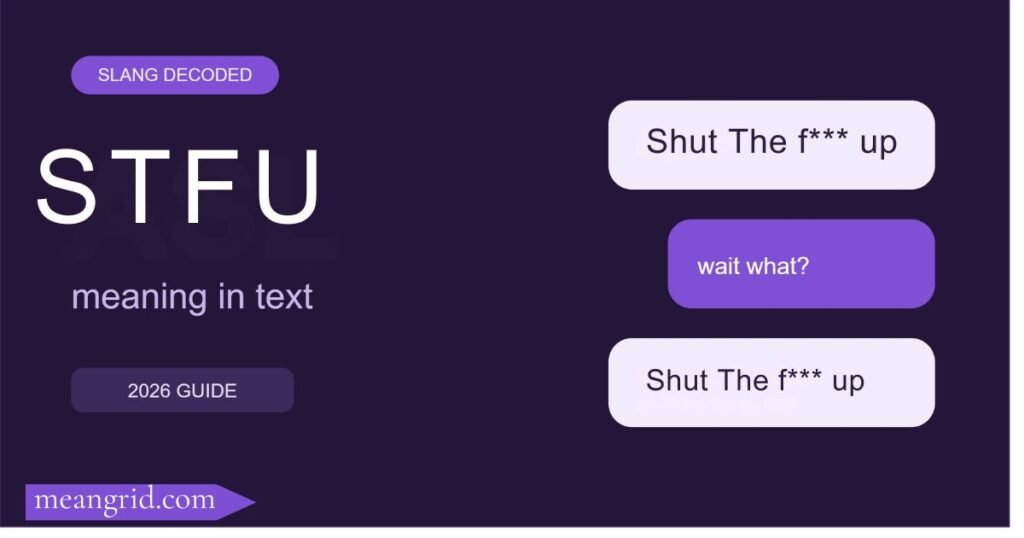
STFU stands for “shut the f*** up.” It’s an internet slang term used in texting and social media to tell someone to stop talking, though the tone can swing from harsh to playful depending on who sends it and how. Context is everything with this one.
You’ve probably seen it pop up in a group chat or under a TikTok comment and paused for a second, wondering if the person is actually mad. That hesitation is normal. STFU is one of those slang terms where the literal words and the real meaning don’t always match, and getting it wrong in either direction can lead to an awkward reply.
STFU Meaning & Definition
At its core, STFU is a four-letter acronym for “shut the f*** up.” It’s blunt by design. The phrase started as a direct command to stop talking, and that base meaning hasn’t changed.
What has changed is how often it’s used to mean something completely different from its literal definition. In modern texting, STFU frequently shows up as:
- A shock reaction (“STFU, no way that happened”)
- A playful jab between close friends
- Genuine annoyance or a real request to stop talking
- Hype or disbelief in response to good news
The word itself is rude by definition. But like a lot of slang, its actual social meaning depends heavily on delivery, punctuation, emojis, and the relationship between the people texting.
Where Does STFU Come From?
STFU traces back to early internet chatrooms and message boards in the late 1990s and early 2000s. Spaces like IRC and AOL Instant Messenger relied on fast typing, and abbreviating a strong phrase was quicker than spelling it out in full. It also slipped past basic word filters that some platforms used at the time.
As texting and then smartphones took over daily communication, STFU rode along with other acronyms like LOL, IDM, and OMG. The difference is that STFU kept its edge. Even as it became more common and more casual, it never fully lost its blunt, confrontational root.
By the 2020s, STFU had become a fixture across nearly every major platform, used by teens, young adults, and gamers alike.
Examples of STFU in Conversation
Seeing it in context makes the tone much easier to read.
Playful, between friends:
- Friend 1: guess who just got the internship
- Friend 2: STFU!! congrats that’s amazing
Mild irritation:
- Friend 1: I already told you this story twice
- Friend 2: stfu I forgot, sorry
Genuinely upset:
- Friend 1: you’re not even listening to me right now
- Friend 2: just STFU and let me finish
Same word, three very different emotional temperatures. The words around it, along with punctuation and emojis, are doing most of the work.
When to Use and When Not to Use STFU
STFU works fine in casual settings with people who already know your texting style. It does not translate well to unfamiliar audiences.
Generally okay:
- Close friends who text this way regularly
- Reacting to shocking or funny news in a private chat
- Gaming voice chat or Discord among regulars
Avoid it:
- Texting a parent, teacher, boss, or new acquaintance
- Public comments where strangers can’t read your tone
- Any moment where the other person seems genuinely upset
If there’s any doubt about how it’ll land, it’s safer to skip it.
How Is STFU Used in Different Contexts?
Context reshapes the entire meaning of STFU. A few common patterns:
- Reacting to news: almost always positive shock, close to “no way” or “seriously?”
- During an argument: typically hostile and meant literally
- In banter: a light jab that signals comfort, not anger
- In gaming: trash talk during intense moments, rarely meant to be taken personally
The same three letters carry all of these meanings, which is exactly why misreads happen so often between people who don’t know each other well.
STFU Meaning on Snapchat, TikTok, Instagram, WhatsApp
| Platform | Common Tone | Typical Use |
| Snapchat | Playful, reactive | Quick response to a snap or story, often with an emoji |
| TikTok | Theatrical, expressive | Comments reacting to impressive or shocking videos |
| Depends on space | Enthusiastic in comments, harsher in DMs during conflict | |
| Depends on group | Common in friend groups, rare in family or work chats | |
| Discord/Gaming | Blunt, fast | Trash talk or frustration mid game, sometimes moderated |
Public platforms like TikTok and Instagram comments tend to skew more theatrical and positive, since the audience is wider and the exaggeration reads as entertainment. Private chats like Snapchat and WhatsApp lean more on existing relationship history to set the tone.
STFU in Professional or Technical Fields
STFU has one notable non-slang meaning worth knowing. It’s also the acronym for the Southern Tenant Farmers Union, a labor organization formed in the 1930s in the American South that advocated for sharecroppers and tenant farmers regardless of race. That meaning shows up occasionally in history and labor studies contexts, and it has nothing to do with the texting slang version.
Outside of that historical reference, STFU has no accepted professional or technical meaning. It should not appear in workplace messages, school assignments, or formal writing.
The Nuance Nobody Explains: Text Has No Tone
Here’s the part most guides skip. Spoken aloud, “shut the f*** up” comes with volume, pitch, and facial expression that instantly tell you if it’s a joke or a real demand. Texted, none of that exists. You’re left decoding intent from punctuation, emojis, and prior context alone.
This is why the exact same message, “stfu,” can read as a compliment from one friend and as a genuine insult from someone you barely know. A trailing laughing emoji, extra letters like “stfuuu,” or an exclamation point usually signal playfulness. A flat, single-word “stfu.” with no emoji and a period at the end reads much more seriously.
If you’re on the receiving end and unsure, it’s worth asking directly rather than guessing. If you’re sending it to someone who doesn’t know your texting habits well, consider whether the joke will actually land without your tone of voice attached to it.
Common Misunderstandings About STFU
A few recurring mix-ups worth clearing up:
- Assuming it’s always an insult. In friend groups, it’s often closer to “wow” or “no way” than an actual command.
- Assuming it’s always harmless. Between strangers or during real conflict, it’s genuinely rude and can escalate tension.
- Reading generational intent wrong. Younger texters lean toward using it as reaction slang, while it’s still occasionally used literally across age groups when someone actually wants the conversation to stop.
- Ignoring platform norms. What’s normal in a gaming lobby can look aggressive in a work adjacent group chat.
STFU vs Similar Terms
| Term | Meaning | Typical Tone |
| STFU | Shut the f*** up | Ranges from playful to hostile |
| STHU | Shut the hell up | Slightly softer, still blunt |
| GTFO | Get the f*** out | Aggressive, often about leaving a space |
| STSU | Shut the Stuck Up | Gentle, non confrontational |
| IDC | I don’t care | Dismissive, not about silencing someone |
STFU sits toward the harsher end of this group. STHU softens the profanity slightly, while shush removes the edge entirely and works fine in polite company.
How to Respond to STFU
How you respond depends on the tone you’re reading.
- If it’s clearly playful: match the energy. “lmaooo stfu I know right” keeps the exchange light.
- If you’re not sure: ask plainly. “wait are you actually annoyed or joking” clears it up fast.
- If it feels hostile: you don’t need to escalate. A simple “okay, noted” or stepping away from the conversation is a reasonable response.
There’s no obligation to keep engaging if someone uses it aggressively and repeatedly.
Tips for Using STFU Naturally
- Save it for people who already know your texting style
- Pair it with an emoji or extra letters when you mean it playfully
- Skip it entirely in new relationships, work chats, or with family members you’re unsure about
- Read the room before typing it in a group chat with mixed familiarity levels
- When in doubt, a softer alternative like “no way” gets the same reaction across without any risk
FAQs
What does STFU mean in a text message?
STFU stands for “shut the f*** up” and is used to react to shocking news or, less often, to genuinely tell someone to stop talking.
Is STFU always rude?
No, among friends it’s frequently a playful or excited reaction rather than a genuine insult.
What does STFU mean from a girl in a joking context?
It typically signals surprise, amusement, or excitement rather than any real anger.
Is there a polite version of STFU?
Shush or “please stop” carry similar intent without the profanity or harsh tone.
Does STFU have any non slang meaning?
Yes, it’s also the acronym for the Southern Tenant Farmers Union, a 1930s labor organization, unrelated to texting slang.
Conclusion
STFU carries a lot of range for four letters. It can be a compliment in disguise, a light joke, or a genuine sign someone wants the conversation to stop.
Reading the platform, the relationship, and the punctuation around it will almost always tell you which one you’re dealing with.

Albert is a dedicated meaning expert with over 6 years of experience researching word meanings, language usage, and definitions. At Mean Grid, he creates clear, accurate, and easy-to-understand content that helps readers explore the true meaning of words and phrases.