
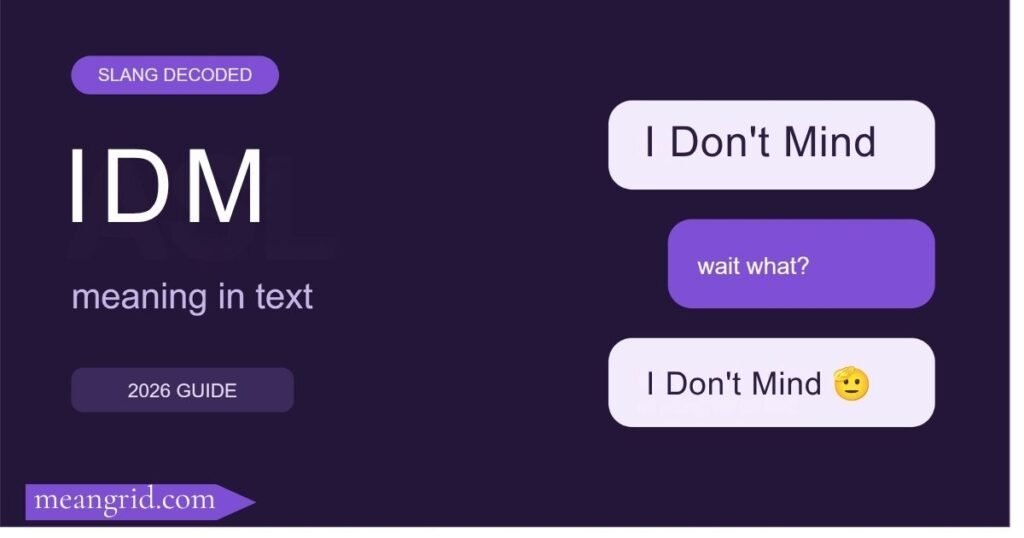
IDM means “I don’t mind.” People text it to show they’re okay with a choice or option without a strong preference either way. It’s a fast, casual way to say “either works for me” without typing the full sentence.
You’ll see IDM in group chats, Snapchat replies, and DMs when someone asks a simple either-or question. It’s not rude by default, and it’s not a hidden code. It’s just a shortcut for a phrase people already say out loud every day. You May Also Like This : RLS Meaning in Text
IDM Meaning & Definition
IDM stands for “I don’t mind.” It’s used when someone is fine with more than one option and doesn’t want to pick for the group. Think of it as a lighter cousin of “sure” or “whatever works.”
The core meaning stays the same across most texting apps. Someone asks a question with two or more choices, and IDM signals openness rather than a firm answer. It shows flexibility, not indifference, though tone can shift that slightly.
Where Does IDM Come From?
IDM follows the same pattern as older texting shortcuts like IDK (“I don’t know”) and IDC (“I don’t care”). As phone keyboards got smaller and group chats got faster, people started trimming common phrases down to their first letters.
“I don’t mind” was already a common spoken phrase long before texting existed. The abbreviation just caught up to how people already talked. It spread through messaging apps and stuck around because it’s short, clear, and easy to type with one thumb.
Examples of IDM in Conversation
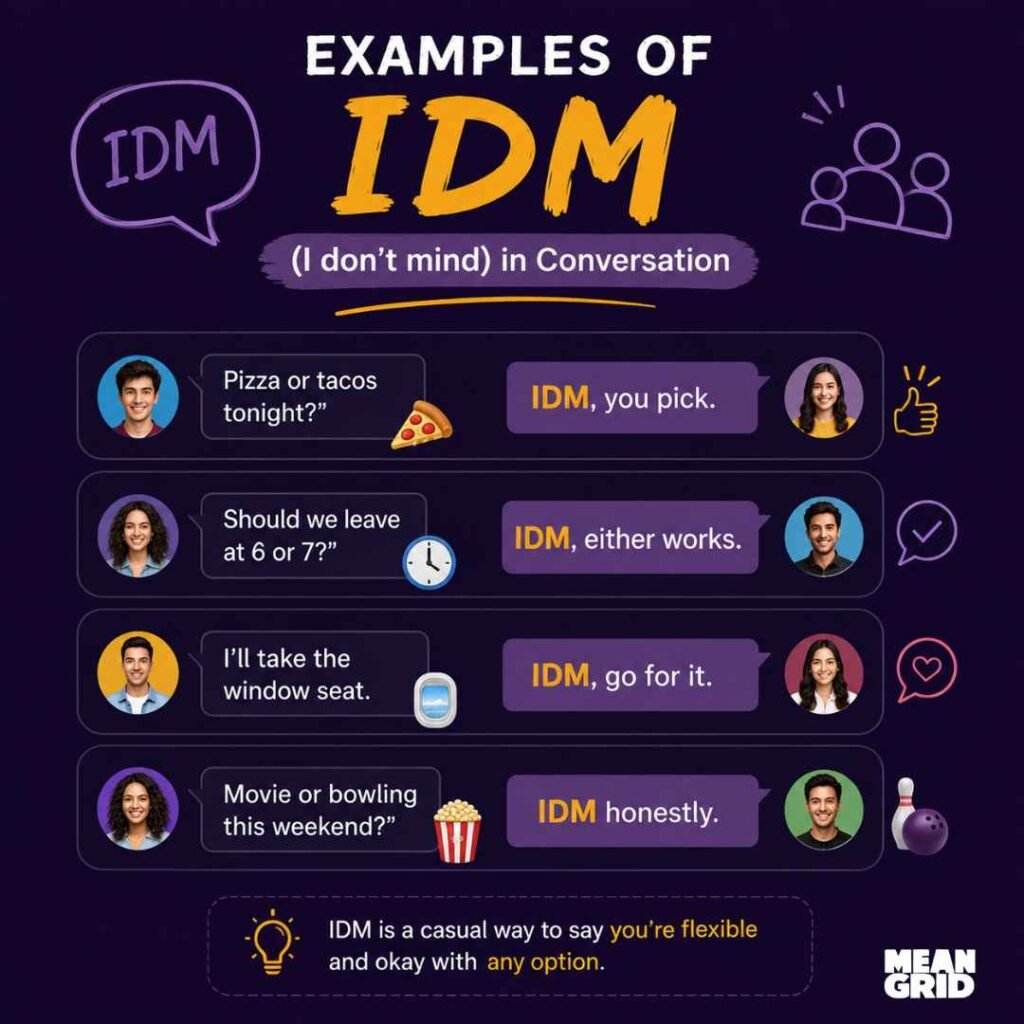
Real examples make the meaning click faster than a definition alone.
- “Pizza or tacos tonight?” “IDM, you pick.”
- “Should we leave at 6 or 7?” “IDM, either works.”
- “I’ll take the window seat.” “IDM, go for it.”
- “Movie or bowling this weekend?” “IDM honestly.”
In each case, IDM hands the decision back to the other person without sounding dismissive. It works best when the question genuinely has two fine options.
When to Use and When Not to Use IDM
Use IDM when a friend, sibling, or casual group chat asks a low-stakes either-or question. It fits perfectly in scheduling plans, picking food, or choosing between two harmless options.
Skip IDM in formal messages, job-related chats, or serious conversations. Typing “IDM” to a manager or in a customer service message reads as sloppy rather than casual. It also falls flat when someone is asking for genuine emotional input, like “do you still want to go to the wedding?” A one-word IDM there can feel like you’re avoiding the real answer.
How Is IDM Used in Different Contexts?
Context changes how much weight IDM carries. Among close friends, it’s practically invisible, just a normal part of fast back-and-forth texting. In a group chat with people who don’t know each other well, it can read as slightly more neutral or distant since there’s no established shorthand yet.
In dating chats, IDM often shows up when picking a date idea or restaurant. It usually reads as easygoing rather than uninterested, especially when followed by an emoji or a quick follow-up line. In work-adjacent group chats, like planning a team lunch, IDM is common but still casual, so it works better for food and timing than for anything that actually needs a decision-maker.
IDM Meaning on Snapchat, TikTok, Instagram, WhatsApp
The meaning doesn’t change much across platforms, but the tone can.
- Snapchat: Common in quick replies to streaks or plans, usually paired with an emoji to keep it light.
- Instagram DMs: Used in comment replies and story replies when someone offers two options.
- WhatsApp: Frequently used in group chats for scheduling, since it keeps replies short in busy threads.
- TikTok comments: Shows up less often as a direct reply and more as a comment reacting to a poll-style caption.
Across all four, IDM keeps its core meaning. The platform mostly affects how many emojis or extra words tend to follow it.
IDM Meaning in Professional or Technical Fields
Outside of texting slang, IDM has a completely separate identity. In software, IDM most often refers to Internet Download Manager, a download accelerator tool for Windows that has nothing to do with texting slang. In IT and enterprise software, IDM can also stand for Identity Management, a system used to control user access and permissions.
Neither of these meanings has any connection to the “I don’t mind” texting sense. If IDM shows up in a tech support thread, a software review, or an IT job listing, it’s almost certainly not the slang meaning at all.
How to Tell What IDM Really Means (Context Clues That Actually Work)
Most guides stop at “IDM means I don’t mind,” but the confusion people actually search for is usually about tone or which IDM someone means. Here’s a quick way to sort it out.
First, check the setting. If the message is in a personal chat, comment, or DM, it’s texting slang. If it’s in a tech forum, software review, or a company’s internal systems documentation, it’s Internet Download Manager or Identity Management.
Second, check tone signals inside the chat itself:
| Signal | Likely Meaning |
| Lowercase “idm” with an emoji | Relaxed, genuinely flexible |
| Capital “IDM” with no punctuation | Neutral, standard use |
| “IDM.” as a full stop, no emoji, no follow-up | Possibly short on patience or distracted |
| “IDM” after a repeated ask from the same person | Can read as slightly checked out |
| “IDM lol” or “IDM either way” | Friendly, low-stakes flexibility |
Autocorrect rarely changes IDM since it’s not a real word, but some keyboards will suggest capitalizing it automatically, which is why capital IDM doesn’t usually signal anything extra on its own. The real clue is what comes before and after it in the conversation, not the letters themselves.
Common Misunderstandings About IDM
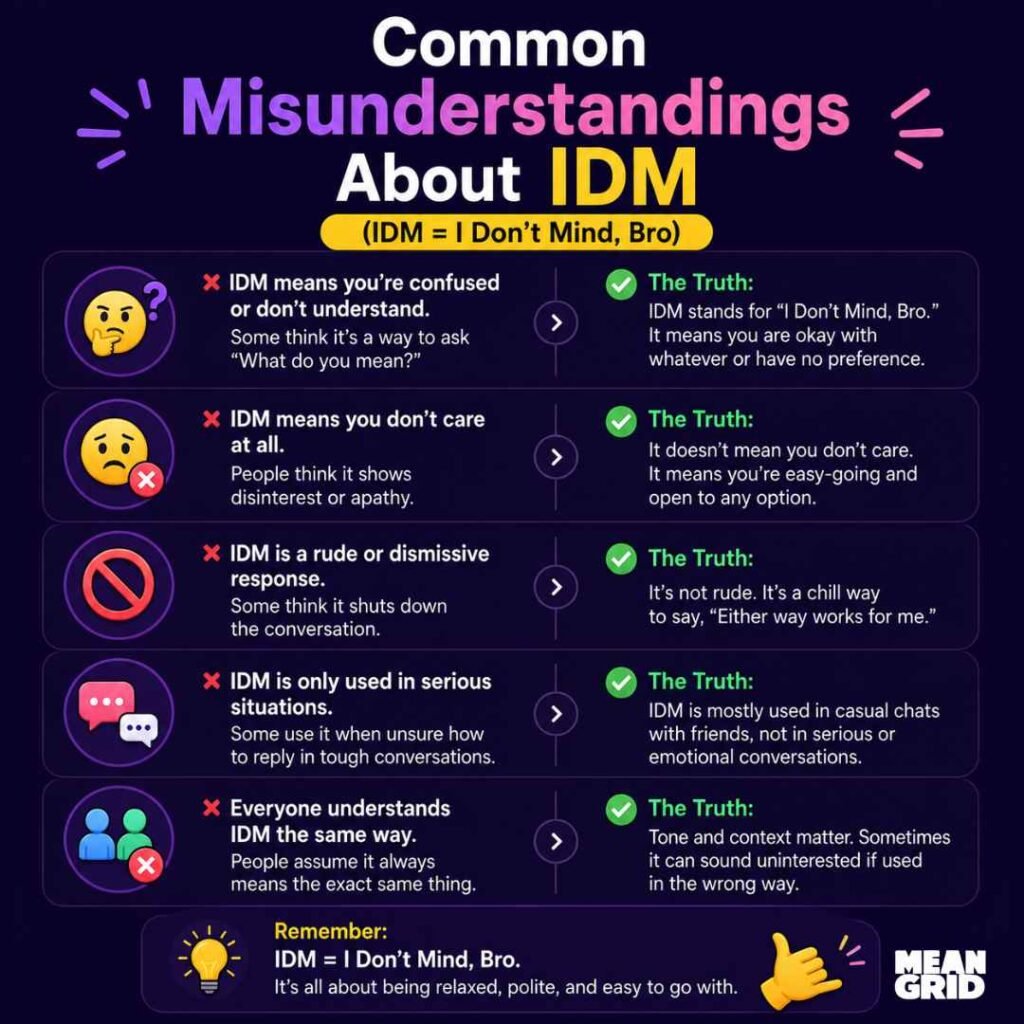
The biggest mix-up is assuming IDM always sounds cold or bored. Most of the time it doesn’t. It reads as neutral-to-friendly unless the rest of the conversation already feels tense.
Another common mistake is treating IDM and IDC as interchangeable. They’re related but not identical in tone, which the next section breaks down clearly. People also sometimes assume IDM is a new or trendy term, when it’s really been in steady, quiet use for years without much change.
IDM vs Similar Terms and Alternatives
| Term | Meaning | Tone |
| IDM | I don’t mind | Open, flexible |
| IDC | I don’t care | Can sound blunt or dismissive |
| IDK | I don’t know | Uncertain, not about preference |
| IMO | In my opinion | States a personal view |
| NP | No problem | Reassuring, not about choices |
IDM sits closer to agreement than IDC does. IDC often shuts a question down, while IDM tends to keep the conversation moving by leaving the choice open.
How to Respond to IDM
If someone replies with IDM, the easiest move is to just make the call yourself.
- “Cool, let’s do 7 then.”
- “Okay, tacos it is.”
- “Alright, I’ll pick the movie this time.”
If you want more input, a quick follow-up works fine: “You sure? No preference at all?” This keeps the conversation warm without making a big deal out of a short reply.
Tips for Using IDM Naturally
Pair IDM with a quick tag like “you pick” or “whatever works” so it doesn’t read as flat. Save it for genuinely low-stakes choices, and spell things out fully when the topic actually matters to you. Use an emoji if you want to soften the tone in a new or less familiar chat.
FAQs
What does IDM mean in a text message?
IDM means “I don’t mind.” It’s used to show you’re okay with either option someone offers.
Is IDM the same as IDC?
No. IDM is generally softer and more agreeable, while IDC can sound more dismissive or indifferent.
Does IDM mean something different in tech or software?
Yes. In tech contexts, IDM usually stands for Internet Download Manager or Identity Management, unrelated to texting slang.
Is it rude to reply with just IDM?
Not usually. It only risks sounding cold if the question was emotional or if it’s used after someone already asked twice.
Is IDM still commonly used in 2026?
Yes. It remains a standard, low-key texting abbreviation across WhatsApp, Instagram, Snapchat, and group chats.
Conclusion
IDM meaning in text comes down to one simple idea: no strong preference, and that’s completely fine.
It works well in casual chats and group plans, but it’s worth swapping out for a full sentence in anything formal or emotionally serious.
Once you know the tone cues to watch for, IDM stops being confusing and just becomes another easy shortcut in everyday texting.
Read More Meanings :

Albert is a dedicated meaning expert with over 6 years of experience researching word meanings, language usage, and definitions. At Mean Grid, he creates clear, accurate, and easy-to-understand content that helps readers explore the true meaning of words and phrases.