
IMS most often means “I’m Sorry ” in casual texting, though it can also stand for “I Mean Seriously,” “I Miss You,” or “I’m Saying” depending on the conversation.
The right meaning depends on who sent it, what came before it, and which platform you’re on. This guide breaks down every common definition so you never have to guess again.
IMS Meaning & Definition
IMS is a texting abbreviation with several meanings. The correct meaning depends on the conversation.
Here are the most common meanings:
- I’m Sorry : Used to apologize quickly in a text or chat.
- I Mean Seriously: Used to emphasize a strong opinion or point.
- I Miss You” Often seen in messages like “IMS you.”
- I’m Saying: Used to agree with or reinforce what someone else said.
There is no single official definition of IMS. It is internet slang, so its meaning changes based on the context.
The best way to understand IMS is to read the rest of the message. The surrounding words, emojis, and conversation usually make the intended meaning clear.
Where Does IMS Come From?
IMS grew out of the same texting culture that gave us BRB, TTYL, and IDK. When phones had character limits, people shortened whatever phrase they used most, and apologies, emphasis, and affection all got compressed into quick letter combos. The habit stuck around because short replies still feel faster than typing full sentences.
The technical use of IMS predates the slang version. Telecom engineers use it for IP Multimedia Subsystem, a framework that lets carriers deliver calls, video, and messaging over one internet-based network. Early instant messaging platforms also used IMS for Instant Messaging Service. Those meanings still show up occasionally, but rarely in a casual text thread.
Examples of IMS in Conversation
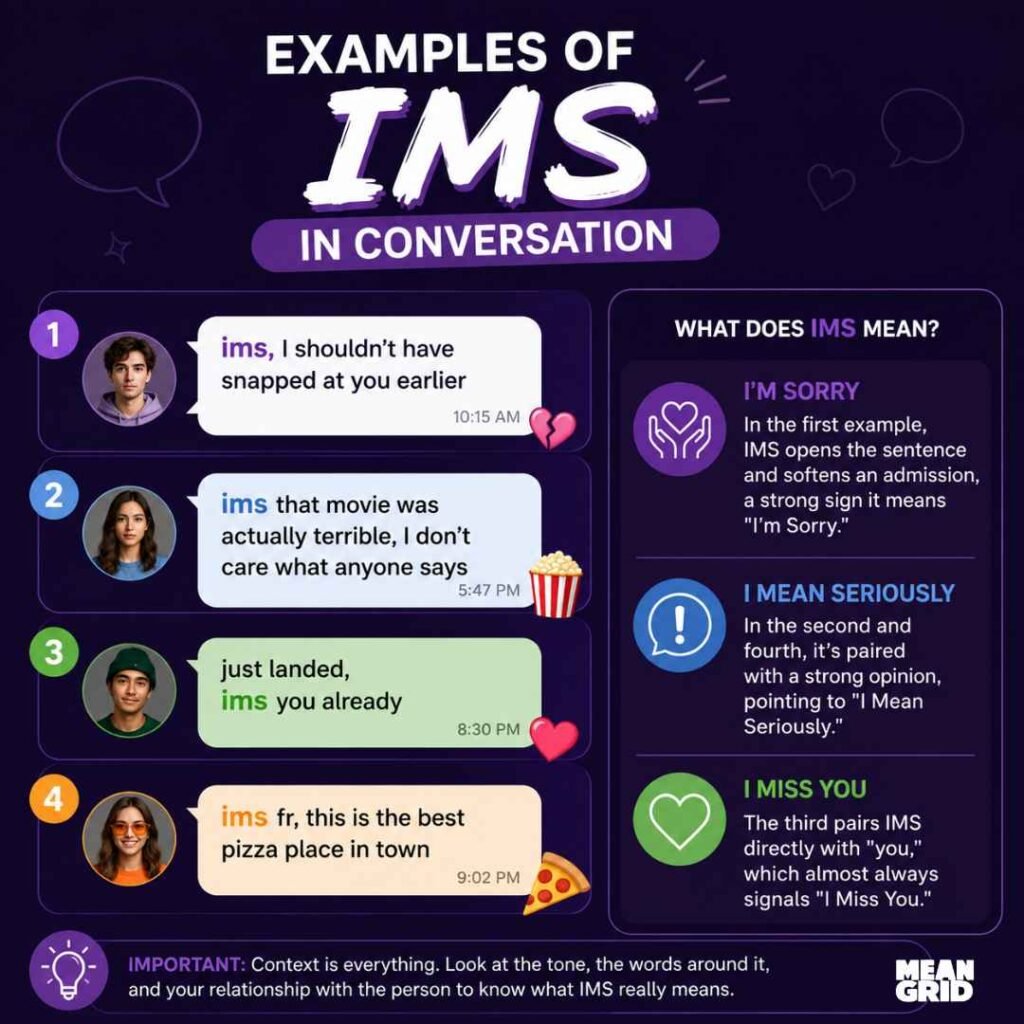
Seeing IMS in a sentence makes the meaning much easier to spot than seeing the letters alone.
- “ims, I shouldn’t have snapped at you earlier”
- “ims that movie was actually terrible, I don’t care what anyone says”
- “just landed, ims you already”
- “ims fr, this is the best pizza place in town”
In the first example, IMS opens the sentence and softens an admission, a strong sign it means “I’m Sorry.” In the second and fourth, it’s paired with a strong opinion, pointing to “I Mean Seriously.” The third pairs IMS directly with “you,” which almost always signals “I Miss You.”
When to Use and When Not to Use IMS
IMS works well in low-stakes, casual exchanges: group chats, texts between friends, quick social media replies, or light apologies over something small. It reads as informal and a little playful, so it fits relationships where a full sentence would feel stiff.
It doesn’t work in situations that call for clarity or sincerity. A real apology after a serious argument deserves full words, not a shortcut that can look like you didn’t take the moment seriously. The same goes for work emails, customer service chats, or messages to anyone who might not know texting slang. In those settings, spelling it out avoids confusion and looks more thoughtful.
How Is IMS Used in Different Contexts?
Context changes what IMS means almost as much as the words around it do.
In friend group chats, IMS usually leans toward “I Mean Seriously,” used to back up an opinion during a lighthearted debate.
In one-on-one texts between people who are close or dating, IMS more often means “I’m Sorry” or, when paired with “you,” “I Miss You.”
In comment sections and public posts, IMS tends to agree with or emphasize a point, closer to “I’m Saying.” Gaming and tech forums are the rare spots where the older “Instant Messaging Service” meaning still pops up, though it’s uncommon even there now.
IMS Meaning on Snapchat, TikTok, Instagram, WhatsApp
On Snapchat and Instagram DMs, IMS shows up most in personal, one-on-one conversations, where it usually means “I’m Sorry ” or “I Miss You” depending on what precedes it.
TikTok comments favor the “I Mean Seriously” reading, since people use it to double down on an opinion in a fast-moving thread.
WhatsApp conversations, which tend to involve closer contacts like family or partners, lean toward the apology and affection meanings more than the emphatic one. Across every app, though, the surrounding words still matter more than the platform itself.
IMS Meaning in Professional or Technical Fields
Outside of texting, IMS carries real technical weight. In telecommunications, IP Multimedia Subsystem is the standard many carriers rely on to combine voice, video, and messaging into one IP-based network, which is part of what makes modern calling and rich messaging features possible.
In older tech contexts, IMS referred to Instant Messaging Service, a general term for chat platforms before “IM” became common shorthand on its own.
If you see IMS in a technical document, an engineering conversation, or a telecom job posting, it’s almost certainly one of these definitions, not the slang version. Reading the surrounding vocabulary quickly tells you which world you’re in.
How to Tell Which IMS Meaning Someone Means
This is the part most guides skip, and it’s the most useful part. You can figure out which IMS someone means by checking four things in order.
First, look at what follows it. “IMS you” is essentially always “I Miss You.” No other meaning attaches naturally to “you” in that position.
Second, check where it sits in the sentence. IMS at the very start, followed by an admission or explanation, usually means “I’m Sorry.” IMS in the middle of a strong opinion, especially before “fr” or “though,” usually means “I Mean Seriously.”
Third, consider the relationship. Apologies and “I miss you” show up more between people who are close, dating, or family. “I mean seriously” and “I’m saying” show up more in group chats, comment threads, and casual banter between people who aren’t necessarily close.
Fourth, rule out a typo. On many phone keyboards, the apostrophe sits close to letters that are easy to hit by accident while typing fast, so “I’m” can turn into “ims” if the apostrophe gets dropped. If IMS appears where “I’m” would make grammatical sense, like “ims heading out now,” that’s often exactly what happened.
Common Misunderstandings About IMS
The biggest misunderstanding is assuming IMS has one fixed meaning. People who only know the “I’m Sorry” version can misread “ims fr” as an apology when it’s actually agreement or emphasis, which changes the whole tone of the message.
Another common mix-up happens with “ims you.” Some readers assume it’s a typo for “I’m Sorry, you…” when it’s shorthand for “I miss you,” which can lead to an awkward reply that doesn’t match what the sender meant at all. Older internet users occasionally read IMS as the technical telecom or messaging term even in a casual text, simply because that’s the definition they learned first.
IMS vs Similar Terms
| Term | Common Meaning | Typical Context |
| IMS | I’m Sorry / I Mean Seriously / I Miss You | Casual apologies, emphasis, or affection |
| IMY | I Miss You | Direct affection, no ambiguity |
| ISY | I Miss You (less common variant) | Similar to IMY |
| TBH | To Be Honest | Sharing an honest opinion |
| NGL | Not Gonna Lie | Admitting something candidly |
IMS stands out because it does the job of three or four separate abbreviations depending on context, while terms like IMY and TBH stay narrow and consistent no matter where you see them.
How to Respond to IMS
Your reply should match whichever meaning fits the conversation.
- If it reads as an apology: “It’s okay, thanks for saying that”
- If it reads as emphasis: “Lol I know, you’re so right”
- If it reads as “I miss you”: “Miss you too, talk soon”
Matching the tone of the reply to the likely meaning keeps the conversation smooth and avoids the awkward pause that comes from misreading a short text.
Tips for Using IMS Naturally
Keep IMS for people who already text you casually, since strangers and older relatives may not recognize it.
Pair it with context clues, like “fr” for emphasis or “you” for affection, so your meaning is obvious without extra explanation.
Avoid it in any message where being misunderstood would actually matter, and when in doubt, add one extra word to clarify, like “ims (sorry)” or “ims you (miss).”
FAQs
What does IMS mean in text?
IMS usually means “I’m Sorry” in text messages. However, it can also mean “I Must Say” or “Instant Messaging Service,” depending on context.
What does IMS mean on Snapchat?
On Snapchat, IMS most commonly stands for “I’m Sorry.” Friends use it to apologize quickly during chats while keeping conversations casual and friendly.
What does IMS mean on TikTok?
On TikTok, IMS generally means “I’m Sorry.” Some creators may use “I Must Say,” so always check the surrounding caption or comments first.
Is IMS always used to mean “I’m Sorry”?
No. Although “I’m Sorry” is the most common meaning, IMS can represent different phrases depending on the conversation, platform, or specific context.
How do I know what IMS means in a message?
Read the entire conversation carefully. The surrounding words, emojis, and topic usually reveal whether IMS means “I’m Sorry” or another phrase.
Conclusion
IMS doesn’t have one single meaning, and that’s exactly why context matters more than the letters themselves.
Once you know to check the words around it, who sent it, and which platform it’s on, figuring out whether someone means “I’m Sorry,” “I Mean Seriously,” or “I Miss You” becomes second nature.

Albert is a dedicated meaning expert with over 6 years of experience researching word meanings, language usage, and definitions. At Mean Grid, he creates clear, accurate, and easy-to-understand content that helps readers explore the true meaning of words and phrases.