
HBY stands for “how about you?” People use it to toss a question back after answering it. If a friend texts “I’m good, just tired, hby?”, they want your answer next.
It’s quick, friendly, and common on Snapchat, Instagram, TikTok, and WhatsApp. Picture a classmate texting “Pizza tonight, hby?” or a coworker saying “Slammed with meetings, hby?” The move is the same every time: here’s my answer, now give me yours.
This guide breaks down HBY meaning in text, how to reply, and what it quietly signals.
HBY Meaning in Text and Full Definition
HBY is a texting abbreviation for how about you. It works as a return question. You share something, then add HBY to hand the conversation back to the other person. Think of it as saying “and you?” out loud.
- Full form: How about you
- Type: Casual abbreviation
- Usual spot: End of a message, right after your own answer
Capitalization changes nothing. HBY, hby, and Hby all mean the same thing.
Where Does HBY Come From?
Nobody can name the person who first typed HBY. It grew out of speech. Most people say “how ’bout you” out loud, and that clipped “’bout” made the shortcut feel natural.
Early phones had slow keyboards and tight message limits, so people trimmed common phrases. “How are you” became HRU. “What about you” became WBU. “How about you” became HBY. Messaging apps then spread these shortcuts everywhere. HBY keeps the first letter of “you,” while HBU swaps in the shorthand “u.”
Examples of HBY in Conversation
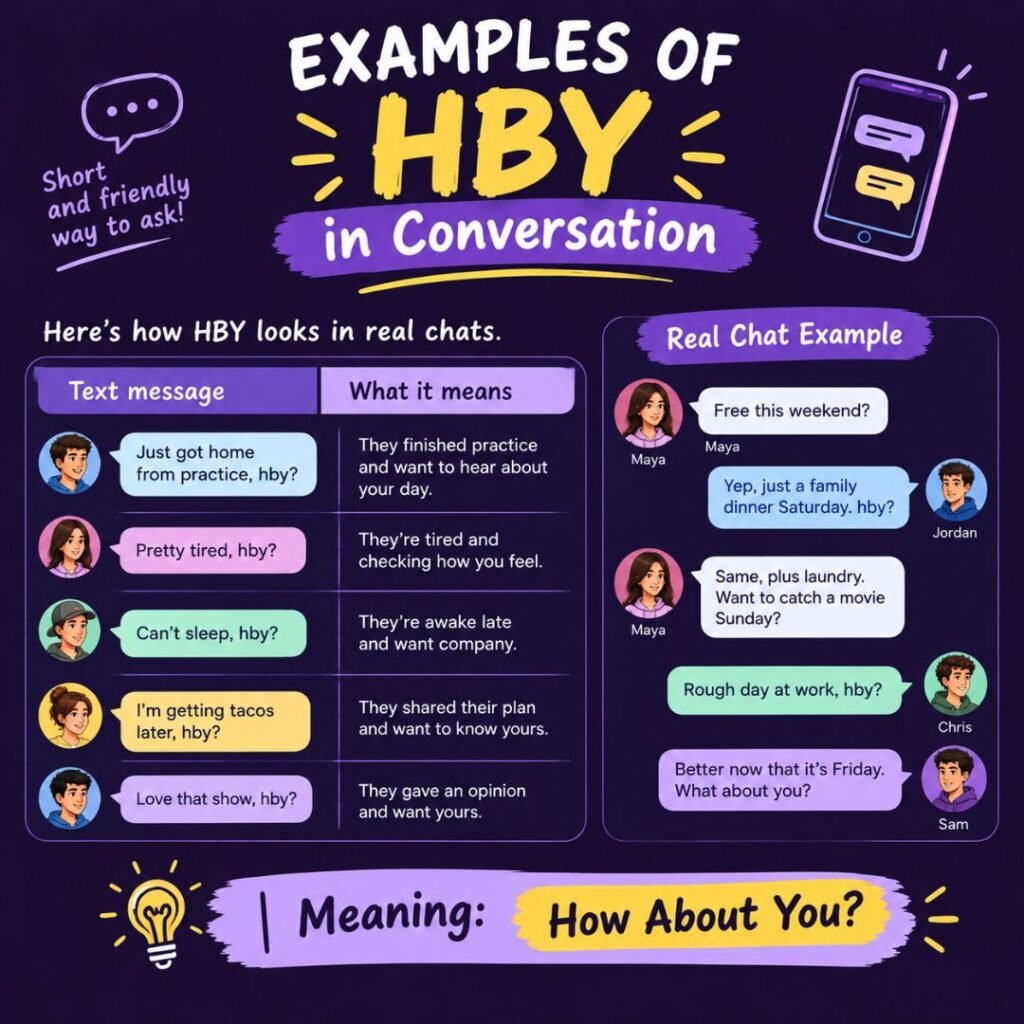
Here’s how HBY looks in real chats.
| Text message | What it means |
| “Just got home from practice, hby?” | They finished practice and want to hear about your day. |
| “Pretty tired, hby?” | They’re tired and checking how you feel. |
| “Can’t sleep, hby?” | They’re awake late and want company. |
| “I’m getting tacos later, hby?” | They shared their plan and want to know yours. |
| “Love that show, hby?” | They gave an opinion and want yours. |
Maya: Free this weekend?
Jordan: Yep, just a family dinner Saturday. hby?
Maya: Same, plus laundry. Want to catch a movie Sunday?
Chris: Rough day at work, hby?
Sam: Better now that it’s Friday. What happened?
When to Use and When Not to Use HBY
Use HBY when:
- You’re texting friends, classmates, or people your age
- You just answered a question and want to keep things moving
- The chat is light, like plans, small talk, or jokes
Skip HBY when:
- You’re emailing a boss, client, or professor
- Someone shared bad news or a serious problem. A flat “hby?” feels cold, so ask a real question
- You’re texting someone who may not know slang, like a grandparent
In those cases, write out “how about you” in full.
A Quick Rule of Thumb
If you’d say “how ’bout you?” out loud to this person, HBY is safe. If you’d say “and yourself?” instead, type the full phrase.
How Is HBY Used in Different Contexts?
Context shapes the meaning behind the three letters.
- Small talk: “Doing good, hby?” keeps a greeting going.
- Making plans: “I’m free after 6, hby?” asks for availability.
- Sharing opinions: “That movie was great, hby?” asks what you think.
- Getting to know someone: “I’m into hiking, hby?” invites you to share your interests.
- Group chats: HBY can aim at one person or everyone, so check who’s tagged or quoted.
Read More: ISK Meaning in Text: What It Really Stands For Across Apps
HBY Meaning on Snapchat, TikTok, Instagram, and WhatsApp
The meaning stays the same everywhere. The habits around it change.
- Snapchat: Replies are fast and short, so HBY keeps a snap thread alive. You’ll often see it in quick answers to a friend’s snap.
- TikTok: You’ll see it in DMs and comment replies, where someone answers a question and asks one back.
- Instagram: Common in DMs and story replies. Someone reacts to your story, then adds “hby?” to start a real chat.
- WhatsApp: Used in everyday chats worldwide. Chats run longer here, so HBY often leads into a fuller reply.
HBY on Dating Apps, Discord, and Work Chat
On Hinge, Bumble, and Tinder, HBY often shows up in early messages. It’s a polite way to keep things balanced. On Discord, it’s casual and usually goes to a specific person. On Slack or Teams, it works with close coworkers but not with senior leaders or clients.
What Your HBY Really Signals: Tone, Timing, and Effort
Most guides stop at the definition. Here’s what HBY says beyond its words.
| What you see | What it usually signals |
| A long answer, then “hby?” | Real interest. They want a real reply. |
| “good hby” | Autopilot politeness. Keep your answer short too. |
| Lowercase “hby?” | Relaxed and friendly. |
| Capital “HBY?!” | Excited, sometimes pushy. |
| “hby.” with a period | Flat or cool. |
| HBY from someone new | Polite curiosity, not a deep question yet. |
| HBY after you shared something big | They want more detail from you. |
| HBY sent within seconds | They’re engaged and chatting live. |
| HBY sent hours later | Often a catch-up reply, not disinterest. |
Use the follow-up test. If they react to your answer with a question of their own, the HBY was genuine. If they reply “nice” and go quiet, it was filler.
Watch for the HBY loop too. When both people only trade “good, hby?” back and forth, the chat has stalled. Break it by sharing one specific thing.
Texts lack voice and face, so punctuation and timing carry the tone. Read the pattern across several messages, not one.
Common Misunderstandings About HBY
- It doesn’t mean “how are you.” That’s HRU. HBY only works after you’ve said something about yourself.
- It doesn’t mean “how you been.” That’s HYB, used when catching up after time apart.
- It doesn’t mean “happy birthday.” HB and HBD cover that, and sites claiming otherwise are wrong.
- It isn’t only for teens. Adults of all ages use it in casual chats.
- It doesn’t demand a long answer. A short, honest reply works fine.
HBY vs Similar Terms and Alternatives
Several look-alike abbreviations do similar jobs, but each fits a different moment.
| Term | Meaning | Best used when |
| HBY | How about you | You answered and want theirs |
| HBU | How about you | Interchangeable with HBY |
| WBU | What about you | Same job as HBY, different wording |
| HRU | How are you | You’re opening a chat |
| HYB | How you been | You’re catching up after time apart |
How to Respond to HBY
Answer the same question they answered, add one detail, then pass the conversation back with a question of your own. Try these:
- They say: “Pretty good, just got off work. hby?” You say: “Same, long day. Want to grab food?”
- They say: “Studying for finals, hby?” You say: “Procrastinating, honestly. What are you studying?”
- They say: “Love hiking, hby?” You say: “Big hiker. Any favorite trail?”
If you’re unsure what they asked, reply to the sentence before the HBY. That’s the question they’re handing you.
What If You Don’t Want to Answer?
Keep it light: “Long story, ask me later. How’s your week?” You stay friendly without sharing more than you want to.
Tips for Using HBY Naturally
- Answer first, then add HBY.
- Share a real detail so the question feels earned.
- Use it once per exchange, since repeating it every message feels scripted.
- Mirror their style: if they write full sentences, match that.
- Swap in a specific question when you want more than a quick answer.
FAQs
What does HBY mean in text?
HBY means “how about you?” People use it to ask the same question back after they answer.
Does HBY mean “how are you”?
No. HBY means “how about you,” and “how are you” is HRU.
What does HBY mean on Snapchat?
On Snapchat, HBY means “how about you?” and keeps a quick chat going.
Is HBY rude in a text?
No. HBY is friendly, though a bare “hby.” with a period after a one-word answer can feel flat.
How do you reply to HBY?
Answer the same question, add a detail, then ask something back.
Conclusion
HBY means “how about you,” and it’s a simple way to keep a text conversation balanced. Answer first, add one real detail, and then pass the question back. Watch the tone signals, because punctuation and timing often say more than the three letters do.
Save the full phrase for formal chats, and use HBY freely with friends. Now you know what HBY means, how to reply, and when to send it. That’s all you need to text it with confidence.

Albert is a dedicated meaning expert with over 6 years of experience researching word meanings, language usage, and definitions. At Mean Grid, he creates clear, accurate, and easy-to-understand content that helps readers explore the true meaning of words and phrases.