
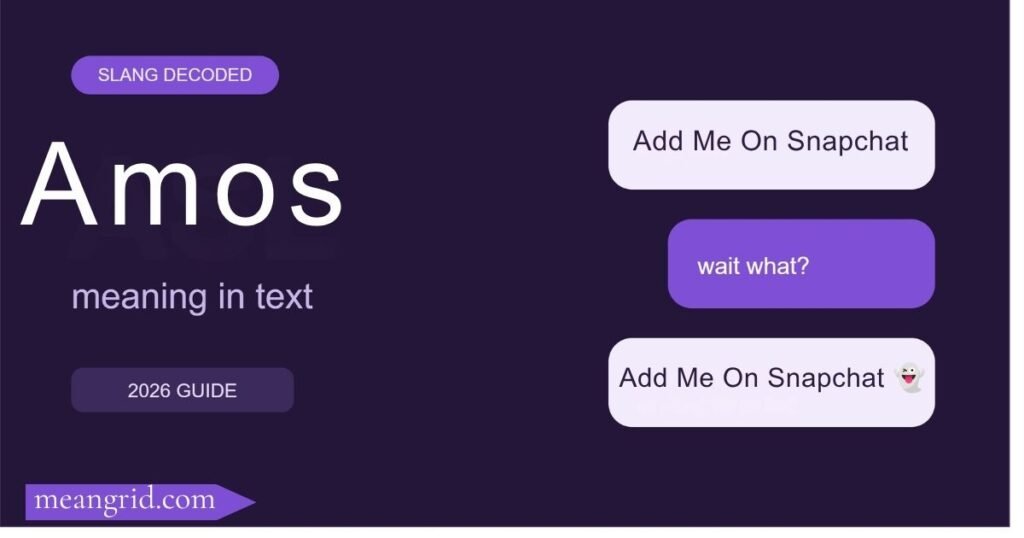
In texting and on social media, amos means “Add Me On Snapchat.” It’s a quick way for someone to ask you to connect with them on Snapchat instead of typing out the full request.
You’ll spot it in Instagram bios, TikTok captions, and casual DMs, almost always tied to expanding a friend list or starting a new conversation somewhere more private.
Say a friend posts “amos 👻” under their latest photo. They’re not naming a person or dropping a random word. They’re asking for your Snapchat username so the two of you can add each other. It’s short, it’s casual, and it fits the fast pace of how younger users text today.
Amos Meaning & Definition
At its core, amos is an acronym built from four words: Add, Me, On, Snapchat. People type it because it saves time and matches the clipped, abbreviation-heavy style common in texting slang like brb or omw.
The meaning stays pretty consistent no matter where you see it. Someone types amos, and they want you to add them on Snapchat. There’s no deeper trick to it. The tone around it can shift though. Sometimes it’s friendly, sometimes flirty, sometimes just practical networking between content creators.
Where Does Amos Come From?
Before it became internet slang, Amos was a Hebrew name meaning “carried by God” or “burden bearer.” It shows up in the Old Testament as the name of a prophet known for speaking on justice and fairness. For centuries, it stayed a formal first name used across many cultures.
The slang version has nothing to do with that history. It grew out of Snapchat’s rise in the mid 2010s, when users started shortening “add me on Snapchat” into a single tappable word for bios and captions. Over time it spread to TikTok and Instagram as a shortcut for moving a conversation to a different app.
Examples of Amos in Conversation
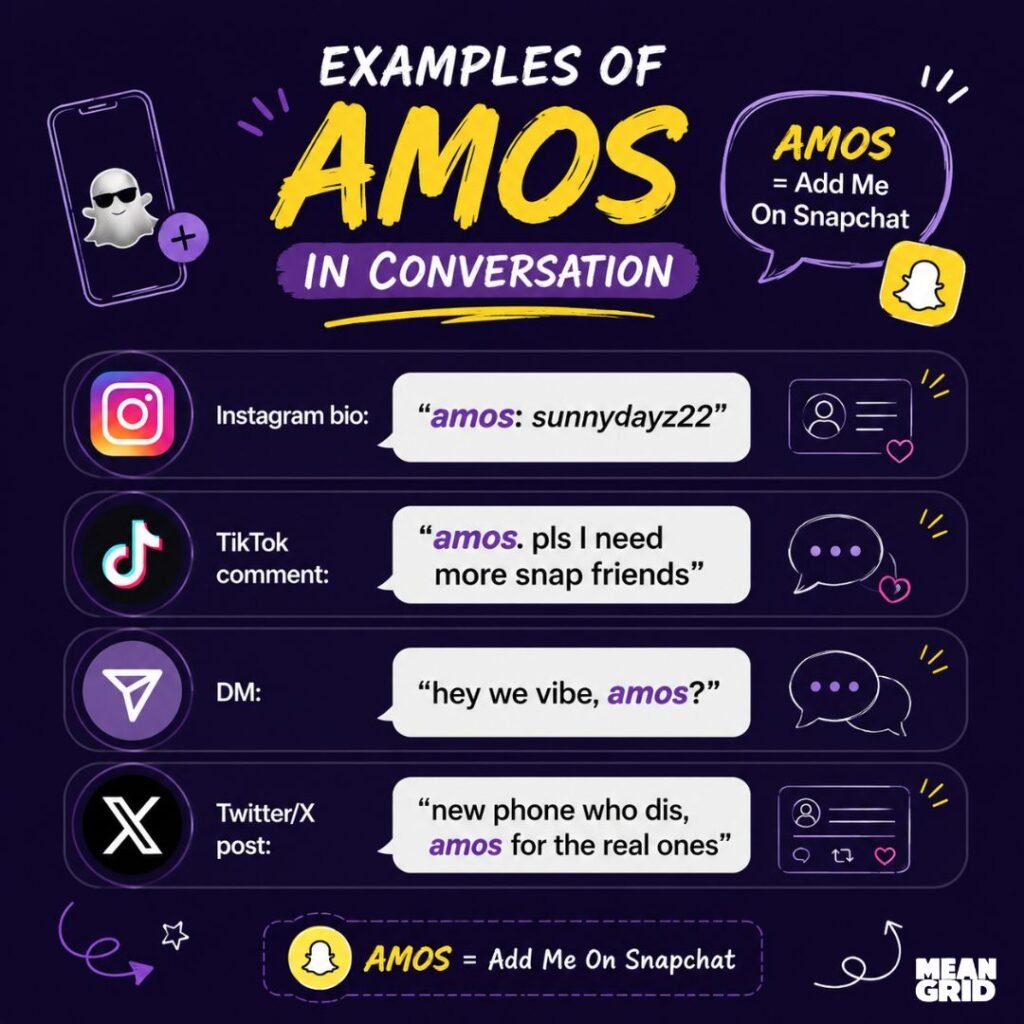
Here’s how it actually shows up in real chats and posts:
- Instagram bio: “amos: sunnydayz22”
- TikTok comment: “amos pls I need more snap friends”
- DM: “hey we vibe, amos?”
- Twitter/X post: “new phone who dis, amos for the real ones”
Notice the username usually follows right after, since the whole point is making it easy for someone to find and add you.
When to Use and When Not to Use Amos
Amos works fine in casual settings. Texting a friend, captioning a TikTok, or writing an Instagram bio are all normal places for it. It signals you’re open to connecting somewhere more personal than the comments section.
It does not belong in professional messages, school assignments, or formal emails. Using it with a coworker or teacher will likely just cause confusion, since most people outside of teen and young adult social circles won’t recognize it right away.
How Is Amos Used in Different Contexts?
Context changes what amos implies, even though the words behind it stay the same.
- Casual friendship: wanting to keep in touch outside of one app
- Content creator networking: growing a following across platforms
- Flirty or dating context: an invitation to chat more privately
- Fan or interest communities: connecting with people who share a hobby or fandom
The acronym itself never changes. What shifts is the intention behind it, which usually comes through in tone, emojis, or the surrounding conversation.
Amos Meaning on Snapchat, TikTok, Instagram, WhatsApp
Snapchat is where amos originated, and it’s still the most direct use since the whole point is adding someone on that app specifically.
TikTok and Instagram are where amos shows up most often today, usually in bios or comment sections, since creators use it to funnel followers toward Snapchat for more casual, unfiltered content.
WhatsApp rarely sees amos used the same way, since WhatsApp itself is already a direct messaging app. When it does appear there, it’s usually someone asking to also connect on Snapchat, not a WhatsApp specific request.
Amos Meaning in Professional or Technical Fields
Outside of slang, “AMOS” does show up as a real acronym in a few technical spaces, most notably as shorthand in certain aircraft maintenance and operating systems used in aviation, and occasionally in software or logistics naming conventions.
These uses have nothing to do with texting slang and almost never overlap with it in casual conversation. If a coworker in an unrelated industry sends “AMOS” in a work email, it’s worth asking directly what they mean rather than assuming either definition.
How to Handle an Amos Request You Don’t Want
Most guides only explain how to send amos, not what to do if you get one you’re not interested in. That matters, especially for teens who get these requests often.
You’re never obligated to respond. Ignoring it is completely normal and the most common response when the request feels random or comes from a stranger.
If you want to be polite but firm, a simple “not right now, thanks” closes it out without drama. And if the request feels pushy, repeated, or comes attached to a suspicious profile, blocking and reporting is always the safer move, especially on platforms where usernames get shared publicly. Treat an amos request the same way you’d treat any request for personal contact information: it’s your call, not an obligation.
Common Misunderstandings About Amos
A few mix ups happen often enough to clear up directly.
- Some people assume amos is always a name, since Amos is a common first name. Context usually makes it clear which one is meant.
- A few newer slang lists claim amos can stand for other phrases entirely. These alternate meanings show up rarely, aren’t widely used, and shouldn’t be treated as equally common. “Add Me On Snapchat” remains the meaning you’ll encounter the vast majority of the time.
- Others think it’s only used flirtatiously. In reality, plenty of amos requests are just about growing a friend list or following, nothing more.
Amos vs Similar Terms and Alternatives
Amos isn’t the only add-me acronym floating around. Here’s how it compares to a few others you might see:
| Term | Meaning | Platform Focus |
| Amos | Add Me On Snapchat | Snapchat, cross-posted on TikTok/Instagram |
| Amosc | Add Me On Snapchat (older variant) | Snapchat, Instagram bios |
| SC me | Send me your Snapchat / add me there | Snapchat |
| Add me on IG | Direct request for Instagram follow | |
| Ames | Casual nickname, sometimes confused with amos | Not an acronym |
The overlap causes some confusion online, but amos and amosc mean the same thing. The others simply point to different platforms.
Tips for Using Amos Naturally
If you want to use it yourself, keep a few things in mind. Pair it with your actual username so people don’t have to ask.
Use it where your audience already expects casual slang, like TikTok or Instagram, rather than more formal spaces. And read the room. A request that feels natural in a fun caption can feel out of place in a serious conversation.
FAQs
What does amos mean in text?
Amos means “Add Me On Snapchat,” a casual acronym asking someone to connect and add you on Snapchat.
What does amos mean on social media?
On social media, amos is a request to add someone on Snapchat, usually placed in bios or captions.
What does amos mean on TikTok?
On TikTok, amos means “Add Me On Snapchat,” often used in captions or comments to gain Snapchat friends fast.
What does amos mean in research?
In research, AMOS stands for Analysis of Moment Structures, statistical software used for structural equation modeling and path analysis.
What does amos mean on Wizz?
On Wizz, amos still means “Add Me On Snapchat,” since users there commonly ask new connections to add them.
Is amos only used on Snapchat?
No. While it started on Snapchat, it’s commonly used in TikTok and Instagram bios and captions too.
Can amos be used in professional settings?
It’s best avoided at work or school. It can come across as unprofessional or simply confuse people unfamiliar with the slang.
Conclusion
Amos is a simple, widely understood piece of internet slang that means “Add Me On Snapchat.”
It shows up most on Snapchat, TikTok, and Instagram, almost always as a casual invitation to connect. Once you know the context, there’s nothing confusing about it at all.

Albert is a dedicated meaning expert with over 6 years of experience researching word meanings, language usage, and definitions. At Mean Grid, he creates clear, accurate, and easy-to-understand content that helps readers explore the true meaning of words and phrases.