
HRU stands for “how are you.” It’s a short texting abbreviation people use to check in on someone quickly, usually in a casual chat, DM, or group message.
You’ll see it most on apps like WhatsApp, Snapchat, Instagram, and Discord, almost always in lowercase and almost always between people who already know each other at least a little.
HRU Meaning & Definition
HRU is built from three letters: H for “how,” R for “are,” and U for “you.” Put together, it reads out as “how are you.”
It’s not a new word or a hidden code. It’s just a shortcut. People use it because typing three letters is faster than typing eleven, and in fast-moving chats, speed matters more than full sentences.
The tone is almost always casual. It works as a greeting, a check-in, or a low-effort way to restart a conversation that’s gone quiet.
Where Does HRU Come From?
HRU grew out of the same texting culture that gave us lol, brb, and idk. Back when SMS messages were limited by character count and typing on a numeric keypad was slow, people started shortening common phrases into single letters or small chunks.
“How are you” was an easy target because it’s said constantly but doesn’t carry much new information. Once smartphones made typing faster, the habit didn’t go away. It just moved over to Snapchat, Instagram, and group chats, where speed and casualness are still the whole point.
Examples of HRU in Conversation
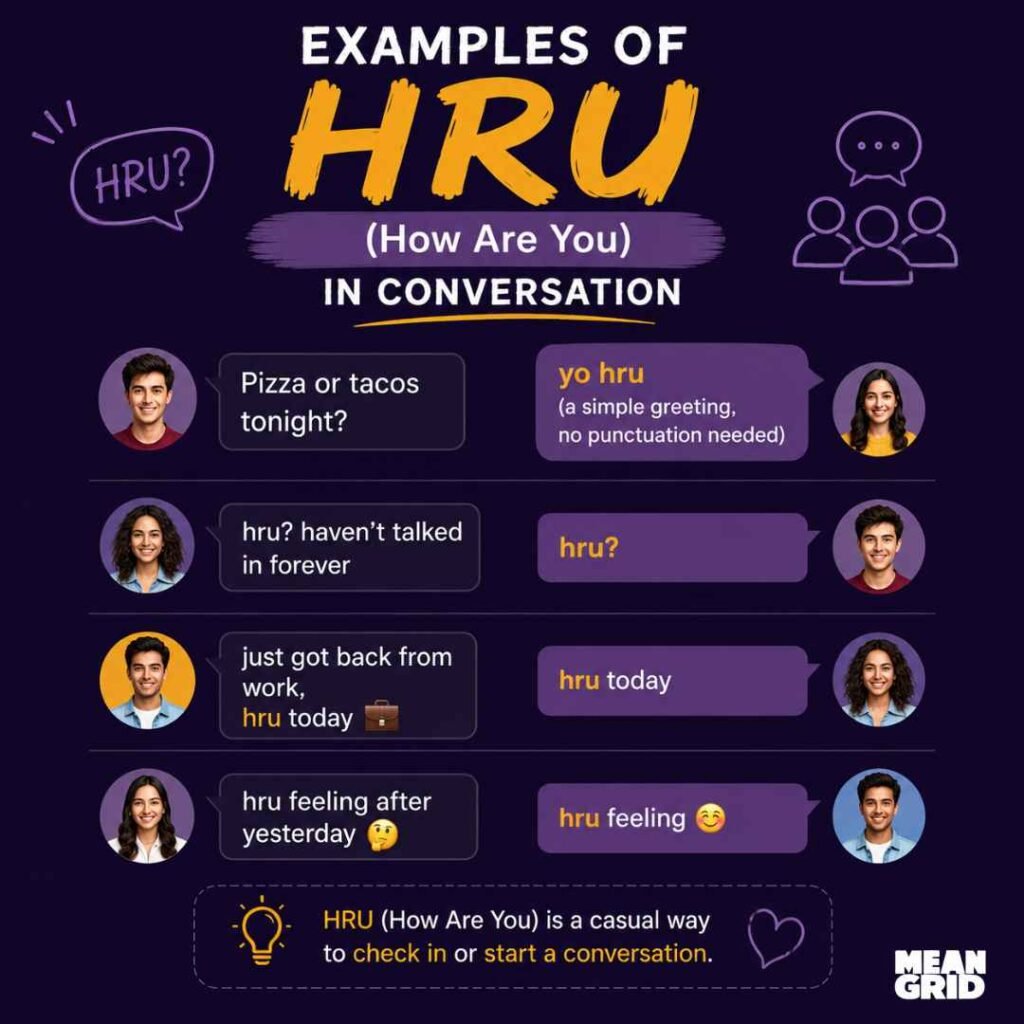
Here’s what HRU looks like in real chats:
- “yo hru” (a simple greeting, no punctuation needed)
- “hru? haven’t talked in forever”
- “just got back from work, hru today”
- “hru feeling after yesterday”
Notice that HRU rarely stands alone for long. It’s usually followed or preceded by a little extra context, which keeps the message from feeling too flat.
When to Use and When Not to Use HRU
HRU works well when:
- You’re texting a friend, sibling, or someone you talk to regularly
- The conversation is already casual
- You want to check in without writing a long message
HRU does not work well when:
- You’re messaging a boss, client, or someone you don’t know well
- The topic is serious, like someone dealing with a loss or a hard time
- You’re writing a formal email or an application message
In serious moments, a fuller sentence like “how are you holding up” reads as more sincere than a clipped “hru.”
How Is HRU Used in Different Contexts?
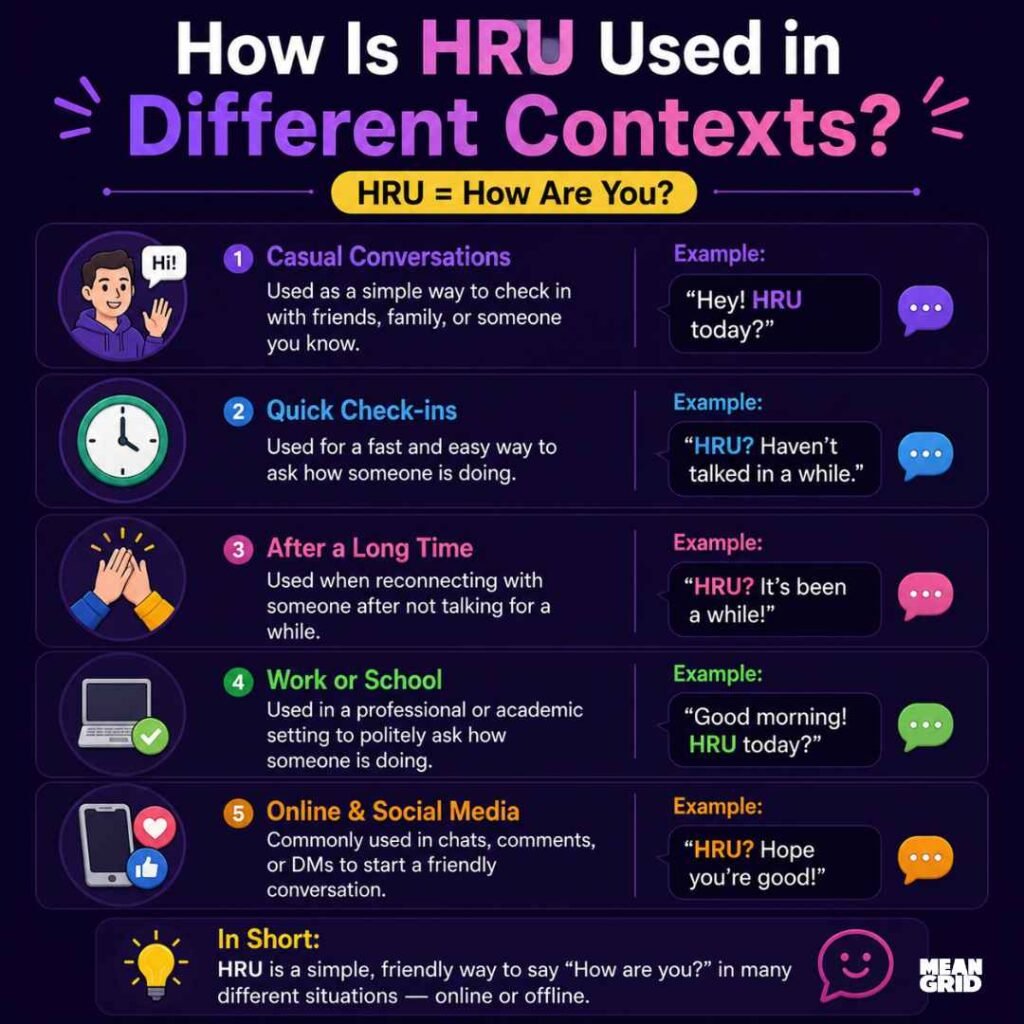
Context changes how HRU lands, even though the meaning stays the same.
- Between close friends, it’s practically background noise, just part of everyday texting rhythm.
- Between new acquaintances or early dating matches, it can feel like a low-pressure way to keep talking without asking something too personal.
- In family group chats, it often shows up as a quick way to check on someone without making a big deal out of it.
The letters never change. What changes is how much warmth or effort the reader assumes is behind them.
HRU Meaning on Snapchat, TikTok, Instagram, WhatsApp
On Snapchat, HRU often shows up mid-streak, as a filler question to keep the exchange going.
On Instagram and TikTok DMs, it’s common after someone comments on a post or replies to a story, working as a natural next line.
On WhatsApp, HRU tends to open a conversation rather than continue one, since WhatsApp chats often start cold after a gap of days or weeks.
Across all four apps, the meaning is identical. Only the pacing and purpose shift slightly.
HRU Meaning in Professional or Technical Fields
Outside of texting, HRU does have one real technical meaning worth knowing. In computer security, HRU refers to a classic access control model used to study how permissions get granted, changed, or taken away in a computer system. It’s a topic covered in some computer science courses and has nothing to do with texting slang.
If you see HRU in a security textbook or a systems paper, it’s this model, not “how are you.” Context makes the difference obvious almost instantly.
The HRU Reply Loop
Here’s something most guides skip entirely: the HRU loop.
It happens like this. Person A texts “hru.” Person B replies “good hru.” Person A replies “good too.” And now both people are stuck holding a conversation that technically continued but didn’t actually go anywhere.
This loop is one of the most common ways casual chats quietly die. Nobody said anything wrong, but nobody gave the other person anything to respond to either. The fix is simple: add one small detail when you answer. Instead of “good hru,” try “good, just finished dinner, hru.” That tiny addition gives the other person something real to reply to, and it breaks the loop before it starts.
Capitalization plays a small role here too. Lowercase “hru” reads as the most casual, almost automatic version. Fully capitalized “HRU” can read slightly more deliberate or emphasized, especially if someone hasn’t heard from you in a while and wants to make the check-in feel a bit more sincere.
Common Misunderstandings About HRU
A few mix-ups come up again and again:
- Confusing HRU with “hur,” which isn’t a real abbreviation and is usually just a typo
- Assuming HRU always signals romantic interest, when most of the time it’s just a habit
- Treating HRU as rude, when in most casual settings it’s simply quick, not careless
- Using HRU in a professional email, where it can come across as too informal
None of these mix-ups are serious, but they explain most of the confusion people search for.
HRU vs Similar Terms and Alternatives
HRU has a few close cousins that get used in similar spots. Here’s how they compare:
| Term | Meaning | Formality | Best Used |
| HRU | How are you | Very casual | Friends, casual check-ins |
| WBU / HBU | What about you / How about you | Very casual | Following up after answering a question |
| SUP | What’s up | Very casual | Greetings, opening a chat |
| WYD | What are you doing | Casual | Asking about current plans |
HRU and WBU often get used together in the same exchange, since one opens the check-in and the other passes the question back.
How to Respond to HRU
A few natural replies:
- “good, just chilling, hru”
- “kinda tired ngl, you good?”
- “not bad, been a long day though”
The goal is to answer honestly, add a small detail, and toss the question back so the conversation keeps moving.
Tips for Using HRU Naturally
- Save it for people you already text casually
- Add a small detail so the reply loop doesn’t happen
- Skip it in anything formal, even a semi-formal email
- Match the energy of whoever you’re talking to
FAQs
What does HRU mean in a text?
HRU means “how are you.” It’s a quick texting abbreviation used to check in casually.
Is HRU rude to say?
No, HRU isn’t rude. It’s just informal, so it works better with friends than in professional messages.
Does HRU mean something different on Snapchat?
No, the meaning stays the same across every app. Only the timing and purpose shift slightly.
What should I reply when someone sends HRU?
Answer briefly, add one small detail about your day, and ask the question back.
Is HRU used in flirting?
Sometimes, but mostly it’s just a habit. Context and the relationship matter more than the letters themselves.
Conclusion
HRU is a simple, casual way of asking “how are you” in a text. It shows up constantly across WhatsApp, Snapchat, Instagram, and group chats, and its meaning never really changes.
What matters most is knowing when it fits, replying with enough detail to keep the chat alive, and saving fuller sentences for moments that need more care.

Albert is a dedicated meaning expert with over 6 years of experience researching word meanings, language usage, and definitions. At Mean Grid, he creates clear, accurate, and easy-to-understand content that helps readers explore the true meaning of words and phrases.