
IONK means “I don’t know.” It’s a casual texting abbreviation people use to admit they’re unsure about something without typing out the full phrase.
You’ll mostly see it in DMs, group chats, and comment sections, especially among younger texters who want a quicker, more playful way to say the same thing as IDK.
IONK Meaning & Definition
At its core, IONK stands for “I don’t know.” It works the same way IDK does, but it carries a slightly looser, more conversational feel. Where IDK can sound flat or even a little formal, IONK reads as something you’d say out loud to a friend.
People type it in lowercase almost every time, usually without punctuation. That’s part of the style. A text like “ionk, ask her yourself” feels natural in a way that “IDK, ask her yourself” doesn’t quite match. The lowercase, no-punctuation format signals that the whole message is meant to sound relaxed rather than clipped or annoyed.
The meaning stays consistent across most situations. Someone types IONK when they genuinely don’t have an answer, when they don’t want to guess, or when they’d rather deflect a question without sounding rude about it.
Where Does IONK Come From?
IONK grew out of the same texting culture that gave us IDM, TBH, and IMS. Shortening common phrases has always been part of digital communication, since typing full sentences on a phone keyboard takes time most people don’t want to spend on a quick reply.
What sets IONK apart is the sound. Say “I don’t know” fast and casually, and it starts to blend into something close to “ionk.” That phonetic shortcut is likely why the term caught on the way it did. It doesn’t just abbreviate the words, it mimics how people actually say them out loud.
Apps built around short-form video and quick replies, like TikTok and Snapchat, gave the term room to spread. Once a phrase shows up enough times in comment sections and captions, it tends to stick, especially with younger users who treat texting slang as a kind of shared shorthand.
Examples of IONK in Conversation
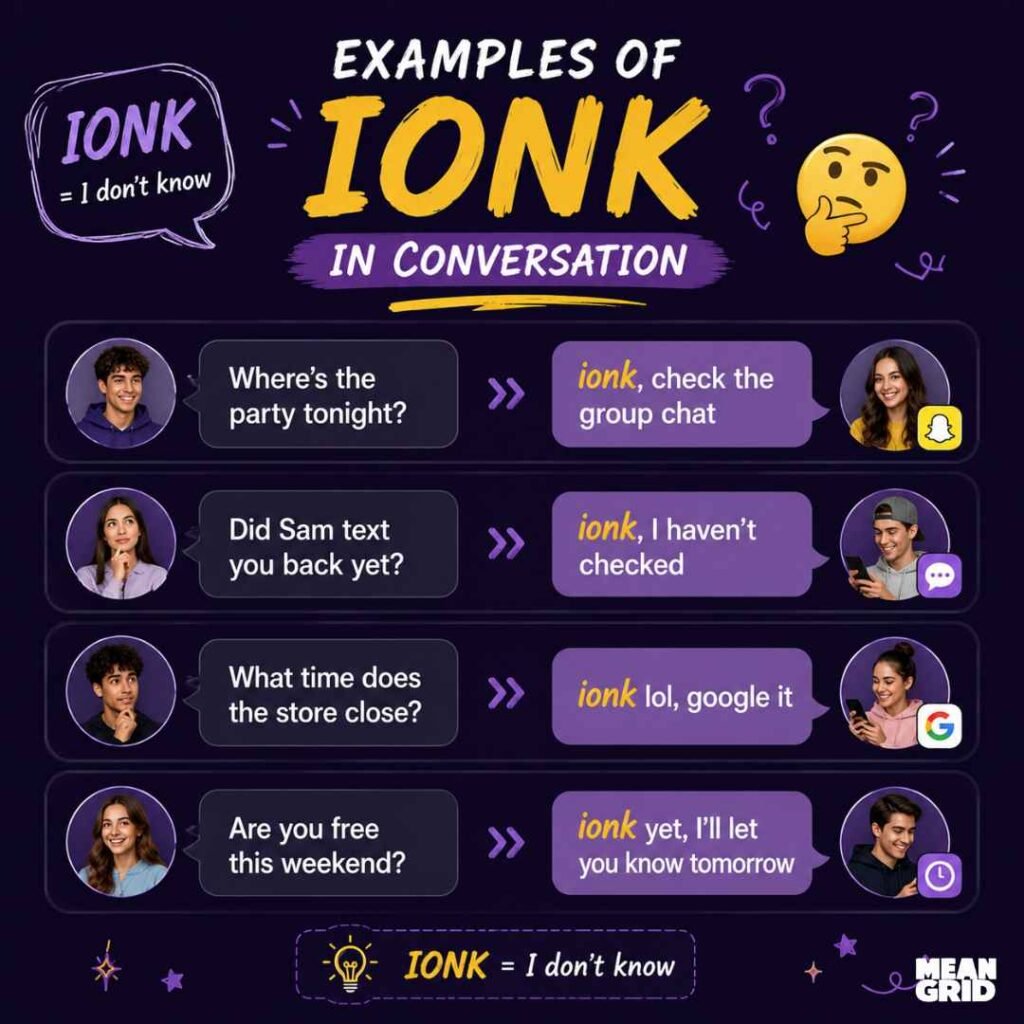
Seeing IONK in context makes the meaning click faster than any definition can.
- “Where’s the party tonight?” / “ionk, check the group chat”
- “Did Sam text you back yet?” / “ionk, I haven’t checked”
- “What time does the store close?” / “ionk lol, google it”
- “Are you free this weekend?” / “ionk yet, I’ll let you know tomorrow”
Notice how it almost always pairs with something else, a suggestion, a laugh, or a promise to follow up. On its own, IONK can feel like a dead end in a conversation. Paired with a next step, it keeps the exchange moving.
When to Use and When Not to Use IONK
IONK fits naturally into texts with friends, siblings, classmates, and anyone you’d talk to casually online. It works well in group chats, comment replies, and quick DMs where a relaxed tone is expected.
It doesn’t belong in work emails, messages to a teacher or professor, or any conversation where you want to come across as clear and professional. In those settings, “I’m not sure” or “I don’t have that information yet” reads better and avoids confusion, especially with someone who might not recognize the abbreviation at all.
A good rule of thumb: if you’d feel comfortable saying “I dunno” out loud to that person, IONK is probably fine in text. If you wouldn’t, skip it.
How Is IONK Used in Different Contexts?
The tone behind IONK shifts slightly depending on what’s being asked.
In a light, joking exchange, it usually just means the person truly has no idea and isn’t bothered by it. In a more serious conversation, the same three letters can carry a bit of hesitation, like the person knows something but isn’t ready to commit to an answer yet. Reading the rest of the message, and the relationship between the two people texting, usually clears up which version is meant.
It also shows up as a soft way to end a topic. Someone might type “ionk, we’ll figure it out” to move a conversation forward without dwelling on an unanswered question.
IONK Meaning on Snapchat, TikTok, Instagram, WhatsApp
The core meaning of IONK doesn’t change across apps, but how it’s used does shift a little by platform.
- On Snapchat, it shows up most in direct chat replies, often paired with a quick snap rather than a long explanation.
- On TikTok, it lives mainly in comment sections, usually as a quick response to a question asked in the video or by another commenter.
- Instagram sees it in both DM replies and caption text, sometimes used almost like a joke rather than a literal answer.
- WhatsApp usage tends to look closer to regular texting, since WhatsApp conversations often run longer and feel more like ongoing chats than quick public replies.
None of this changes what IONK means. It just shows that the term flexes to match how each platform is typically used.
IONK Meaning in Professional or Technical Fields
There’s no established technical or professional definition for IONK. Unlike some texting abbreviations that double as terms in aviation, medicine, or software, IONK doesn’t carry a second meaning outside of internet slang.
If you come across it in a work document or technical context, it’s most likely a typo or an unrelated internal shorthand specific to that workplace, not a recognized industry term.
Does IONK Always Mean “I Don’t Know”?
This is where a lot of explanations stop short. IONK almost always means “I don’t know,” but it’s worth knowing that a small number of people read it differently, as “I only know” or, less often, “I only now know.”
Those alternate readings show up rarely, and usually only make sense when the surrounding sentence spells it out, like “ionk what she told me, not the full story.” Outside of that kind of specific setup, “I don’t know” is the meaning you should assume almost every time.
If a message using IONK genuinely doesn’t make sense as “I don’t know,” check whether the sender might be using it as shorthand for something else entirely, since a small group of texters use it as a personal abbreviation unrelated to the common slang meaning.
Common Misunderstandings About IONK
The biggest mix-up happens with people unfamiliar with newer slang, who might read IONK as a typo or a name rather than an abbreviation. Older texters or anyone outside of casual online spaces may need it spelled out the first time it’s used with them.
Another mix-up involves similar-looking terms. IONK, ION, and IOK look alike at a glance but don’t mean the same thing, which leads to confused replies when someone assumes they’re interchangeable.
IONK vs Similar Terms
| Term | Meaning | Typical Tone |
| IONK | I don’t know | Casual, playful |
| IDK | I don’t know | Neutral, slightly more formal |
| ION | I don’t | Casual, often followed by more text |
| IOK | I’m okay | Neutral, reassuring |
The overlap between IONK and IDK causes the most confusion, since they technically mean the same thing. The difference comes down to tone. IDK reads as a straightforward, no-frills answer. IONK reads as something a little more relaxed, almost like you’re shrugging while you type it.
How to Respond to IONK
Replying to IONK is usually simple, since it rarely needs more than a follow-up or a quick acknowledgment.
- “ionk, ask her yourself” / “okay, I will”
- “ionk, we’ll see” / “fair enough, let me know when you find out”
- “ionk lol” / “no worries, just wondering”
The best replies either move the conversation forward or let the person off the hook without pressing for an answer they clearly don’t have.
Tips for Using IONK Naturally
Keep it lowercase and skip the punctuation if you want it to read casually, since that’s the format most people expect.
Pair it with a follow-up thought instead of leaving it as your entire reply, which keeps the conversation from stalling out.
Save it for people who already text casually with you, and default to spelling things out with anyone new to texting slang or in a more formal setting.
FAQs
What does IONK mean in a text message?
IONK means “I don’t know.” It’s a casual way to admit uncertainty without typing the full phrase.
Is IONK the same as IDK?
Yes, both mean “I don’t know.” IONK just sounds more relaxed and casual than IDK.
What’s the difference between IONK and ION?
IONK means “I don’t know,” while ION means “I don’t.” They’re related but not interchangeable.
Is IONK appropriate for work messages?
No, IONK is too casual for professional texts or emails. Use “I’m not sure” instead.
Where did IONK come from?
IONK developed from casual texting culture as a phonetic shortcut for saying “I don’t know” quickly.
Conclusion
IONK is a quick, casual stand-in for “I don’t know” that fits naturally into texts, comments, and DMs. Once you know the tone it carries and where it fits best, it’s an easy term to recognize and use correctly.

Albert is a dedicated meaning expert with over 6 years of experience researching word meanings, language usage, and definitions. At Mean Grid, he creates clear, accurate, and easy-to-understand content that helps readers explore the true meaning of words and phrases.