
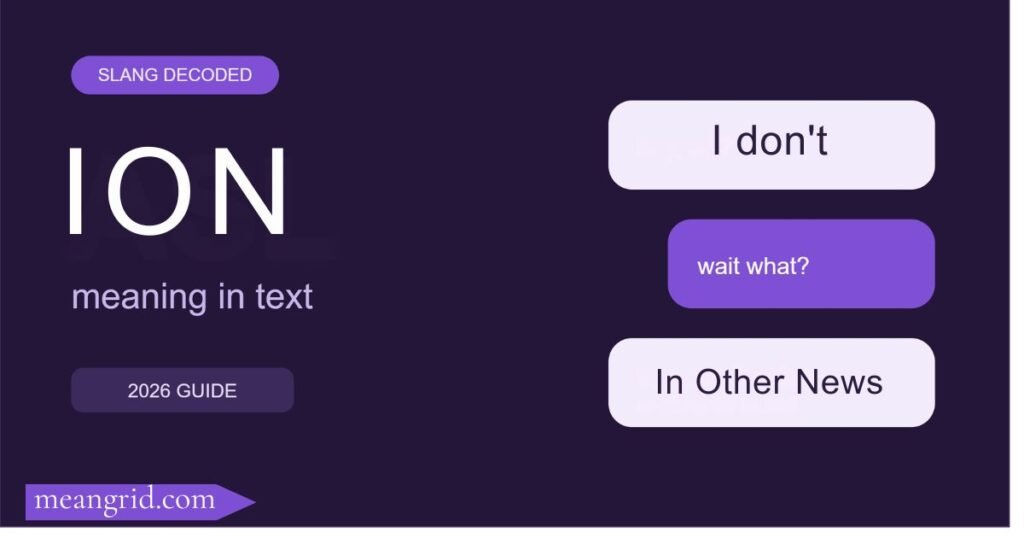
“ION” usually means “I don’t” in texting and on social media. It’s a phonetic shortcut, since “I don’t” said fast can sound just like “ion.”
In some cases, especially older internet slang, ION also stands for “In Other News,” used to switch topics mid conversation. The correct meaning almost always comes down to context, mainly where the word sits in the sentence.
This guide breaks down both meanings, shows real examples, and helps you use ION the right way without confusing anyone.
ION Meaning & Definition
In texting, ION most often means “I don’t.” People use it to say they don’t like something, don’t want something, or don’t feel like doing something. It stands in for the whole phrase, so you’ll usually see it at the start of a sentence.
There’s a second meaning too. Written in all caps, ION can stand for “In Other News,” a phrase people use to shift a conversation to something new. Context tells you which one you’re dealing with, and we’ll cover exactly how to spot the difference later in this guide.
Where Does ION Come From?
The “I don’t” version comes from African American Vernacular English (AAVE), where fast, casual speech naturally blends words together. Say “I don’t” quickly out loud and it starts to sound like “ion.” That pronunciation made its way into texting during the 2010s, then spread widely through platforms like Twitter and TikTok.
The “In Other News” version has a different history. It borrows from broadcast journalism, where anchors used that exact phrase to move between unrelated stories. Online, people shortened it to ION for the same job: changing the subject smoothly.
Examples of ION in Conversation
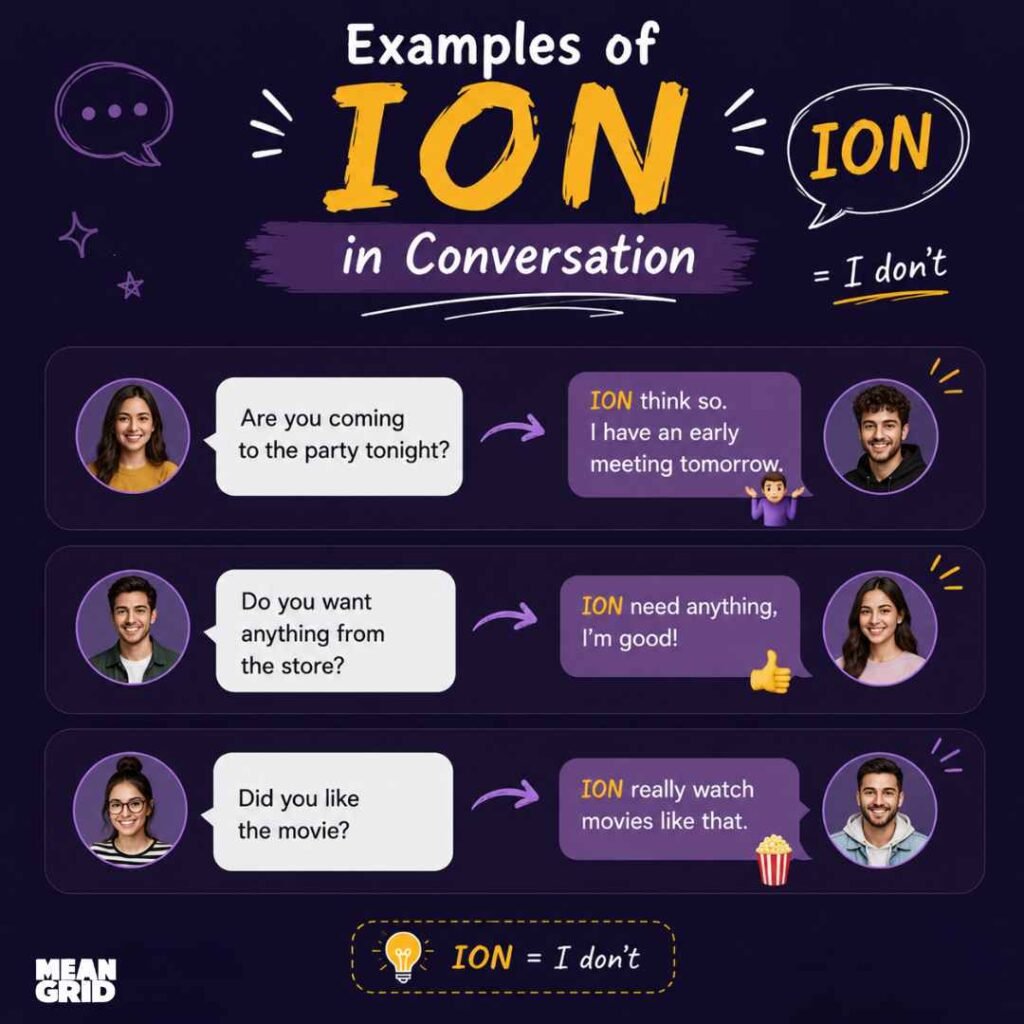
Seeing ION in action makes both meanings click faster.
- A: You coming out tonight? B: Ion feel like it tbh.
- A: Did you finish the assignment? B: Ion even started ngl.
- A: ION, I just adopted a dog! B: No way, send pics!
- A: We should talk about last night. B: Ion trying to get into that rn.
In the first two, ION replaces “I don’t.” In the third, it’s a topic switch, not a denial at all. That difference is the key thing to watch for.
When to Use and When Not to Use ION
ION fits casual settings like texting friends, replying to comments, or writing captions. It signals a relaxed, informal tone, which is exactly what makes it feel natural in group chats.
It doesn’t belong in professional emails, school papers, or anywhere clarity matters. Using it there can come across as careless, even if that’s not the intent. A simple rule works well here: if you’d say “I don’t” out loud in a formal setting, spell it out in writing too.
How Is ION Used in Different Contexts?
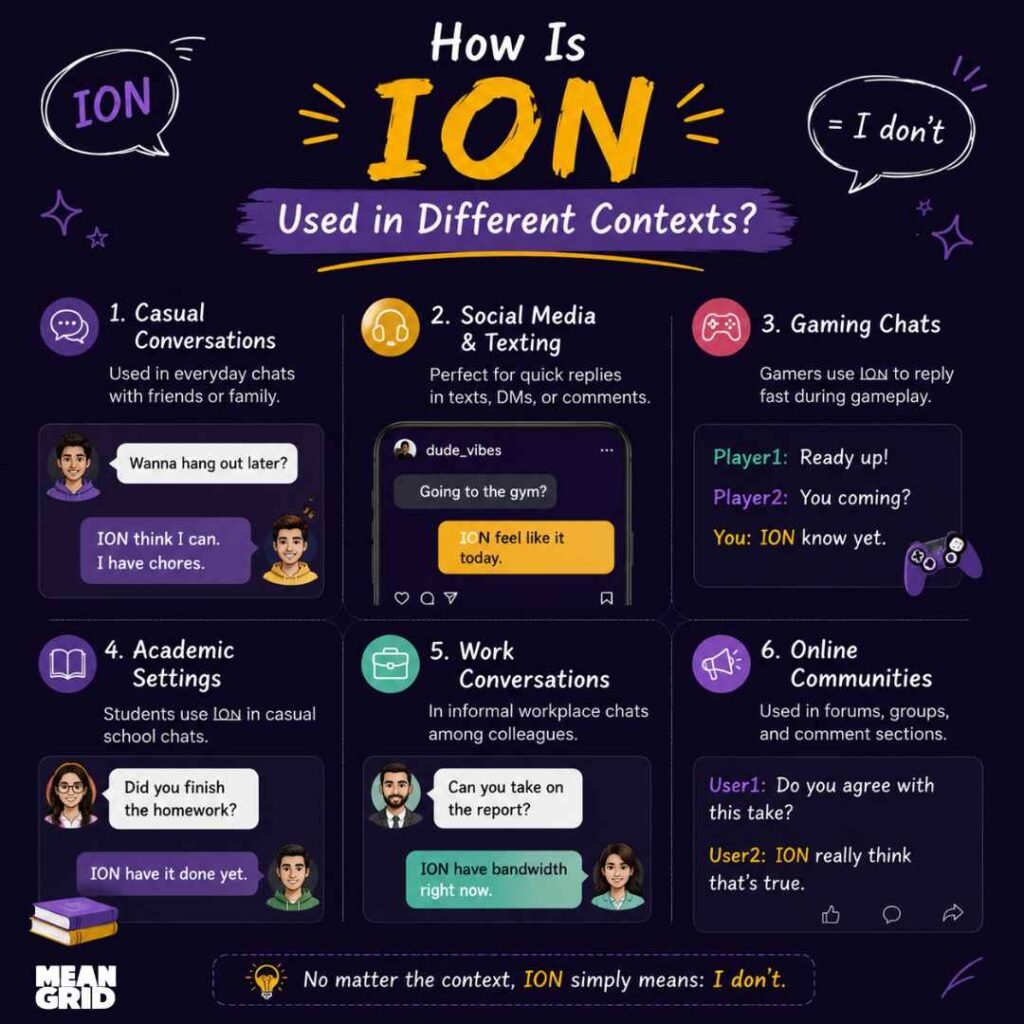
Context changes everything with ION. Among close friends, it often carries a joking, unbothered tone, almost like shrugging off a topic. In a more serious conversation, that same word can come across as dismissive if the timing feels off.
Age plays a role too. Younger users tend to read ION as “I don’t” automatically. Older readers, or people less familiar with texting slang, are more likely to assume it means “In Other News,” or to wonder if you’re talking about chemistry. Reading the room matters more than the word itself.
ION Meaning on Snapchat, TikTok, Instagram, WhatsApp
ION shows up a little differently depending on the platform.
- Snapchat: Common in quick replies and streak chats, almost always meaning “I don’t.”
- TikTok: Frequent in comments and captions, often paired with other slang like “fr” or “ngl.”
- Instagram: Used in DMs and captions, both as “I don’t” and occasionally as a topic switch in longer posts.
- WhatsApp: Less common, since WhatsApp skews toward older users and more direct messaging habits.
The platform doesn’t change the meaning, but it does affect how often you’ll see it and which version shows up more.
ION Meaning in Professional or Technical Fields
Outside of texting, “ion” has a completely different, well established meaning. In chemistry and physics, an ion is an atom or molecule that has gained or lost an electron, giving it an electric charge. This shows up in science classes, lab reports, and technical writing.
That meaning has nothing to do with the slang version. If someone texts “ion know,” they’re not talking about charged particles. But if a chemistry textbook says “the ion has a negative charge,” that’s the scientific term doing exactly what it’s meant to do.
How to Tell Which ION You’re Reading
Most guides list ION’s meanings without explaining how to actually tell them apart in the moment. Here’s a fast way to check.
First, look at capitalization. Lowercase “ion” almost always means “I don’t.” All caps “ION” leans toward “In Other News,” though this isn’t a hard rule, since plenty of people type in lowercase no matter what they mean.
Second, check sentence position. If ION opens a message and it’s followed by a brand new topic, like a piece of news or an announcement, it’s the “In Other News” version. If it’s followed by a verb, like “ion care” or “ion think,” it’s standing in for “I don’t.”
Third, watch for stacking. Slang often piles up, like “ion even know fr fr” or “ion think so tho.” When ION shows up next to other casual shortcuts, that’s a strong sign you’re looking at “I don’t,” since that version blends naturally into fast, informal speech in a way “In Other News” doesn’t.
Common Misunderstandings About ION
A lot of people assume ION only has one meaning, which leads to real confusion in group chats. Someone expecting a topic change might completely misread “ion care” as a strange, random comment.
Another mix-up worth knowing: autocorrect rarely flags “ion” as a typo, since it’s already a real English word in chemistry. That means the slang version slides through spell check untouched, unlike a lot of other invented text slang that gets autocorrected into something totally different.
Some readers also assume ION is inherently rude. It’s not. Tone depends entirely on the message around it, not the abbreviation itself.
ION vs Similar Terms and Alternatives
ION overlaps with a few other common abbreviations, but each one does its own specific job.
| Term | Meaning | Best Used For |
| ION | I don’t / In Other News | Denial, disinterest, or a topic change |
| IDK | I don’t know | Lack of knowledge specifically |
| IDC | I don’t care | Indifference |
| NGL | Not gonna lie | Honest or blunt statements |
| TBH | To be honest | Sharing an honest opinion |
ION is broader than IDK, since it can attach to almost any verb, not just “know.” It also sounds more casual than a full phrase like “I don’t care,” which is part of why it caught on so quickly.
How to Respond to ION
Replying to ION depends on which meaning you’re catching.
- If it means “I don’t”: A: “Ion wanna go out tonight.” B: “That’s fair, next time then.”
- If it means “In Other News”: A: “ION, I got the job!” B: “Wait, congrats! Tell me everything.”
- If you’re unsure: A: “ion…” B: “Wait, ion what? Finish that thought lol.”
That last option works well when the context genuinely isn’t clear yet.
Tips for Using ION Naturally
Keep these in mind if you want ION to sound natural instead of forced.
- Use it at the start of a sentence, not buried in the middle.
- Pair it with a verb for the “I don’t” meaning, like “ion feel” or “ion want.”
- Save it for casual chats, not emails or schoolwork.
- Don’t overuse it. One or two per conversation reads as natural, but every sentence starts to feel try hard.
FAQs
What does ION mean in a text message?
ION usually means “I don’t” in texting, though it can also mean “In Other News” depending on context.
Is ION the same as IDK?
No. ION means “I don’t,” a general statement, while IDK specifically means “I don’t know.”
Is it rude to say ION?
Not by itself. ION is just casual slang, and its tone depends on the rest of the message.
Does ION mean something different in science?
Yes. In chemistry, an ion is an atom or molecule with an electric charge, completely unrelated to the slang meaning.
Where did the ION slang come from?
The “I don’t” version comes from African American Vernacular English, based on how “I don’t” sounds when spoken quickly.
Conclusion
ION mostly means “I don’t” in modern texting, with “In Other News” as a less common second meaning. Capitalization, sentence position, and surrounding slang all help you figure out which one you’re looking at.
Once you know the pattern, ION stops being confusing and starts feeling like just another normal part of texting.
Read More Meanings :

Albert is a dedicated meaning expert with over 6 years of experience researching word meanings, language usage, and definitions. At Mean Grid, he creates clear, accurate, and easy-to-understand content that helps readers explore the true meaning of words and phrases.