

Ever stopped mid sentence and wondered whether it is training or trainning? You are not alone. This spelling slip trips up English learners and confident writers alike, mostly because of how English handles suffixes.
Some words double their last letter before “ing,” so it feels logical that train would too. It does not. One version is correct English, and the other is a typo that can make a resume, email, or caption look careless.
Here is the quick answer, the reason behind it, and a simple way to get it right every time.
Quick Answer: Training or Trainning
Training is the correct spelling. Trainning is always wrong, in American English, British English, and every other version of English out there.
The word has one N in the middle because it comes from the verb “train,” and “train” does not double its last letter when you add “ing.” Think of it as train + ing = training. Nothing extra needed.
What Does Training Mean?
Training is the process of learning or teaching a skill, behavior, or habit through practice and instruction. It is a noun in most sentences, though it can also work as a verb form (“she is training for a marathon”).
You will see it used in a few main ways:
- Education and skills: “The new hires start training on Monday.”
- Physical fitness: “His training schedule includes four runs a week.”
- Animals: “Puppy training takes patience and a lot of treats.”
- Professional development: “Our company offers free safety training.”
- Technology: “The model’s training data came from public sources.”
Same spelling every time. One N. No exceptions.
Where Does the Word Training Come From?
Training traces back to the verb “train,” which entered English from Old French “trainer,” meaning to pull or drag. That French word goes back to the Latin “trahere,” which also means to pull.
The original idea was literal. You pulled something along behind you, like the “train” of a long gown or a line of railway cars. Over time, the meaning stretched to cover pulling someone toward a goal, which is how teaching and coaching entered the picture. The teaching sense shows up in the 1500s.
Here is the useful part for spelling. The root is “train,” and the “ing” ending is just a suffix stuck on the back. The root never changed to “trainn,” so the ending has no reason to change it either.
Why Trainning Is Wrong: The Grammar Breakdown
Trainning is wrong because English only doubles a final consonant in certain cases, and “train” does not fit those cases.
The doubling rule works like this. When a short word ends in a single vowel followed by a single consonant, you often double that consonant before adding “ing” or “ed.” That keeps the vowel sound short.
“Train” has two vowels together (the “ai”), so the rule never kicks in. The vowel sound is already long, and there is nothing to protect.
| Base Word | Vowel Pattern | Add “ing” | Why |
| run | single vowel + consonant | running | Doubles to keep the short vowel |
| plan | single vowel + consonant | planning | Doubles to keep the short vowel |
| stop | single vowel + consonant | stopping | Doubles to keep the short vowel |
| train | double vowel + consonant | training | No doubling needed |
| rain | double vowel + consonant | raining | No doubling needed |
| wait | double vowel + consonant | waiting | No doubling needed |
See the pattern? Nobody writes “raining” as “rainning” or “waiting” as “waitting.” Training belongs on the same team.
How to Use Training in Professional Writing
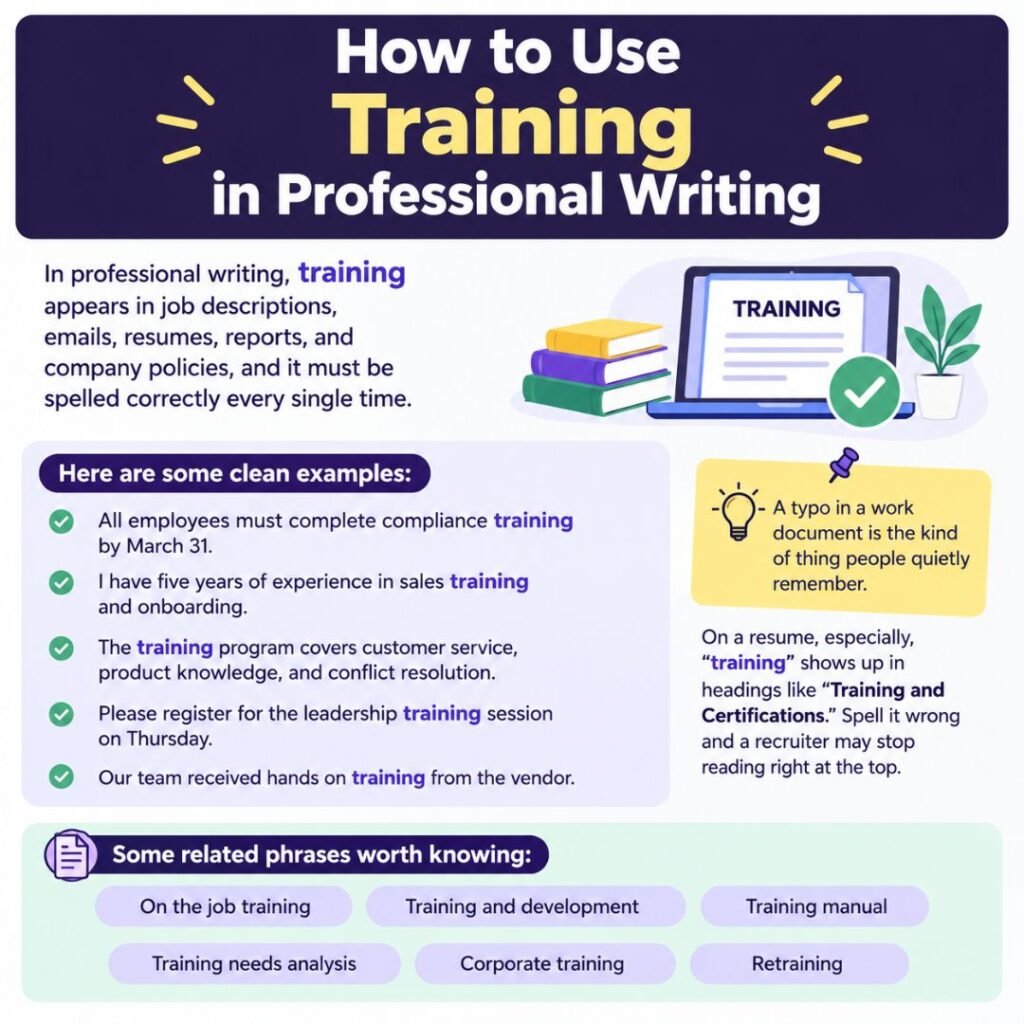
In professional writing, “training” appears in job descriptions, emails, resumes, reports, and company policies, and it must be spelled correctly every single time.
A typo in a work document is the kind of thing people quietly remember. Here are some clean examples:
- “All employees must complete compliance training by March 31.”
- “I have five years of experience in sales training and onboarding.”
- “The training program covers customer service, product knowledge, and conflict resolution.”
- “Please register for the leadership training session on Thursday.”
- “Our team received hands on training from the vendor.”
On a resume especially, “training” shows up in headings like “Training and Certifications.” Spell it wrong there and a recruiter may stop reading right at the top of the page. Brutal, but true.
Some related phrases worth knowing:
- On the job training
- Training and development
- Training manual
- Training needs analysis
- Corporate training
- Retraining
Read More Grammar: Eminent vs Imminent: What’s the Difference and How to Use Each One
How to Use Training in Casual Writing
In casual writing, “training” works exactly the same way, even when your tone is relaxed.
Texts, captions, and social posts are where “trainning” sneaks in most often, because people type fast and skip proofreading.
Here is how it looks in everyday life:
- “Gym training starts at 6 a.m. Send coffee.”
- “My dog’s training is going well. He still eats socks, though.”
- “Day 12 of marathon training and my knees have filed a complaint.”
- “Is this training session mandatory? Asking for my nap.”
Casual does not mean misspelled. Autocorrect will usually catch it, but not always, so it helps to know the right form by heart.
Training vs Trainning vs Similar Words: Comparison Table
The table below shows the correct forms of the word next to the common wrong versions, so you can spot the difference at a glance.
| Word | Correct? | Notes | Example |
| Training | Yes | Standard spelling in US and UK English | “Her training starts today.” |
| Trainning | No | Extra N, never correct | “Her trainning starts today.” |
| Traning | No | Missing the “i” | “Traning is tomorrow.” |
| Trainig | No | Missing the second “n” | “Trainig is tomorrow.” |
| Trained | Yes | Past tense of “train” | “He trained for months.” |
| Trainer | Yes | A person who trains others | “The trainer was patient.” |
| Trainee | Yes | A person being trained | “The trainee asked great questions.” |
| Trainings | Sometimes | Plural used in business settings | “We offer several trainings.” |
A quick note on that last one. Style guides argue about “trainings,” since “training” is usually an uncountable noun. Many workplaces use it anyway to mean separate sessions or courses. If you want to play it safe, write “training sessions” or “training programs” instead.
Common Training Spelling Mistakes
The most common mistakes are doubling the N, dropping the I, and dropping an N.
Here is what people type when they get it wrong:
- Trainning: The famous extra N. This is the main offender.
- Traning: The “i” goes missing, usually from fast typing.
- Trainig: The second N disappears, and the word looks half finished.
- Traininng: A double slip at the end of the word.
- Trainner: Someone applied the same wrong doubling to “trainer.”
- Trainned: Same mistake, past tense edition. The correct form is “trained.”
The root cause is nearly always the same. People see “running,” “planning,” and “winning,” and their brain assumes every verb plays by that rule. Train does not.
Real Life Example: When One Extra N Costs You
Dave opened a gym in Ohio and ordered a huge banner that read “Free Personal Trainning This Weekend.” He checked the phone number three times. The spelling never crossed his mind.
By lunch, a neighbor had posted a photo with a caption saying the gym needed “extra training in spelling.”
Dave paid a rush fee to reprint it. Lesson: the biggest words get the least proofreading, so check them first.
How Common Is the Trainning Mistake? Data and Trends
“Training” is one of the most searched and used words in English, and “trainning” shows up as a regular misspelling in search queries, forms, and informal writing.
Exact monthly search numbers change constantly, so treat any single figure you see online with caution. What stays steady is the pattern behind the searches:
- People search for “training or trainning” and “trainning or training” to confirm the spelling before they publish or send something.
- “Trainning meaning” appears as a query because some people assume it might be a separate word. It is not.
- Searches spike around job seasons, school terms, and fitness resolutions, because that is when people write about training the most.
- Mobile users make the mistake more often, since small keyboards and thumb typing invite doubled letters.
Search engines usually correct the typo automatically and show results for “training” instead. That is a good hint about which spelling is right, since the algorithm has seen billions of examples.
For anyone who wants real numbers, Google Trends is free and shows how interest in related terms rises and falls over time.
Memory Trick: How to Remember the Correct Spelling
The easiest memory trick is to picture a TRAIN with only ONE engine, because training has only ONE N in the middle.
Here are a few more ways to lock it in:
- Start with the root. Say “train” first, then add “ing.” Nothing else changes.
- Compare it to rain. You write “raining,” not “rainning.” Train works the same way.
- Count the letters. T R A I N I N G. Eight letters, two N’s, and they are separated by an I. They never sit side by side.
- Use the chain trick. The N’s are like train cars with an “I” coupling between them. Put two N’s together and the train derails.
Pick whichever one makes you smile. The goofier it is, the longer it sticks.
Step by Step Guide to Spelling Training Correctly
To spell training correctly, start with the base word “train” and add “ing” without changing anything.
Follow these steps:
- Write the base word. Type “train.” That is T, R, A, I, N.
- Check the vowels. Notice the two vowels together (A and I). That means no doubling rule applies.
- Add the ending. Attach “ing” directly to the end.
- Read it back. You should see “training” with one N before the “i” and one N before the “g.”
- Test it against similar words. If “raining” and “waiting” look right to you, “training” does too.
The same steps work for related forms. “Train” + “ed” gives “trained.” “Train” + “er” gives “trainer.” “Re” + “train” + “ing” gives “retraining.”
Read Also: Afterward or Afterwards: Which Is Correct? (With Examples)
Mini Quiz: Training or Trainning?
This short quiz checks whether the rule has sunk in, and every answer is listed at the end.
Question 1. Which spelling is correct?
- A) Trainning
- B) Training
- C) Traning
Question 2. Fill in the blank: “The new employees begin their ______ on Monday.”
- A) trainning
- B) trainig
- C) training
Question 3. Which word follows the same spelling pattern as “training”?
- A) Running
- B) Raining
- C) Planning
Question 4. What is the past tense of “train”?
- A) Trainned
- B) Trained
- C) Traned
Question 5. Which sentence is correct?
- A) She is trainning for a marathon.
- B) She is traning for a marathon.
- C) She is training for a marathon.
Question 6. Why does “training” have only one N in the middle?
- A) Because English likes short words
- B) Because “train” has two vowels, so the doubling rule does not apply
- C) Because it is a British spelling
Question 7. Which of these is a correct word?
- A) Trainner
- B) Trainee
- C) Trainnee
Answers:
- B) Training
- C) training
- B) Raining
- B) Trained
- C) She is training for a marathon.
- B) Because “train” has two vowels, so the doubling rule does not apply
- B) Trainee
Score 6 or 7 and you are officially a spelling pro. Score less, and just reread the memory trick. No judgment here.
FAQs
Is it training or trainning?
Training is correct; trainning is always a misspelling in British and American English.
Is trainning a word in British English?
No, trainning is not a correct British English spelling. The correct spelling is training.
What does training mean?
Training means learning or practicing skills, knowledge, or abilities through instruction and repeated practice.
Why is trainning spelled wrong if running has a double N?
Running doubles the n because run ends in a consonant-vowel-consonant pattern. Train already ends with two vowels before n, so it stays training.
Is trainings a correct word?
Yes, trainings can be correct when referring to multiple training sessions or programs. However, training sessions is usually more natural.
Conclusion
Training is the correct spelling, and trainning is a typo that has no place in your writing. The word comes from “train,” which stays just as it is when “ing” gets added to the end.
Remember the one engine trick, compare it to “raining,” and you will never second guess it again. Bookmark this page, share it with a coworker who keeps making the mistake, and go enjoy your next training session with a clean, correctly spelled conscience.

Albert is a dedicated meaning expert with over 6 years of experience researching word meanings, language usage, and definitions. At Mean Grid, he creates clear, accurate, and easy-to-understand content that helps readers explore the true meaning of words and phrases.