
HMU stands for hit me up. It means someone wants you to reach out by text, call, or DM whenever it’s convenient for you. It’s one of the most common texting abbreviations around, and people use it because it’s short, low pressure, and easy to drop into almost any message.
You’ll spot it in group chats, under Snapchat stories, and in Instagram captions. The core meaning stays the same everywhere: get in touch with me.
HMU Meaning & Definition
The hmu meaning in text is simple: it’s an invitation to contact someone. Most people use it to mean “text me,” “call me,” or “message me when you’re free.” It’s informal, so it fits casual conversations way better than formal ones.
There are a couple of other meanings floating around too. Some people use HMU to mean “hook me up,” which is a request for help, a favor, or a connection to something they want. There’s also a joke definition, “hold my unicorn,” that started online as a meme and isn’t meant to be taken seriously. In everyday texting, though, “hit me up” is almost always what’s intended.
Where Does HMU Come From?
The phrase “hit me up” has been around a lot longer than texting itself. It grew out of casual American slang and got a big boost from hip hop culture in the 1990s, where “hit me up” was a common way to ask for contact.
As texting and early internet slang took off, people shortened the phrase to save keystrokes. HMU started showing up on slang dictionary sites in the late 2000s, and it caught on fast because it matched how people were already talking. The joke meaning “hold my unicorn” appeared a bit later, around 2010, after users on slang sites started posting funny alternate definitions for popular acronyms.
Examples of HMU in Conversation
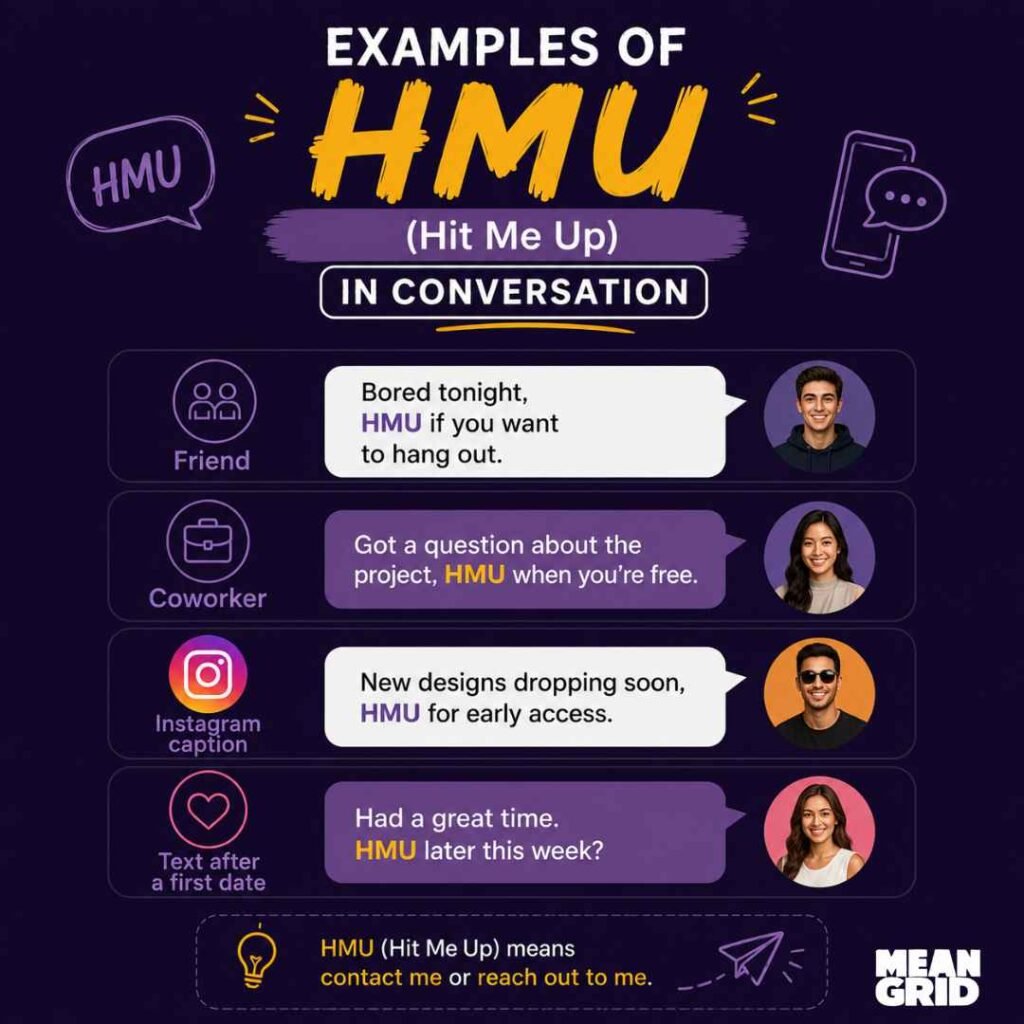
Seeing HMU in real conversations makes the meaning click faster than any definition. Here are a few natural examples:
- Friend: “Bored tonight, HMU if you want to hang out.”
- Coworker: “Got a question about the project, HMU when you’re free.”
- Instagram caption: “New designs dropping soon, HMU for early access.”
- Text after a first date: “Had a great time. HMU later this week?”
In every case, HMU is doing the same job: opening the door for someone to reach back out.
When to Use and When Not to Use HMU
HMU works well in relaxed, everyday texting. It’s a fine fit for:
- Chatting with friends or family
- Casual invites to hang out
- Social media posts inviting DMs
- Light workplace chats, if your team already texts casually
It’s not a good fit for:
- Formal emails or job applications
- First contact with a stranger in a professional setting
- Serious news, like a death in the family or a medical update
- Any message where clarity matters more than casualness
If you wouldn’t say “hit me up” out loud in that situation, skip the abbreviation too.
How Is HMU Used in Different Contexts?
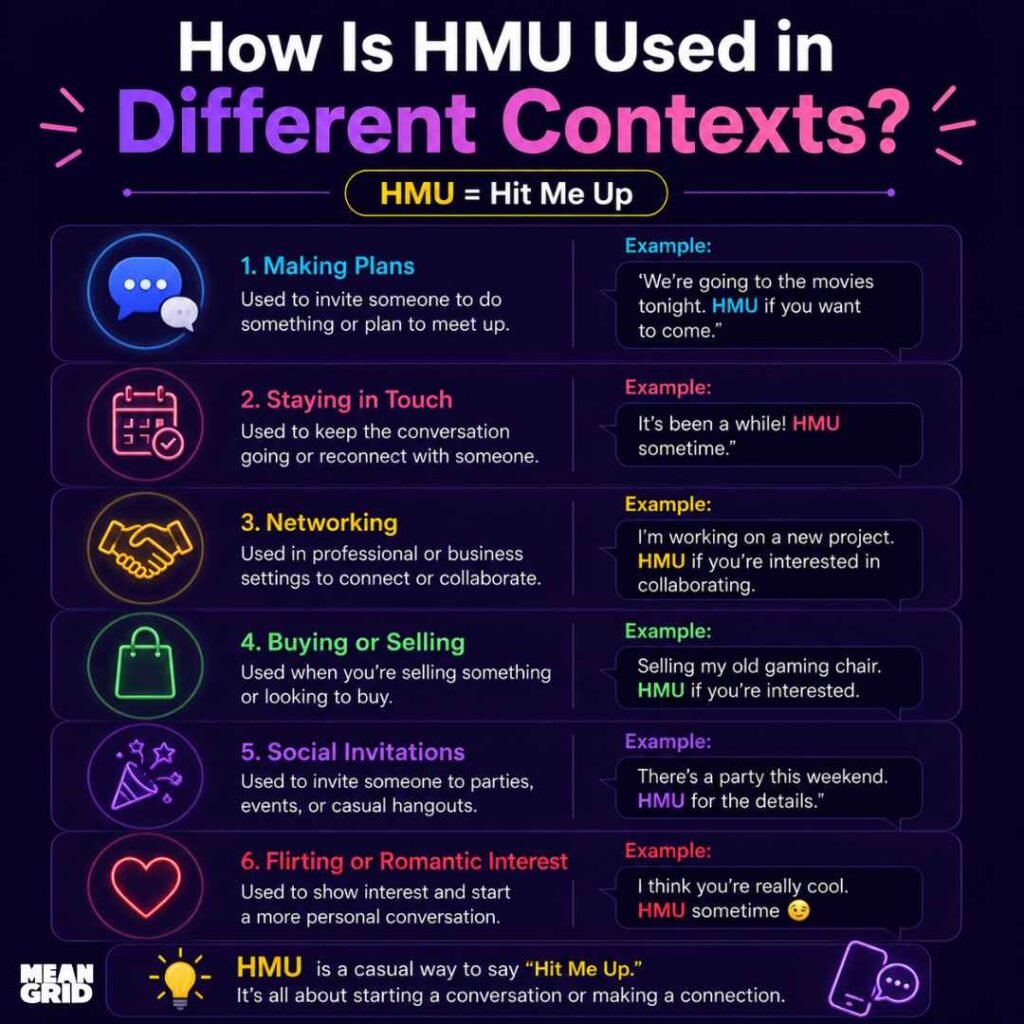
The meaning of HMU barely changes, but the tone shifts a lot depending on who’s sending it.
- Between friends, it’s just an easy way to stay in touch. No pressure, no hidden meaning.
- In dating or flirting, HMU can carry a little extra warmth. “Single tonight, HMU” reads very differently than “HMU if you’re free to help me move.”
- In business or sales posts, it’s a call to action. Sellers use it to invite buyers to message them directly instead of commenting publicly.
- In gaming, HMU usually means someone wants teammates. “HMU if you want to squad up” is an invite to play together.
HMU Meaning on Snapchat, TikTok, Instagram, WhatsApp
HMU shows up a little differently depending on the app.
- Snapchat: Common in stories, often inviting friends to send a snap or start a chat.
- TikTok: Shows up in captions or comments, usually inviting people to DM about a topic in the video.
- Instagram: Frequently used in captions for selling something, offering advice, or inviting collaboration.
- WhatsApp: Mostly used in private one-on-one chats between people who already know each other, so it reads more personal and direct.
The meaning stays consistent across all four, but the audience size changes how it feels. A public HMU is an open invite to anyone; a private one is aimed at a specific person.
How Punctuation Changes What HMU Really Means
This is the part most guides skip, but it actually matters. The way HMU is written often tells you more than the word itself.
- “hmu” lowercase, no punctuation: Casual and low stakes. No real urgency behind it.
- “HMU!” with a capital and exclamation point: More excited or urgent. Often used for invites happening soon, like a party that night.
- “hmu…” with trailing dots: Can signal hesitation, sadness, or someone fishing for attention rather than a straightforward request.
- “HMU???” with question marks: Usually frustration, like someone who’s been waiting on a reply and is nudging again.
- Repeated letters, like “hmuuu”: Playful or exaggerated, common between close friends.
Reading these small signals helps you catch the real tone behind a message instead of just the literal words.
Common Misunderstandings About HMU
A few mix-ups come up again and again with this term:
- Assuming it’s always flirty. Most of the time it’s completely platonic. Context and relationship matter far more than the word itself.
- Thinking it demands an instant reply. HMU is an open invitation, not a deadline. There’s no obligation to respond right away.
- Confusing it with similar-looking acronyms. People sometimes mix it up with other short texting terms that look alike but mean something different.
- Non-native English speakers missing the tone entirely. Since HMU relies so heavily on context, it can be genuinely confusing for anyone learning English as a second language.
HMU vs Similar Terms and Alternatives
HMU isn’t the only shorthand for “get in touch.” Here’s how it compares to a few common alternatives:
| Term | Meaning | Typical Tone |
| HMU | Hit me up, contact me | Casual, open invite |
| DM me | Direct message me | Platform-specific, usually social media |
| HRU | How Are You | Info-focused, less social |
| PM me | Private message me | Similar to DM, often used on forums |
| Hook me up | Connect me with something or someone | Favor-based request |
HMU stands out because it’s the most flexible. It works for hangouts, business, flirting, and gaming without needing to change the phrase itself.
How to Respond to HMU
The best reply depends on who sent it and why. A few natural options:
- To a friend: “On my way home, call you in ten.”
- To someone you’re interested in: “Just thinking about you, what’s up?”
- To a seller or sales post: “Still available? What’s the price?”
Short, direct replies almost always work better than a plain “ok,” since they keep the conversation moving.
Tips for Using HMU Naturally
A few quick pointers if you want to use HMU yourself:
- Save it for people you already text casually.
- Skip it in first messages to strangers in professional settings.
- Pair it with a reason when you can, like “HMU if you’re around tonight,” instead of leaving it vague.
- Match the energy of the conversation you’re already in.
FAQs
What does HMU mean in a text message?
HMU means “hit me up,” which is a casual request for someone to contact you by text, call, or message.
Is HMU always flirty?
No, HMU is usually platonic. It only reads as flirty when the context or relationship suggests it.
Is it rude to ignore an HMU?
Not really. HMU is an open invitation, not a demand, so there’s no obligation to respond immediately.
What’s another way to say HMU?
Common alternatives include “DM me,” “text me,” “let me know,” or “reach out anytime.”
Can HMU be used in professional messages?
It’s best avoided in formal settings. It fits casual workplace chats but not emails or first professional contact.
Conclusion
HMU simply means “hit me up,” an easy way to invite someone to reach out whenever they’re free. The tone changes depending on who sends it and how it’s written, but the core request never really does.
Once you can read the context and the small signals around it, HMU becomes one of the easiest pieces of texting slang to use with confidence.

Albert is a dedicated meaning expert with over 6 years of experience researching word meanings, language usage, and definitions. At Mean Grid, he creates clear, accurate, and easy-to-understand content that helps readers explore the true meaning of words and phrases.