
YH means “yeah” or “yes.” It’s a two-letter shorthand people type instead of writing the full word, usually to agree with something or confirm a plan.
You’ll see it most in casual texting, group chats, and social media comments, and it almost always carries the same relaxed, informal tone as saying “yeah” out loud.
YH Meaning & Definition
At its core, YH is just a faster way to type “yeah.” It works anywhere “yeah” or “yes” would fit in a sentence, whether you’re answering a question, agreeing with a friend, or just acknowledging that you read a message.
Some people also connect YH to “yuh huh,” an older, more playful way of saying yes that kids used before texting even existed. The letters got pulled straight from that phrase and shortened even further once phone keyboards made typing full words feel slow.
YH isn’t rude on its own. It isn’t a hidden code for something inappropriate either. It’s simply quick typing, and its tone comes almost entirely from the context around it rather than the letters themselves.
Where Does YH Come From?
Texting shorthand like YH grew out of a simple problem: early phones had tiny keyboards, and typing full words took forever. People started chopping words down to their bare bones, keeping just enough letters to still make sense.
YH picked up steam on early messaging platforms and spread fast once smartphones and social apps made texting the main way people talked to each other. It never really left. If anything, it’s more common now than it was ten years ago, since so much daily conversation happens through typing instead of speaking.
Examples of YH in Conversation
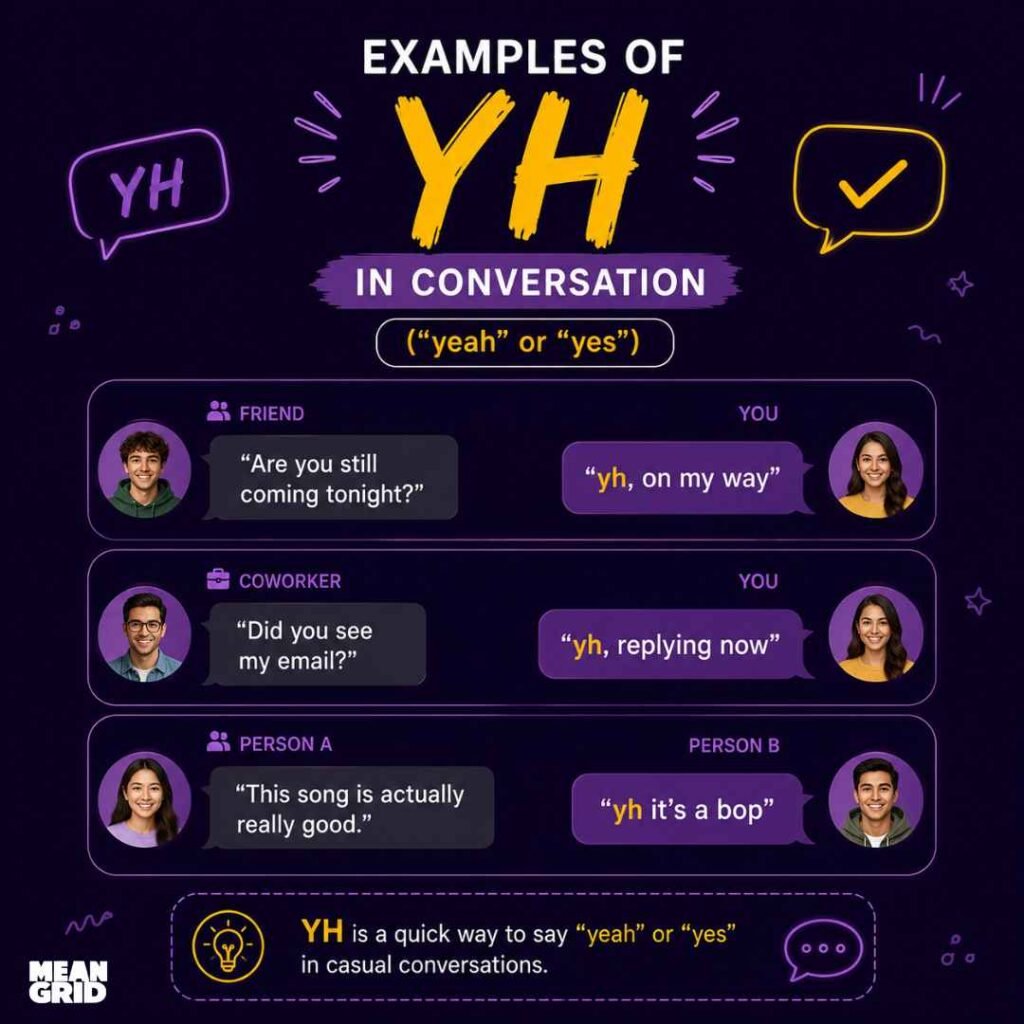
Seeing YH in real exchanges makes the meaning click faster than any definition can.
- Friend: “Are you still coming tonight?” You: “yh, on my way”
- Coworker: “Did you see my email?” You: “yh, replying now”
- Person A: “This song is actually really good.” Person B: “yh it’s a bop”
In each case, YH slides in exactly where “yeah” would go, with zero change in meaning.
When to Use and When Not to Use YH
YH works well in casual, low-stakes conversations. It fits perfectly in group chats, texts with friends, or quick social media replies where nobody expects formal language.
It doesn’t belong in professional emails, job applications, or messages to teachers, clients, or anyone you don’t know well. In those settings, typing out “yes” or “I agree” reads as more respectful and avoids any risk of sounding careless.
A simple rule: if you’d say “yeah” out loud to that person without thinking twice, YH is fine in text. If you’d never say “yeah” to their face in that setting, skip it.
How Is YH Used in Different Contexts?
YH usually just means agreement, but the feeling behind it shifts depending on what surrounds it.
- Plain YH: neutral confirmation, no strong emotion either way
- YH with an emoji: friendly, upbeat, adds warmth to a short reply
- YH with no punctuation and no follow-up: can read as flat, tired, or uninterested
- YH YH: repeating it usually adds emphasis, almost like saying “yeah, yeah” with a hint of impatience or humor
Tone almost always comes from what’s attached to the YH, not the letters alone.
YH Meaning on Snapchat, TikTok, Instagram, WhatsApp
The meaning stays the same everywhere, but how it’s used shifts slightly by platform.
- On Snapchat, YH shows up constantly in quick back-and-forth chats, often paired with short reactions or streaks talk.
- On TikTok, people drop YH in comments to agree with a video or another comment without writing a full sentence.
- On Instagram, it’s common in DMs and comment replies, especially when someone is agreeing with a caption or another user.
- On WhatsApp, YH tends to show up in fast personal conversations, often between people who already know each other well, since WhatsApp skews toward closer, everyday chats rather than public comments.
YH in Gaming and Discord Chats
This is one place most guides barely touch, but it matters. In gaming voice chats and Discord servers, YH sometimes gets used to check if someone is still active, as a shortened version of “you here?” rather than “yeah.” Players type it fast during a match to see if a teammate is paying attention.
Context makes the difference clear almost instantly. If YH follows a question or statement, it means “yeah.” If it stands alone right after someone goes quiet mid-game, it’s more likely checking if they’re still there. Reading the sentence right before it tells you which one you’re dealing with.
Common Misunderstandings About YH
A few mix-ups come up again and again with this abbreviation.
- People sometimes confuse it with “why,” but that’s just the letter Y on its own, not YH.
- Some assume YH always sounds dismissive, but plenty of people use it warmly, especially with a follow-up message or emoji.
- Others think it’s brand new Gen Z slang, when really it’s been around since early messenger platforms and just carried over into modern apps.
- A few think YH has some hidden or inappropriate meaning, but it’s genuinely just a shortcut for “yeah.”
YH vs Similar Terms
Several short affirmatives look almost identical to YH, so a quick side-by-side helps clear up the differences.
| Term | Meaning | Typical Feel |
| YH | Yeah | Neutral, quick agreement |
| Yeh | Yeah (alternate spelling) | Same meaning, more common in UK texting |
| Ye | Yes/Yeah | Even shorter, feels more casual or lazy |
| YW | You’re welcome | Different meaning entirely, often confused with YH |
| YK | You know | Not an agreement word, easy to mix up at a glance |
The biggest mix-up is YH versus YW. They look similar at a glance, but YW replies to “thank you,” while YH replies to almost anything that calls for a yes.
How to Respond to YH
Replying to a bare YH doesn’t have to feel awkward. A few natural options work well depending on the conversation.
- If it answers a direct question, you can just move the conversation forward: “cool, see you at 7 then”
- If it feels flat or unclear, ask a light follow-up: “yh as in you’re coming, or yh as in maybe?”
- If you want to keep things easygoing, mirror the tone: “yh same”
None of these require overthinking. A short reply doesn’t automatically mean the person is upset or losing interest.
Tips for Using YH Naturally
A few habits make YH feel natural instead of careless.
- Save it for people you already text casually, not new contacts or formal settings
- Add a word or emoji when you want to sound warm instead of flat
- Avoid using it as your only reply when someone shares something exciting, since a bare YH can undersell your reaction
- Skip it completely in emails, cover letters, or workplace messages to anyone above your close coworkers
FAQs
What does YH mean in a text message?
YH means “yeah” or “yes.” It’s a shortened way to agree with someone or confirm something without typing the full word.
Is YH rude to send?
No, YH isn’t rude by default. It only reads as dismissive when it’s sent alone with no emoji, punctuation, or follow-up in a conversation that expected more.
Does YH mean something different on Snapchat or TikTok?
No, the core meaning stays “yeah” on every platform. Only the tone and typical use shifts slightly depending on where it’s used.
What’s the difference between YH and YW?
YH means “yeah,” while YW means “you’re welcome.” They look alike but answer completely different kinds of messages.
Can YH mean something other than yeah?
Occasionally, mostly in gaming chats, where it can shorthand “you here?” when checking if someone is still active. Outside gaming contexts, it almost always means “yeah.”
Conclusion
YH is a simple, informal way of typing “yeah,” built for fast, casual conversations across texting and social media. It fits naturally with friends and close contacts but isn’t the right choice for professional messages.
Once you read the tone around it, whether that’s an emoji, a repeated YH, or the silence that follows, the meaning becomes easy to spot every time.

Albert is a dedicated meaning expert with over 6 years of experience researching word meanings, language usage, and definitions. At Mean Grid, he creates clear, accurate, and easy-to-understand content that helps readers explore the true meaning of words and phrases.