
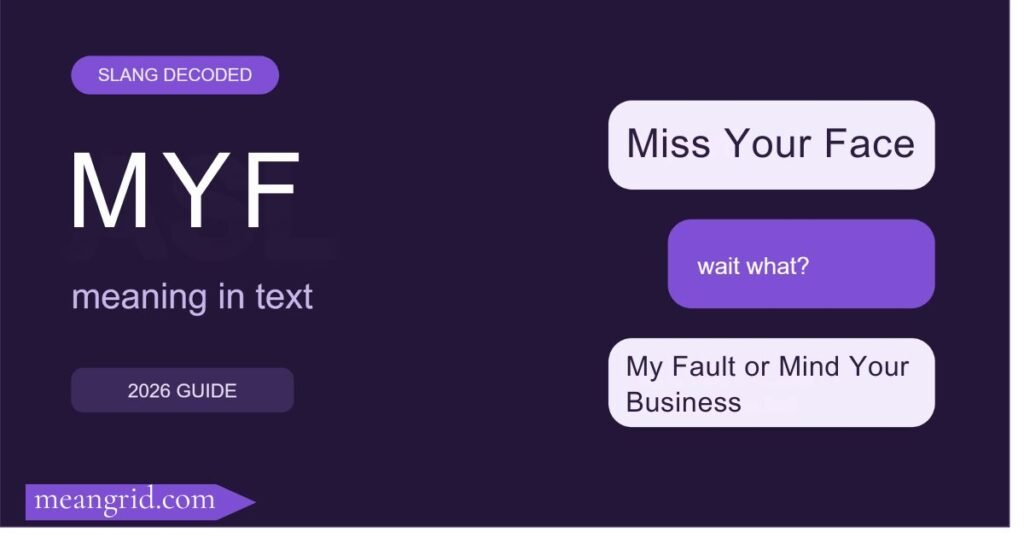
MYF usually means “Miss Your Face,” a casual way of saying you miss seeing someone. It can also mean “My Fault” as a quick apology, or “Mind Your Business” when someone wants you to back off. The correct reading depends entirely on who sent it and what the conversation looked like right before it showed up.
You probably landed here because someone sent you “myf” out of nowhere and you had to stop mid-scroll to figure out what it meant. That’s normal. Texting slang like this rarely comes with a manual, and three letters can carry three completely different moods depending on where they show up.
MYF Meaning & Definition
MYF has three common definitions, and none of them is officially “correct.” Slang doesn’t work like a dictionary. It spreads through group chats, gets reused with a slightly different meaning, and eventually just sticks.
- Miss Your Face — an affectionate way to say you miss someone, often sent after seeing an old photo or a video
- My Fault — a quick, casual apology, similar to saying “my bad”
- Mind Your Business — a blunt way to tell someone to stop asking questions, sometimes softened with “friend” tacked on
A fourth, less common reading floats around too: “Miss You Forever,” usually seen in captions rather than one-on-one texts. If you’re also seeing terms like igh or yfm pop up nearby, they belong to the same slang family.
Igh is a short, flat way of saying “alright,” often used to end a conversation without much enthusiasm. Yfm usually means “you feeling me,” a check-in to see if the other person understands or agrees. None of these three-letter terms have a single locked meaning, and MYF fits right into that same pattern.
Where Does MYF Come From?
MYF isn’t new. Early records of “Miss Your Face” as texting shorthand go back to the late 2000s, when SMS character limits pushed people toward shorter phrases for anything emotional. “My Fault” as an apology has roots in AAVE and East Coast slang, particularly Philadelphia, where it’s used the same way people elsewhere say “my bad.”
The “Mind Your Business” reading is newer and grew alongside TikTok comment culture, where a quick, semi-polite brush-off became its own kind of social currency.
So MYF isn’t one term with one history. It’s three separate phrases that happened to compress down to the same three letters, and they’ve been drifting along in parallel ever since.
Examples of MYF in Conversation
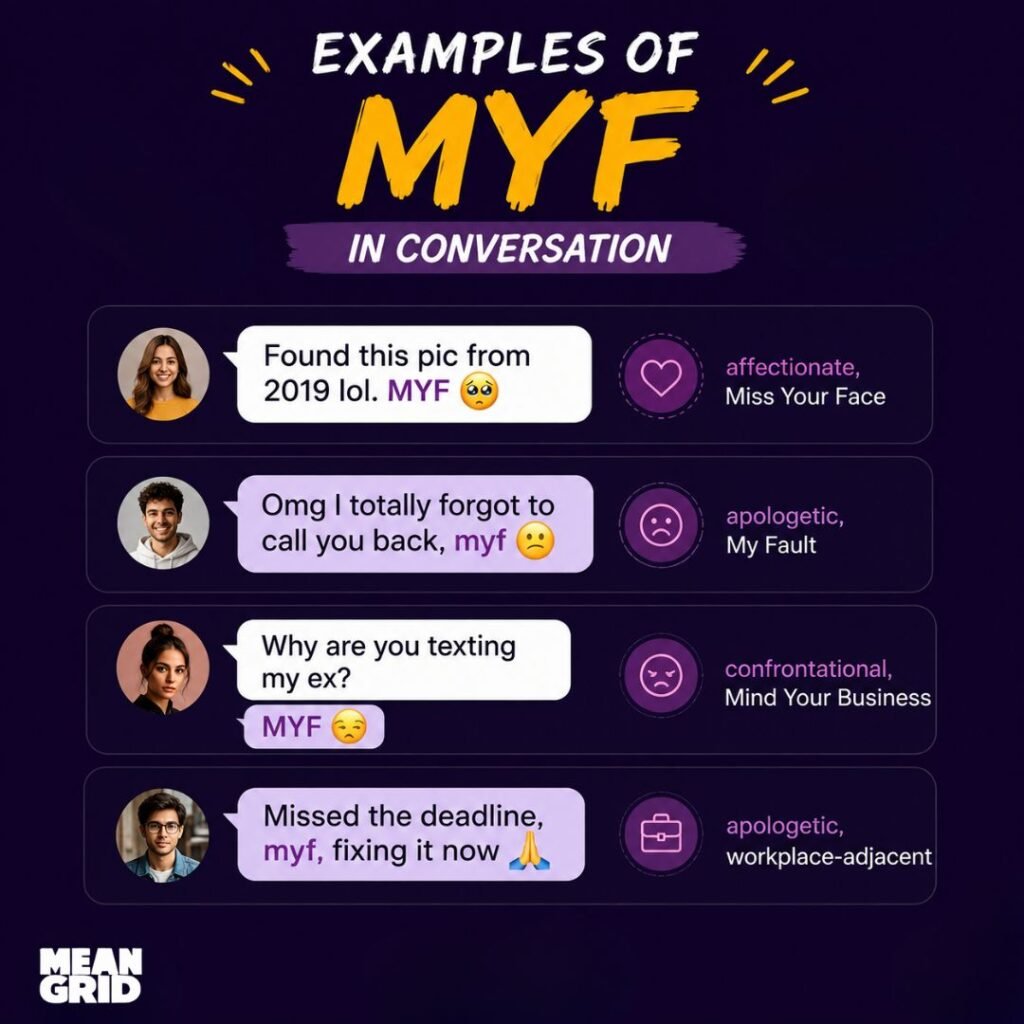
Seeing MYF in context makes the meaning click faster than any definition list.
- “Found this pic from 2019 lol. MYF 🥺” — affectionate, Miss Your Face
- “Omg I totally forgot to call you back, myf” — apologetic, My Fault
- “Why are you texting my ex?” / “MYF 😒” — confrontational, Mind Your Business
- “Missed the deadline, myf, fixing it now” — apologetic, workplace-adjacent
Notice how punctuation and emojis do a lot of the heavy lifting. A soft emoji next to MYF almost always signals affection. No punctuation and a flat tone usually signals the confrontational meaning.
When to Use and When Not to Use MYF
MYF works well in casual, low-stakes conversations with people who already know your texting style. It’s a poor fit anywhere clarity actually matters.
Good spots for MYF:
- Texting a close friend or partner after seeing an old photo
- Casually apologizing for something small in a group chat
- Brushing off a nosy comment from someone you know well
Avoid MYF in:
- Work emails, Slack messages, or any professional thread
- A first conversation with someone new, since they may not know the term
- Situations where a real apology or a real explanation is expected
How Is MYF Used in Different Contexts?
Context changes the odds of which meaning is intended. A partner sending MYF out of the blue is almost certainly going for “Miss Your Face.”
Someone replying to a question they didn’t want to answer is leaning toward “Mind Your Business.” A quick MYF after a mistake, especially followed by a fix or explanation, is “My Fault.”
| Situation | Likely Meaning |
| Reply to an old photo or memory | Miss Your Face |
| Reply to a nosy or personal question | Mind Your Business |
| Reply right after a mistake | My Fault |
| Caption on a nostalgic post | Miss You Forever |
MYF Meaning on Snapchat, TikTok, Instagram, WhatsApp
Platform changes the odds too, since each one has its own texting culture.
- Snapchat: Leans affectionate. A random MYF on a Snap or story reply is almost always “Miss Your Face,” since Snapchat is built around close, ongoing conversations.
- TikTok: Comment sections lean toward “Mind Your Business” or its softer cousin “Mind Your Business, Friend.” Captions on throwback videos lean affectionate instead.
- Instagram: DMs and story replies trend affectionate, similar to Snapchat, since Instagram conversations tend to be more personal and one-on-one.
- WhatsApp: Meaning stays closest to whatever the sender’s regional or friend-group norm already is. WhatsApp doesn’t have one dominant reading the way TikTok comments do.
MYF Meaning in Professional or Technical Fields
There isn’t a real professional or technical definition of MYF. It doesn’t show up in business shorthand, project management tools, or industry jargon. If you see it in a work context, it almost always means someone accidentally slipped into texting habits, usually as “My Fault” after a small error.
If that happens to you, the fix is simple. Send a short follow-up that spells it out plainly, something like “sorry, meant to say that was my mistake, fixing it now.” That one line resets the tone and keeps the slip from looking careless.
How to Tell Which MYF Someone Means
This is the part most guides skip past with a vague “it depends on context.” Here’s a faster way to check, in order:
- Who sent it? A partner or close friend leans affectionate. A stranger or acquaintance leans confrontational.
- What came before it? A nostalgic photo or “I miss hanging out” points to Miss Your Face. A prying question points to Mind Your Business. A dropped ball or mix-up points to My Fault.
- What does the punctuation look like? Soft emojis and lowercase letters read as affectionate. No punctuation, sent sharply, reads as confrontational.
If none of those line up cleanly, just ask. “Wait, what do you mean by that lol” clears it up in one message and avoids replying in the wrong emotional register, which is an easy way to make an innocent MYF feel awkward.
Common Misunderstandings About MYF
People often assume MYF only has one meaning, usually whichever one they saw first. That assumption is exactly how mixed signals happen. Someone expecting an apology reads MYF as sarcasm. Someone expecting affection reads a confrontational MYF as unexpectedly cold.
Another common mix-up is confusing MYF with visually similar acronyms like MYB or IMY, which carry different meanings entirely despite looking alike at a glance.
You May Also Like: CTFU Meaning in Text: What It Really Means (2026)
MYF vs Similar Terms
| Term | Meaning | Typical Tone |
| MYF | Miss Your Face / My Fault / Mind Your Business | Depends on context |
| IMY | I Miss You | Affectionate |
| MYB | Mind Your Business | Blunt, confrontational |
| WYF | Where You From | Neutral, informational |
| YFM | You Feeling Me | Checking for agreement or understanding |
| IGH | Alright | Flat, low-effort acknowledgment |
If you want a safer option that carries less risk of being misread, IMY or MYB communicate a single clear idea instead of MYF’s three-way ambiguity.
How to Respond to MYF
- If it reads affectionate: “aww myf too, let’s catch up soon”
- If it reads apologetic: “all good, don’t stress about it”
- If it reads confrontational: “okay okay, just curious lol”
Matching the tone back is usually enough. If you’re genuinely unsure, a quick clarifying question beats guessing wrong.
Tips for Using MYF Naturally
Save MYF for people who already know your texting style. Pair it with an emoji when you mean it affectionately, since bare text can read colder than intended.
Skip it entirely in any conversation where a misunderstanding would actually cost you something, like a work thread or a new relationship still finding its footing.
FAQs
What does MYF mean in a text message?
MYF most often means “Miss Your Face,” though it can also mean “My Fault” or “Mind Your Business” depending on context.
Is MYF always meant to be affectionate?
No. MYF can be affectionate, apologetic, or blunt, so the sender and situation matter more than the letters themselves.
Does MYF mean the same thing on every platform?
Not exactly. Snapchat and Instagram lean affectionate, while TikTok comments often lean toward “Mind Your Business.”
Is it okay to use MYF in a work chat?
No. MYF is casual slang and can easily be misread in professional settings, so it’s best avoided there.
What’s a safer alternative to MYF if I want to be clear?
IMY works well for affection and MYB works well for a direct “mind your own business,” since both carry a single fixed meaning.
Conclusion
MYF doesn’t have one locked definition, and that’s exactly why it trips people up. Reading the sender, the message before it, and the tone gets you to the right meaning almost every time. When in doubt, a quick clarifying question always beats a guess.
Explore More Meanings :
- IONK Meaning in Text: Definition, Uses & Examples
- TSTS Meaning in Text: Full Definition, Examples & Uses
- Amos Meaning in Text: Snapchat Slang Explained

Albert is a dedicated meaning expert with over 6 years of experience researching word meanings, language usage, and definitions. At Mean Grid, he creates clear, accurate, and easy-to-understand content that helps readers explore the true meaning of words and phrases.